Body recomposition coaching that tracks fat and muscle
TriageFit is a body recomposition coach for losing fat and building muscle at the same time. Your training keeps progressing, your nutrition adjusts each week, and body-composition trends and progress photos show both changes while the scale barely moves. A real coach is there as back-up when something needs a person, and it costs €50 / 4 weeks.
By TriageFit · Updated
Body recomposition is the slow, steady version of changing shape: losing fat and building muscle in the same months rather than dieting hard and then bulking hard. It suits people who would rather look a little better every month than a lot better for one summer. It is also the hardest goal to coach on your own, because the scale can stay almost flat for weeks while your body changes underneath it, and without the right measurements that looks exactly like failure.
Training that keeps progressing
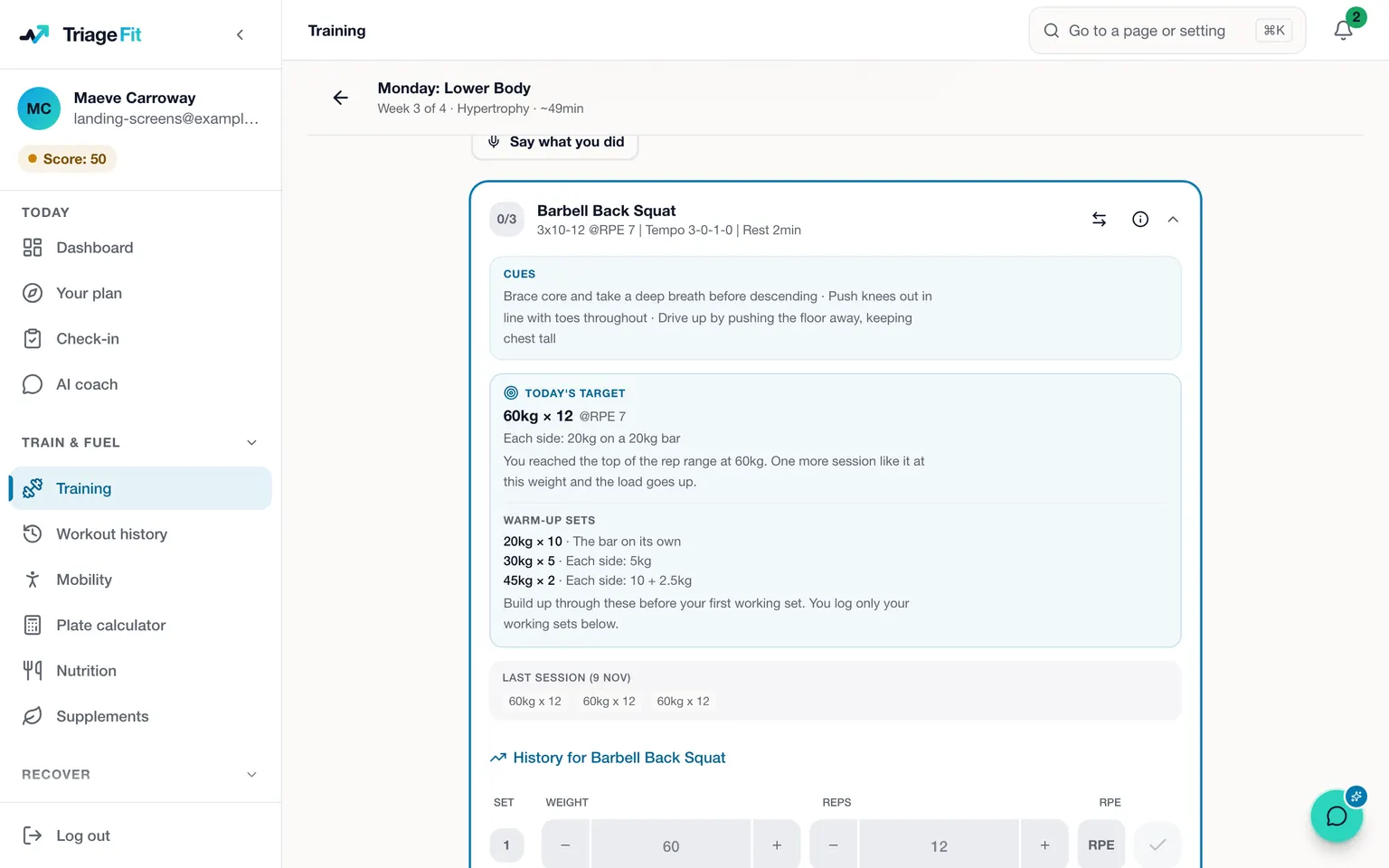
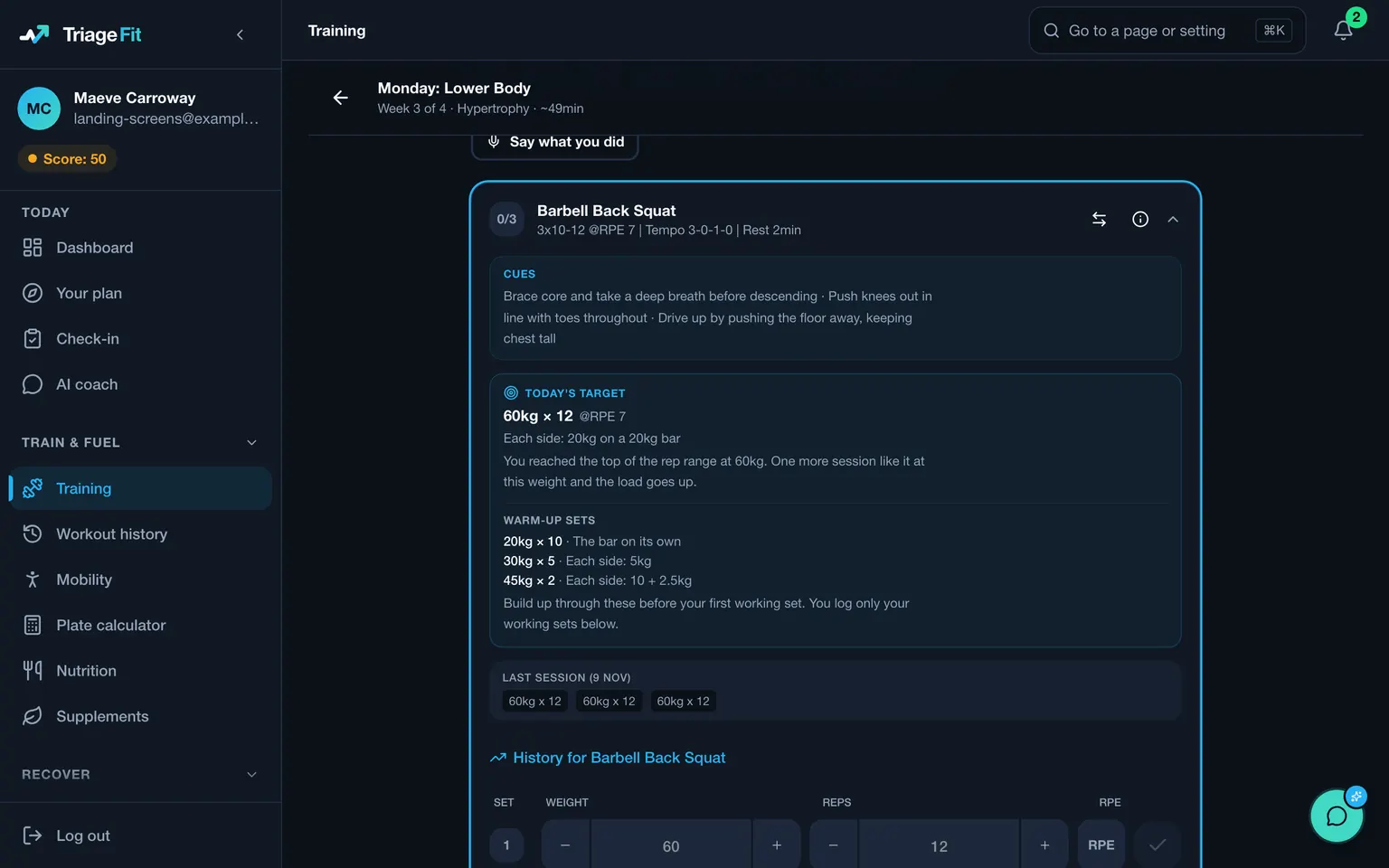
Muscle only comes if the training asks for it. Your programme is built from a thirty-minute intake, in coach-designed phases of four to six weeks that keep cycling for as long as you train, with the split, the rep ranges, the tempo and the rest set for each phase. Progressive overload tracking keeps the record of every lift, so you can see the strength coming up even when the scale says nothing has happened.
Food that adjusts with you
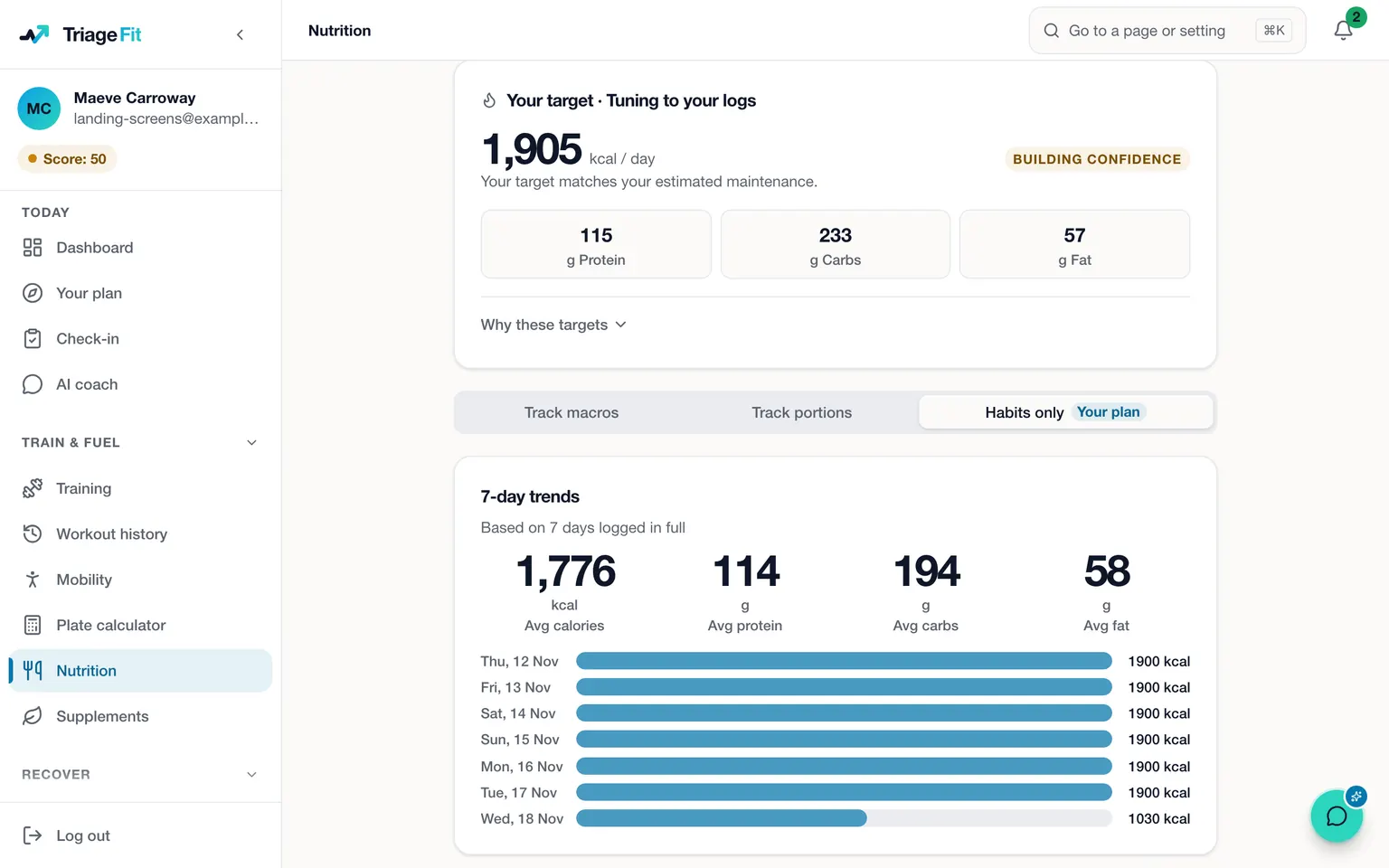
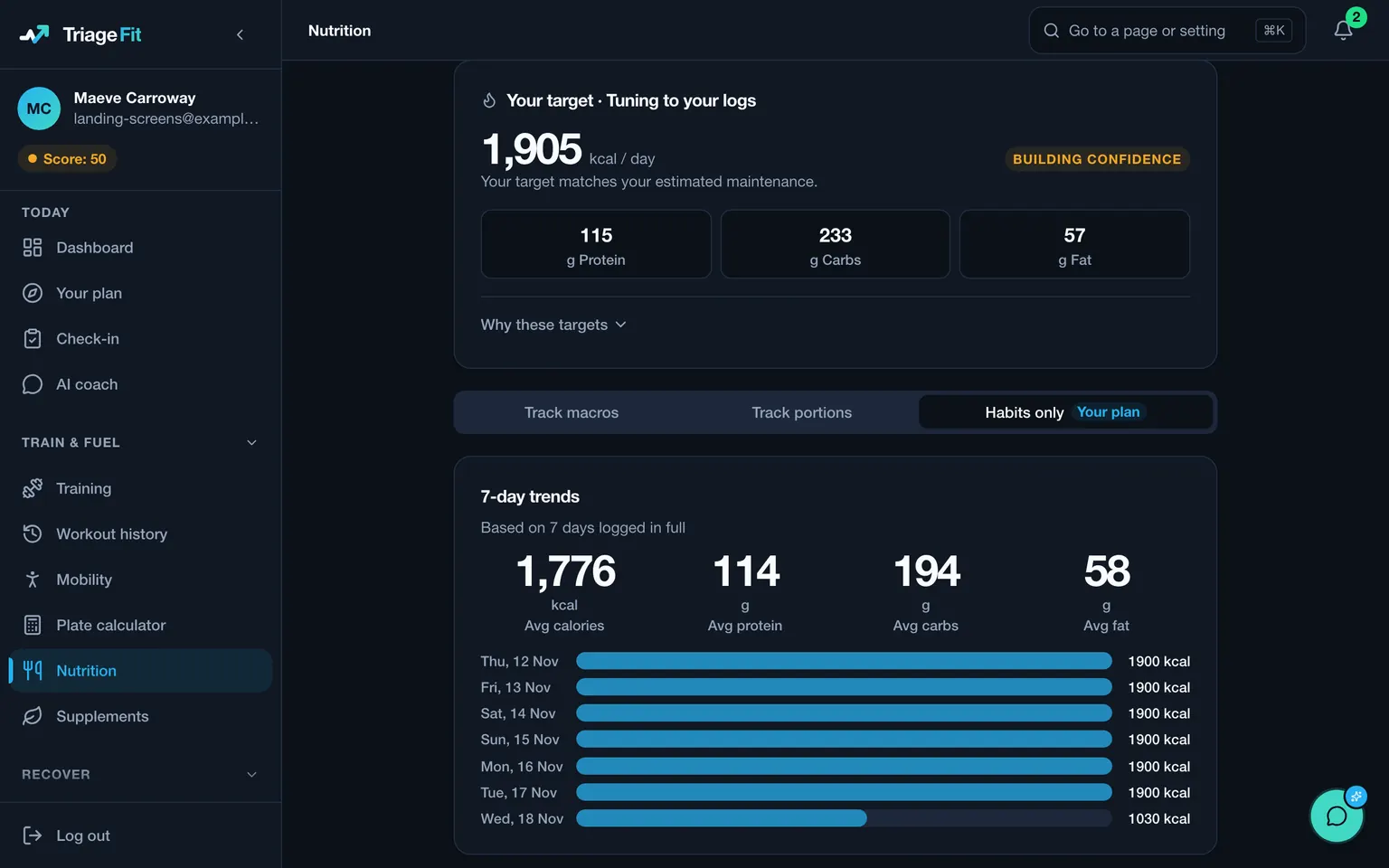
"Build muscle and lose fat" is one of the goals you pick in the intake. With it chosen, your calorie target is held at maintenance, the amount your body uses in a normal week as worked out from your metabolism, so the food supports the muscle you are training while the fat comes off slowly. Your macros adjust each week from your check-in. Protein is spread across your day, which matters more in a recomposition than in almost any other goal, because the food has to support building muscle while the fat comes off. Meals you eat often can be saved with their macros, and the AI coach can step your calories or change your macro split between check-ins, each as a proposal you confirm. The phases, the progression and the food targets come from 20+ years of coaching real clients, and the AI coach is how that method reaches you between check-ins.
Your year plan carries a lane of nutrition phases beside your training blocks, each saying what it is for, so the months of a recomposition and whatever follows them are laid out ahead of time. The AI coach also reads across weeks of your food log and raises one pattern at a time in its weekly message, with a small change to try.
Measuring both changes at once
This is where most recomposition attempts fall apart. While your goal is recomposition, a drift in your weight is never counted as progress or as a setback, and a waist that comes in is. Body-composition trends and a progress photo timeline sit beside your weight and your lift records, so the two changes can be seen separately. Two progress photos can be compared side by side, which is often where a recomposition month shows first. A month where your weight moved by almost nothing, your waist came in, your photos changed and your lifts went up is a good month, and the app shows it as one.
On the strength side, each main lift is given a strength level from beginner to elite for your body weight, along with the weight the next level asks for, so a lift that climbs while the scale holds still shows up as progress. Shareable progress links let you show someone the trend without handing over your phone.
Reading a flat scale
A flat scale during a recomposition can be good news or a stall, and the other records are how you tell which. Your targets follow the smoothed trend in the food and weight you log, so one odd weigh-in does not move them, and they change only once a couple of weeks of data show a real trend. Your measurements, photos and lifts sit beside that trend in the check-in, where the AI coach reads them together in your coaching message. When the scale is flat and everything else is moving, you can see the plan working. When the whole picture has stalled, you can ask the AI coach to step your calories or change your macro split, each as a proposal you confirm.
Recovery that supports the work
Building muscle on moderate food depends on recovering well. The effort each session asks for adjusts to how you are recovering, and sleep regularity and quality are tracked beside your training. If you wear a device you can import its data from Apple, Garmin, Whoop, Oura or Fitbit, and heart-rate variability and resting heart rate feed into your daily readiness.
Habits for a slow goal
A recomposition is won over months, so habits carry more of it than any single week does. The habit system ties a new habit to a moment already in your day with an if-then plan, such as making tomorrow's lunch while the kettle boils. Journaling sits beside it, and a quarterly review looks back over the sessions, consistency and health score of the last twelve weeks, the stretch a recomposition actually takes.
The weekly check-in
Once a week, on the day you choose, you check in. The sessions and food you logged are already filled in, the weigh-in is optional, and you add how the week felt, a win and five quick ratings. A coaching message about the week arrives within seconds and your next week is rebuilt around it.
Three months of recomposition
Say you start in January, training three days a week with your weight roughly steady. By March your weight has barely changed. Your photos show a narrower waist and broader shoulders, your body-composition trend has moved in the right direction and your press is up across two phases. Without those records the three months would feel wasted. With them, the coaching can show you that the plan is working and keep it on course.
Recomposition after 40
Recomposition is the goal many people pick after 40, because it keeps the strength they have while the waist comes in, and recovery sets more of the pace than it did at 25. The same intake goal, maintenance calories and side-by-side measurements apply at any age, with the effort each session asks for matched to how you are recovering. Online personal training for men over 40 walks through a recomposition for men in their forties and fifties, and personal training for women over 40 covers strength training for women at that stage.
Questions between check-ins
The AI coach answers at any hour. It can swap an exercise for the equipment in front of you, move a session when your week changes shape or log a workout from a sentence, and each change is a proposal you confirm. Coaches answer questions in the group, in the open, so the answer to yours is there for the next member who asks.
What it costs
One plan covers the training, the nutrition, the tracking, the AI coach and the group: €50 every 4 weeks or €500 a year, with VAT included. You can pause or cancel from inside the app.
How to start
Pick a plan on the pricing page, create your account and pay, and the intake opens. Fat loss coaching is the faster route when fat loss comes first, online bodybuilding coaching is for when size is the priority, and online fitness coaching walks through a whole week.
Questions people ask
- Can I lose fat and build muscle at the same time?
- That is what a recomposition sets out to do, and it is slower than dieting or building on their own. TriageFit coaches it with training that keeps progressing, nutrition that adjusts each week and measurements that show both changes separately.
- How will I know it is working if my weight stays the same?
- Body-composition trends, a progress photo timeline, your lift records and a strength level for each main lift sit beside your weight. A flat scale with a narrowing waist, changing photos and rising lifts is the pattern a recomposition is aiming for, and the coaching reads them together.
- How many calories should I eat for body recomposition?
- Choose the build muscle and lose fat goal in the intake and your calorie target is held at maintenance, the amount your body uses in a normal week, worked out from your metabolism. Protein is spread across your day, and your macros adjust each week from the food and weight you log, following the smoothed trend so one odd weigh-in does not move them.
- How much does a body recomposition coach cost?
- TriageFit is €50 every 4 weeks or €500 a year, with VAT included. That one plan covers the training, the nutrition, the body-composition tracking, the AI coach and the group, and you can pause or cancel from inside the app.
- What happens if nothing is changing?
- Your weight, measurements, photos and lifts all sit in your weekly check-in. If the whole picture has stalled, ask the AI coach to step your calories or change your macro split, and it proposes the change for you to confirm before anything moves.
Garmin, Whoop and Oura are trademarks of their owners. TriageFit is independent of each of them, and none of them has reviewed or endorsed this page.
Read next
- Weight loss coaching built around your weekly check-inWeight loss coaching where your calorie target adjusts each week to your results, your training stays in the plan and real coaches are on hand.
- Fat loss coaching that protects the strength you builtFat loss coaching for people who lift: targets that adjust weekly, diet-break detection, a programme that keeps progressing and an AI coach on your week.
- Online nutrition coaching that moves with your weekOnline nutrition coaching with calorie targets matched to your metabolism, macros that adjust weekly, protein spread through the day and an AI coach on it.
- What Weight Watchers costs in Ireland, the UK and the USHow much is Weight Watchers? Core is €25 a month in Ireland and UK plans start from £6 a month, on a twelve-month commitment. Med+, plans and cancelling.