A personal trainer for men over 40 who want strength and a leaner body
TriageFit works as a personal trainer for men over 40 who want to stay strong and get leaner without wrecking their joints or their week. The effort each session asks for adjusts to your recovery, your programme is built around work and family, and real coaches answer questions in your group. It costs €50 / 4 weeks.
By TriageFit · Updated
Men over 40 often train the way they did at 25, and their bodies send the bill in the form of a sore shoulder, a stiff back and a fortnight off. The other common pattern is to stop lifting heavy altogether, which gives away the strength and muscle that matter more with every year. The answer sits between the two: training that still progresses, recovery that is taken seriously and a plan that fits around a job, a family and everything else a week at this age holds.
Built around work and family
Your intake takes about thirty minutes and can be saved and finished later. It covers your goals, your training history, the injuries you have collected, how your week runs and the equipment you have. The programme is designed from your answers on our coaches' principles and filled from a library of 494 exercises to suit your level and your kit. The intake's health screen asks about your heart, blood pressure and prescribed medication, and an answer such as a heart condition your doctor has not cleared means the programme is on hold until that doctor gives you the all-clear and you tell the app, with your GP remaining the person for anything medical.
Each injury you have collected gets a grade, mild, moderate or severe, and a direction, improving, about the same or getting worse. Take the shoulder that complains about overhead pressing. Graded severe, or moderate and getting worse, it has the barbell and dumbbell overhead presses and the other exercises that could aggravate it set aside from the first session, with other exercises for the same muscles in their place. With any milder grade it keeps them, each with a warning to stay in a pain-free range and stop the set rather than work through pain. Either way, lateral raises can stay in a lighter form, with a note on how high to lift. The same grading covers the other common problem areas, among them the elbow, wrist, neck, lower back, hip, knee, ankle and foot. The body map in the intake's quick movement check is stricter, and a painful area you mark on it has those exercises set aside however you rate it, unless it is a lower-back mark that your other answers there clear for hip hinging.
Effort matched to recovery
The effort each session asks for adjusts to how you are recovering. Sleep, resting heart rate and daily readiness sit beside your training, and if you wear an Apple Watch, a Garmin, a Whoop, an Oura ring or a Fitbit you can upload an export so heart-rate variability guides your recovery too. When a stretch of work and training catches up with you, the AI coach can give you a recovery week, which you confirm. The phases, the progression and the food targets come from 20+ years of coaching real clients, and the AI coach is how that method reaches you between check-ins.
Strength that still progresses
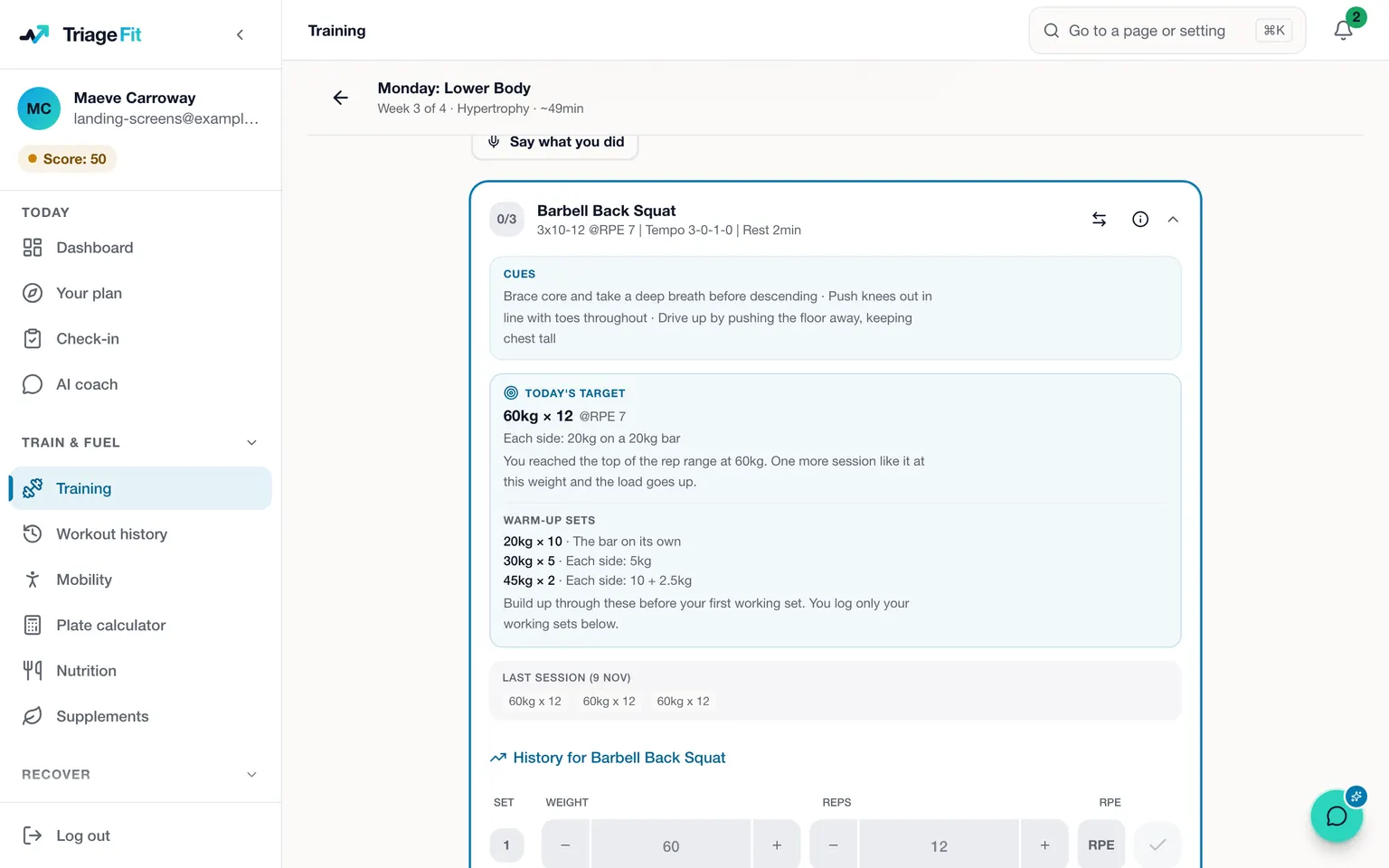
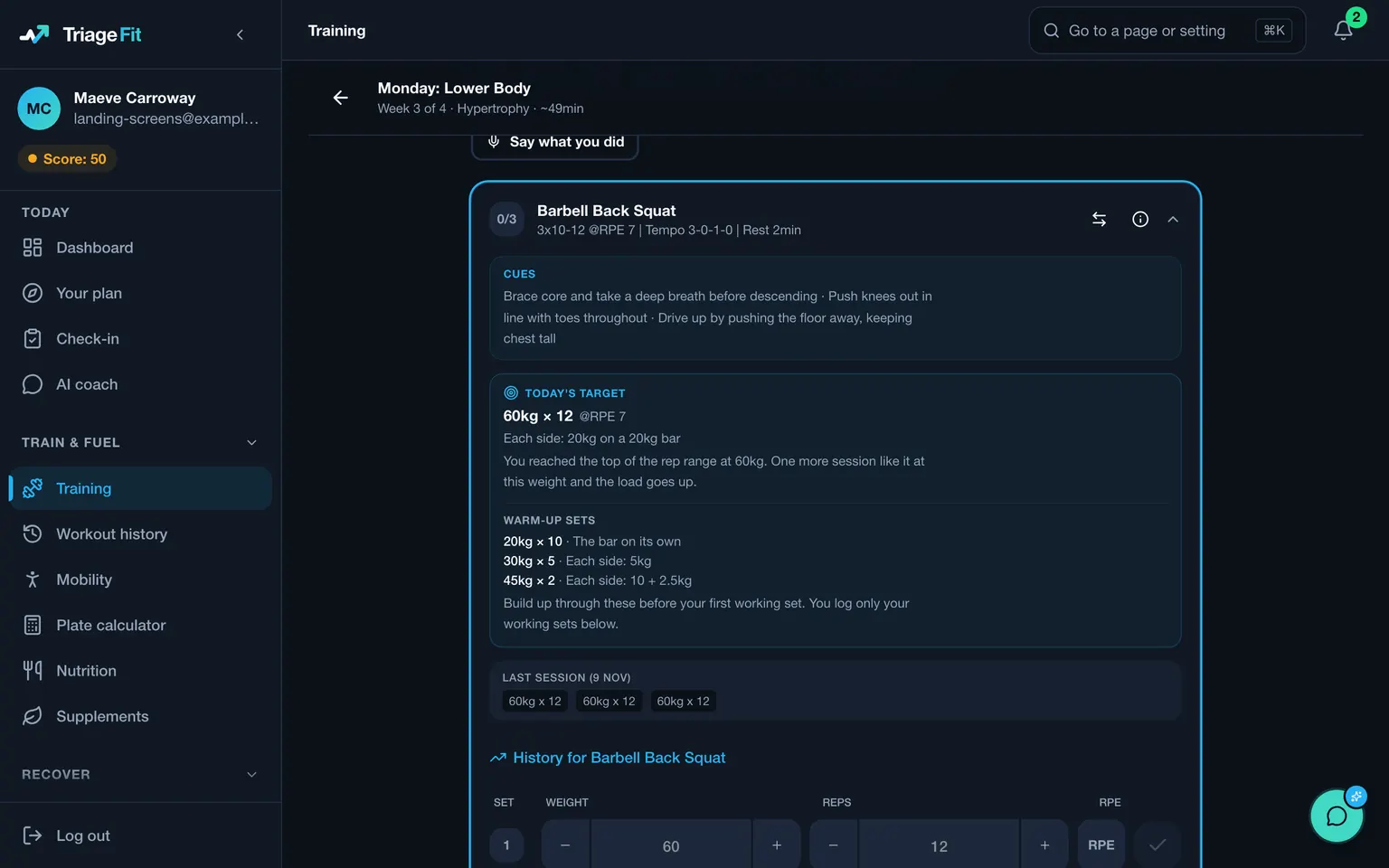
The programme runs in coach-designed phases of four to six weeks that keep cycling for as long as you train, and progressive overload tracking records every set, so you can see whether the main lifts are still moving. Each one also carries a strength level, from beginner to elite, set against your body weight. Every exercise has coaching cues and the main lifts have video, and a coach reviews the form checks you send, which is your insurance against the injury that costs you a season.
Mobility for a body that has sat at a desk
Before each session there is a short warm-up circuit matched to what the session trains, with any tight areas you flag worked in. A separate mobility programme, built from a short movement screen, works on your stiffest ranges, often the hips, the upper back and the ankles after years at a desk, and progresses as they open up.
Getting leaner
Your calorie target is matched to your metabolism, your macros adjust as your logged food and weight show a trend, and protein is spread across your day so the muscle you are training has what it needs while the fat comes off. Meals you eat often can be saved with their macros, and when you have been in a deficit for a long stretch, the app detects it and offers a diet break. Body-composition trends and a progress photo timeline show the change the scale on its own would hide.
Body recomposition coaching for men over 40
Body recomposition means losing fat and building muscle over the same months, rather than dieting hard and then trying to win the muscle back, and after 40 it is the goal that lets you keep the strength you have while your waist comes in. "Build muscle and lose fat" is one of the goals you can pick in the intake. With it chosen, your calorie target is held at maintenance, the amount your body uses in a normal week, so the food supports the muscle you are training while the fat comes off slowly. Protein is spread across your day, and the programme keeps the main lifts progressing through each phase, because the muscle only comes if the training keeps asking for it.
The scale can sit almost still for weeks during a recomposition, so the app reads the change from more than your weight. While your goal is recomposition, a drift in your weight is never counted as progress or as a setback, and a waist that comes in is. Your waist measurement, body-composition trends, a progress photo timeline and the strength level on each main lift sit side by side in your check-in, where the AI coach reads them together in your coaching message. Your targets follow the smoothed trend in the food and weight you log, so one heavy weekend does not move them. When the whole picture has stalled, you can ask the AI coach to step your calories or change your macro split, each as a proposal you confirm. Body recomposition coaching covers the goal at any age.
Cardio that helps rather than hurts
Easy-pace cardio builds your aerobic fitness around the lifting, as a finisher or on days of its own, with a heart-rate band set for you so the easy work stays easy.
When the week falls apart
The AI coach can trim a session to the time you have, move it to another day, build a programme for a hotel gym when you travel, or take the rest of the week off when you are ill. Every change is a proposal you confirm. For pain, it proposes a swap and tells you when a physio should see it.
The weekly check-in
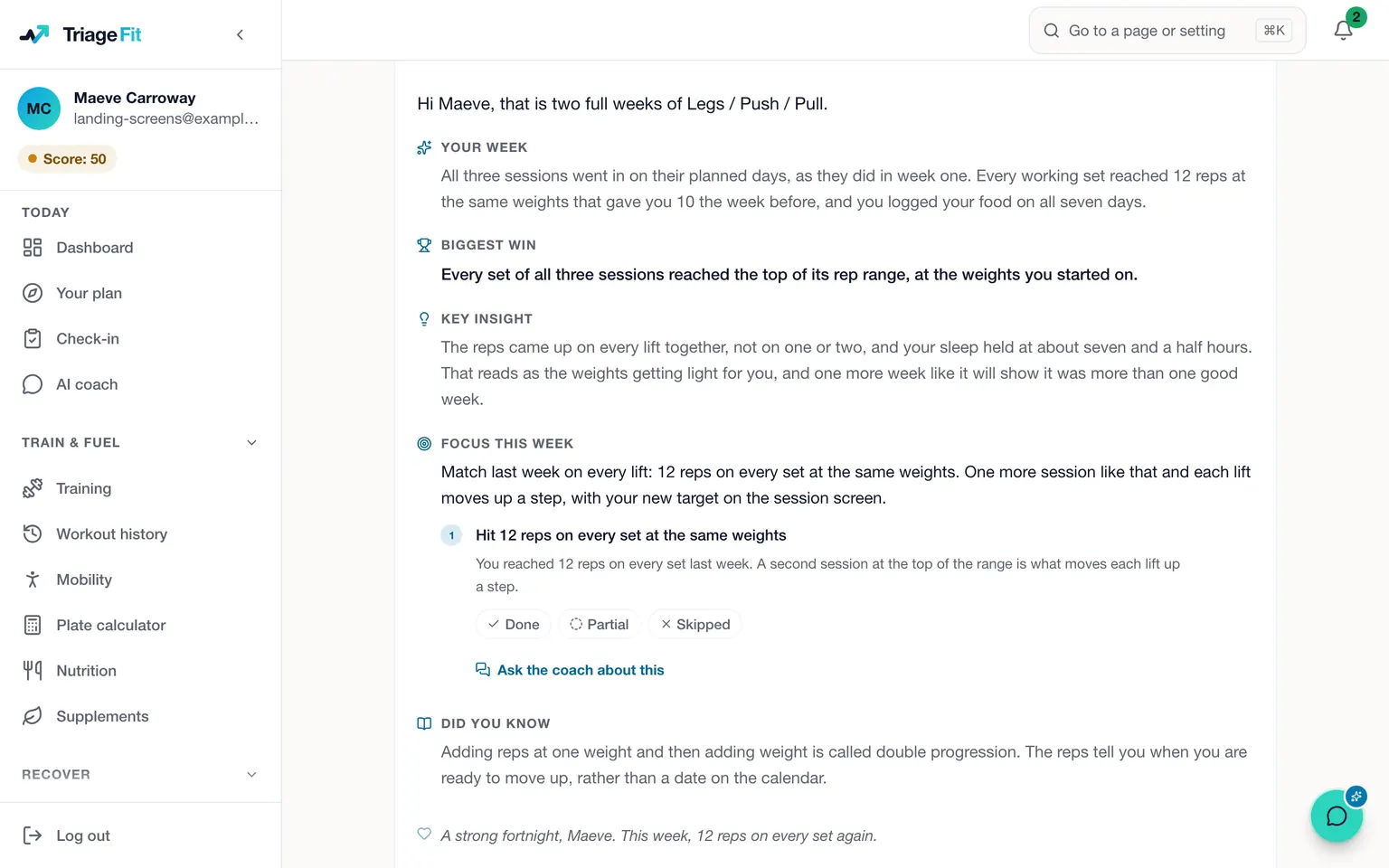
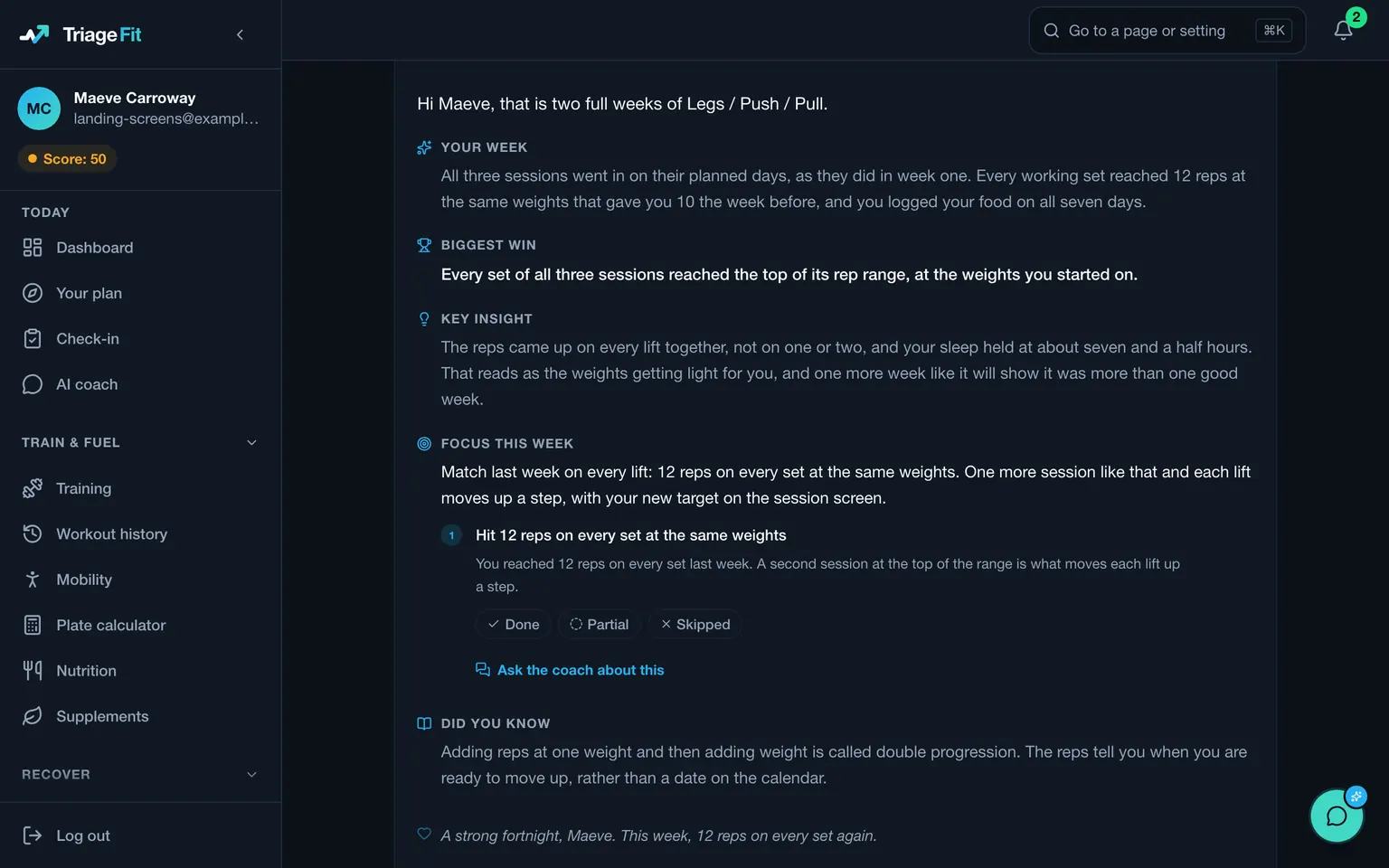
Once a week, on the day you choose, you spend a few minutes checking in, with your logged sessions already filled in. You add how the week went, a weigh-in if you like, a win and five quick ratings. A coaching message on the week arrives within seconds, your next week is rebuilt around it, and a real coach is there as back-up when something needs a person.
A season of training
Say you are 48, run a small business and lift twice a week when you can. Your back seizes up once or twice a year and you are carrying more round the middle than you would like. Your intake records the back, which you rate as mild and about the same, and with it quiet when you join, you leave the body map blank. The first phase builds the main lifts, and each exercise that could set your back off carries a warning to stay in a pain-free range and stop the set rather than work through pain. Your targets put you in a modest deficit, and the warm-up works your hips before every session. A trade show in week five becomes a hotel-gym week rather than a missed one, and by the end of the second phase your log shows the lifts climbing while your body-composition trend comes down.
What it costs
One plan at €50 every 4 weeks or €500 a year covers all of it, VAT included, with no extra charge for form checks or nutrition. What a personal trainer costs in Ireland compares it with paying per session.
Starting out
Choose a plan on the pricing page, set up your account and pay, and the intake opens. Online coaching for men covers the wider picture, and a personal trainer for over 50s looks at the decade after.
Questions people ask
- I have old injuries. Can I still train properly?
- Yes. In the intake you grade each one as mild, moderate or severe and say whether it is improving, about the same or getting worse. For the shoulder, knee, lower back and the other areas the programme screens, a severe grade, or moderate and getting worse, sets aside the exercises that could aggravate it, and a milder grade keeps them with a warning to stay in a pain-free range. A painful area you mark on the body map sets them aside too, apart from a lower-back mark your quick movement check clears for hip hinging. If something flares later, the AI coach proposes a swap and tells you when a physio should see it.
- How does the programme fit around work and family?
- It is built around the days you tell the intake you have. When a week changes, the AI coach can shorten a session, move one or cut the number of days you train, and each change is a proposal you confirm before anything moves.
- Will I get leaner without losing strength?
- The programme keeps your lifts progressing while your calorie target comes down, protein is spread across your day, and body-composition trends and progress photos show whether the change is coming from fat. Real coaches answer questions in your group.
- Can a man over 40 build muscle and lose fat at the same time?
- That is what body recomposition sets out to do, and it is one of the goals you can pick in the intake. Your calorie target is held at maintenance, protein is spread across your day and the main lifts keep progressing, while your waist measurement, body-composition trends and progress photos show the change your weight on its own would hide.
Garmin, Whoop and Oura are trademarks of their owners. TriageFit is independent of each of them, and none of them has reviewed or endorsed this page.
Read next
- Strength coaching for over 50s, built from your own historyCoaching for over 50s: an intake that records your history and your health, a programme built from it and real coaches in your group.
- Getting back into the gym, coached from your first week backCoaching for your return to the gym: a start set from one proper intake, a programme that builds back week by week, and an AI coach reading every check-in.
- Fitness coaching built around a full working weekA fitness coach for busy professionals: a programme built around your diary, one weekly check-in in place of daily admin, and an AI coach at any hour.
- Body recomposition coaching that tracks fat and muscleA body recomposition coach and trainer for losing fat and building muscle at once: training that progresses and nutrition that adjusts every week.