What Wibbi costs a clinic, and what goes into the quote
Wibbi pricing is set by quote: its pricing page gives a quote for every plan, on request. The Professional plan includes a library of more than 20,000 exercises, patient education, programme templates, an online patient portal, the Wibbi Vive app for iOS and Android, several episodes of care and links with electronic medical records, and a clinic can start with a free 30-day trial. TriageFit's clinic partnership sits beside it at no cost to the clinic, and patients who move on to coached training after discharge get 10% off every payment.
By TriageFit · Published
Wibbi sets its prices by quote. Wibbi, which used to trade as Physiotec, sells home exercise software that clinicians use to send programmes while a patient is in treatment, and its pricing page lists what each plan holds and asks the clinic to request a quote. TriageFit's clinic partnership is for the patient who finishes that treatment and wants to keep training with a coach.
How Wibbi sets its price
Wibbi's pricing page gives a quote for every plan, on request. There are three of them: Wibbi Professional for physical rehabilitation, Wibbi Speech Professional for speech therapy and Wibbi Vet Professional for veterinary rehabilitation. The Professional plan is meant for independent therapists, clinics, outpatient groups and health systems, and the veterinary plan for independent veterinary rehabilitation therapists and small clinics.
What a clinic pays therefore depends on the conversation with Wibbi's team, and the useful preparation is to know which parts of the platform it wants. The plan itself is one part of the quote, and the add-ons below are the rest.
What the Professional plan includes
The Professional plan includes a library of more than 20,000 exercises, patient education, programme templates, an online patient portal, the Wibbi Vive app for iOS and Android, several episodes of care and links with electronic medical records. Patients reach their programme through the Wibbi Vive app for iOS and Android and an online patient portal, and the clinic gets patient-reported outcomes and NPS surveys along with a knowledge base and customer support for clinicians.
Wibbi's page on home exercise features puts the library at more than 20,000 exercise videos across more than 18 specialties, with more than 300 templates that can be adapted and more than 15 printout layouts. Clinicians can follow completion, effort, pain, strength and endurance. In the patient portal, patients record pain, session length, difficulty and sets, as the patient reports them, and Wibbi sends automated reminders. Wibbi also offers a care pathway builder that schedules each patient's activities from first assessment to discharge, with automated reminders.
The add-ons that change the quote
Wibbi lists four add-ons: remote therapeutic monitoring, a custom branded app, continuing education and enhanced security. Remote therapeutic monitoring is available only in the USA.
The branded add-on is the clinic's own branded app on iOS and Android, with a patient dashboard, a daily to-do list, mobile notifications and online forms. Continuing education brings more than 1,500 continuing education courses. Enhanced security covers patient data controls, single sign-on through SAML 2.0 and multi-factor authentication, and Wibbi's security page describes single sign-on and SCIM provisioning through Microsoft Azure and Google for large hospitals and multi-site clinics and a one-time code sent by email at login. The choice between a branded app and a referral partnership looks at what the branded route asks of a clinic beyond the bill.
The trial and the guarantee
Wibbi offers a free 30-day trial, and its trial page promises a full refund for a customer who is not satisfied after six months. Physitrack pricing and Physitrack alternatives cover Physitrack and the other platforms clinics set beside it.
When the home programme runs out
A patient who finishes treatment may want to know what comes next, whether that is training in a gym, getting back to five-a-side or a winter of training at home.
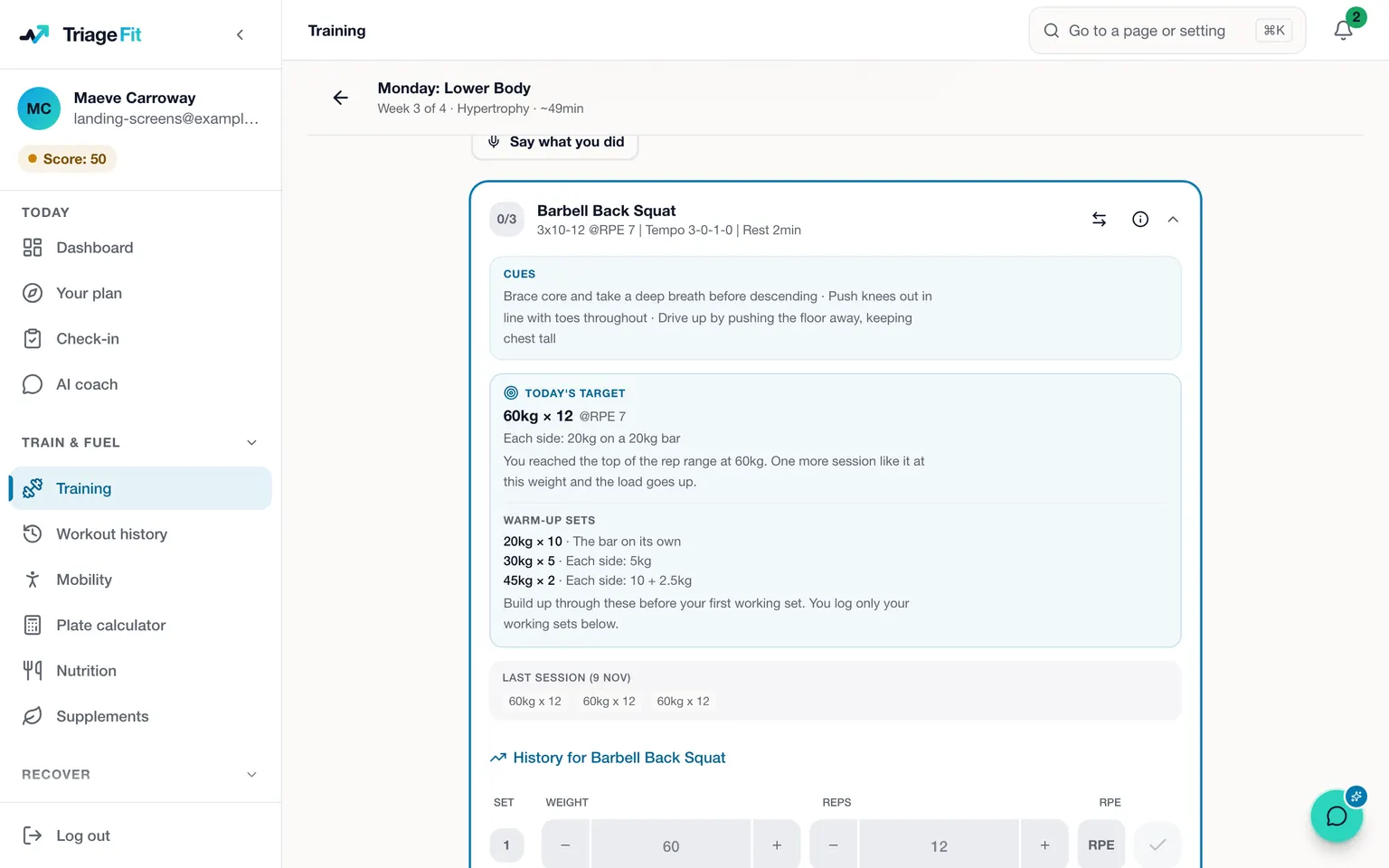
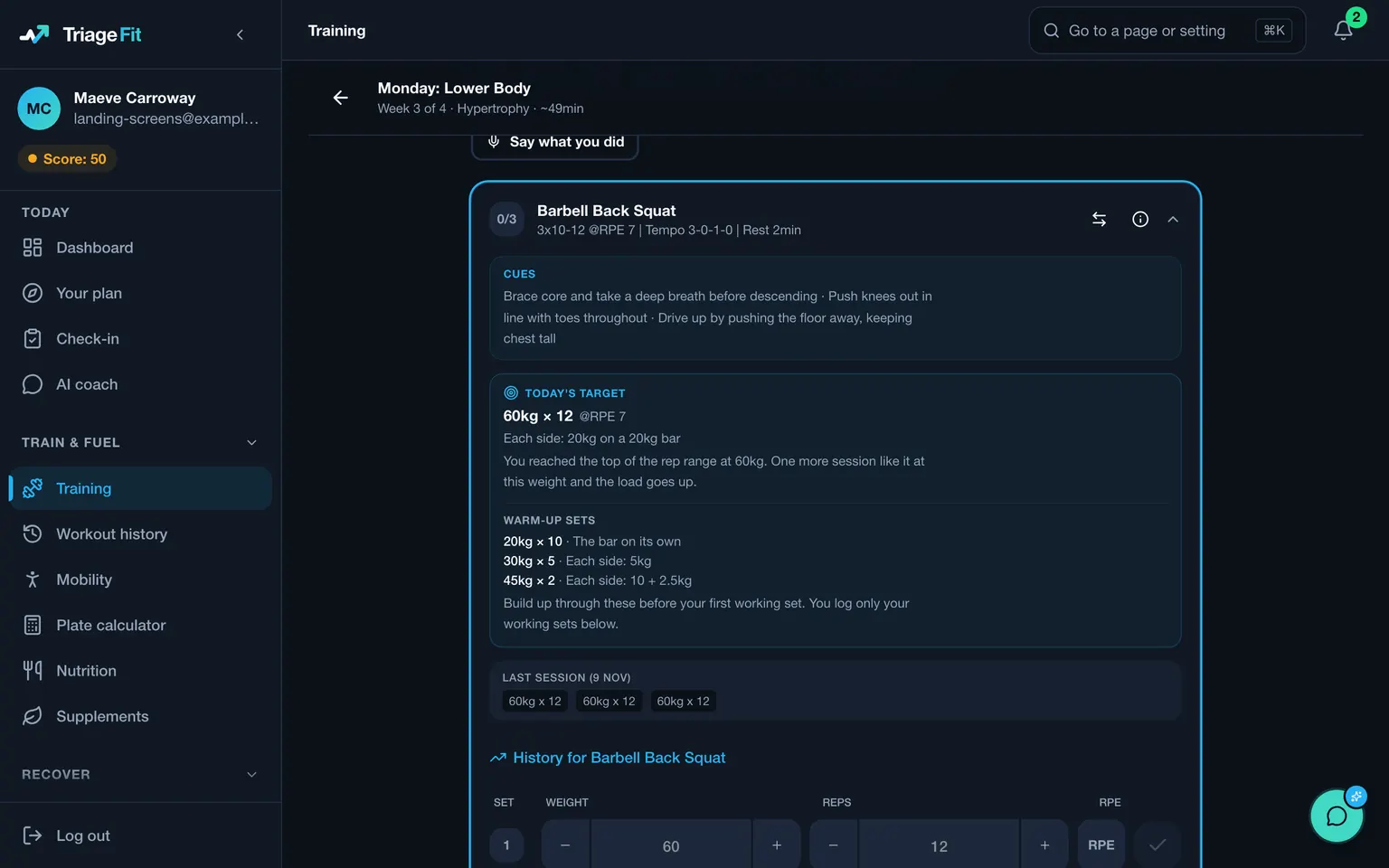
TriageFit gives that patient a coached programme of their own. Joining starts with an intake that takes around half an hour, in which they mark the injury on a body map, say which side it is on and how much it troubles them, and then answer questions on their goal, their training history, their equipment and how long they can give each session. The programme follows phases our coaches designed, and each session is drawn from the 494 exercises in our library that fit their equipment, their level and that injury. A few answers on the health screen, chest pain among them, pause the programme until their doctor has cleared them and they confirm it on their plan page.
Each week, on a day they choose, the patient sends a check-in. The coaching reply arrives in seconds, and the AI coach reads the same answers. What the AI coach works from is 20+ years of coaching real clients, set out in phases our coaches designed and tailored to each member's goals, equipment and week. When an exercise aggravates the injury, the AI coach suggests a replacement for it and says when the injury is worth a physio's look, and it waits for the patient to agree before anything on the plan changes. Home exercise programme software puts Wibbi next to three other platforms and follows a patient into this stage.
A clinic in Galway
A clinic in Galway with five physiotherapists has used Wibbi since it was Physiotec, and sends home programmes through the Wibbi Vive app while patients are in treatment. One of its patients, a nurse in their thirties, has had seven sessions for a right knee that flared up when they took up running again, and they want to get properly strong before building the running back up.
On the last visit the physio passes over the clinic's partner one-pager with the final home programme. The nurse signs up for TriageFit a few days later by scanning its QR code, which brings 10% off each payment, and ticks the box at checkout that lets the clinic see their progress. The right knee goes on the body map in the intake, and the programme is built with it in mind.
Three weeks in, a block of night shifts leaves the nurse two training days instead of three, and they ask the AI coach to rework the week. It suggests moving the main work onto the two days that are free, and the nurse accepts. A month on, their physio opens the Patients tab in the clinic portal and finds the current programme week, the date of the last check-in and the adherence figure waiting there.
The cost to the clinic
The clinic pays TriageFit nothing. Membership is paid by the patient, at €50 every 4 weeks or €500 a year including VAT. A patient who came through the clinic's link keeps 10% off every one of those payments for as long as they stay a member.
Where a clinic's professional rules allow it to take a referral fee, it can turn the fee on from its settings, and doing so records the clinic's confirmation that the fee is allowed and that it will disclose it as those rules require. The fee is 5% of each payment, or €2.25 on a four-weekly payment and €29.25 over a year of them, and it comes out of TriageFit's share, so the patient pays the same. Fees are held for 30 days and reversed by a refund or chargeback, and once the clinic is owed €20 or more they are paid monthly through Stripe Connect.
So whatever figure Wibbi's quote comes to, the partnership leaves the clinic's spending where it was.
Registering the clinic
Registration is a single form. Only the clinic's name, the name of the person registering and a contact email are required, and the website, that person's role and the number of clinicians can be added too. The portal, the partner link and the patient discount are live as soon as the form is sent. TriageFit then checks by hand that the clinic is real and that the person who registered it can act for it, emails the outcome, and opens progress sharing once the check has passed. The partner clinic terms set out the arrangement in full.
Questions people ask
- How much does Wibbi cost?
- Wibbi's pricing page gives a quote for every plan, on request, so the figure depends on the plan and on which add-ons the clinic wants: remote therapeutic monitoring, a custom branded app, continuing education and enhanced security.
- Does Wibbi offer a free trial?
- Yes. Wibbi offers a free 30-day trial, and its trial page promises a full refund for a customer who is not satisfied after six months.
- Is Wibbi the same company as Physiotec?
- Yes, it is one company that has traded under both names. Wibbi's about page says the company was founded in 1993, as Physiotec, and its rehabilitation page introduces Wibbi as formerly Physiotec.
- Can a clinic use Wibbi and the TriageFit partnership together?
- Yes. Wibbi carries on as the clinic's tool during treatment, and the partnership begins at discharge for patients who want coached training. The partner link and the printable one-pager go to the patient with the last home programme, and anyone who joins through them gets 10% off every payment.
Sources
- Wibbi, pricing, checked 4 November 2026
- Wibbi, about, checked 4 November 2026
- Wibbi, rehabilitation, checked 4 November 2026
- Wibbi, home exercise features, checked 4 November 2026
- Wibbi, care pathway builder, checked 4 November 2026
- Wibbi, custom branding, checked 4 November 2026
- Wibbi, security and reliability, checked 4 November 2026
- Wibbi, free trial, checked 4 November 2026
Wibbi and Physitrack are trademarks of their owners. TriageFit is independent of each of them, and none of them has reviewed or endorsed this page.
Read next
- Rehab My Patient alternatives, set against its own pricesRehab My Patient alternatives set against its sterling plans, from Physitrack's price per practitioner to Wibbi's quotes, and coaching after discharge.
- How a physio referral partnership with TriageFit worksHow a physio referral partnership with TriageFit runs, from registering to a patient's first check-in, and what the clinic sees, pays and earns.
- Home exercise programme software, and the step after dischargeHome exercise programme software compared on pricing: Physitrack, Medbridge, Wibbi and Rehab My Patient, and where coaching picks up after discharge.
- Coached exercise for your patients after physio dischargeA coached programme for patients leaving physio, built around the injury you treated, discounted through your clinic's link and shared only if they choose.