The best workout tracker apps, and when you need more than a log
The best workout tracker app makes logging a set quick and shows you plainly whether your lifts are moving. Caliber, Ladder, Peloton's Strength+, Fitbod and MacroFactor's workout app all record your weights and reps, and they differ in who plans the session you log. TriageFit records every set and charts every lift as well, and adds phases our coaches designed and real coaches in your group, for €50 every 4 weeks with VAT included.
By TriageFit · Published
A workout tracker earns its place in the minutes between sets, when you want last week's figures in front of you and a quick way to record this one. Every app on this list logs your weights and reps, and they differ in who writes the session you are logging: you, the author of a ready-made plan, an algorithm or a coach. Each rival's price and features come from its own website, help pages or App Store listing.
Who writes the session you log
| Who writes the session | Trackers in this group |
|---|---|
| You | Caliber's free version |
| The author of a ready-made plan | Caliber Plus, Ladder, Peloton's Strength+ |
| An algorithm, working from your log | Fitbod, MacroFactor's workout app |
| A coach, or phases coaches designed | Trainwell, Future, Caliber's Premium Coaching, TriageFit |
Logs you fill in yourself
Caliber has a free version, which covers unlimited workouts that you build and track yourself, more than 800 exercises with video tutorials, private workout chats with friends and family, and a link to Apple Health for cardio, food, steps and body measurements, along with a way to send your training data to ChatGPT or Claude for analysis.
Caliber Plus adds more than 120 coach-designed training plans to choose from, a Strength Score that rates your strength against your potential for your age and gender, a Strength Balance view across the main muscle groups, lessons on training and nutrition, nutrition targets, custom exercises and supersets, exercise swaps and progress photos. It costs $12 a month or $72 a year, the price given in a help-centre guide last updated in June 2024 (checked 19 November 2026).
A log you fill in yourself suits a lifter who already follows a programme they trust, whether it came from a book, a coach they once had or years of their own trial and error. The app keeps the record, and the decisions about what comes next stay with you.
Trackers with a plan built in
Ladder begins with a team quiz that matches you with a coach and a team from your goals and preferences. The monthly plan, at $29.99 a month, gives you a weekly workout plan, in-ear coaching and video demonstrations, progress tracking in the Ladder Journal, a link to an Apple Watch and to Spotify or Apple Music, and coach tips and motivation in the team chat (checked 3 November 2026). For the logging itself, Ladder lists rep and weight logging as you go, with your progress and personal records tracked over time. The annual plan costs $179.99 a year, which works out at $14.99 a month, and new members get seven days free, with no card needed to start and no payment taken until the trial ends.
Peloton's Strength+ app is built for lifting with barbells, dumbbells and cable machines, and you add the weight and reps you lift to track your progress. It also has multi-week programmes, one-off workouts, a workout generator it says is tailored to your goals, video tutorials, form demonstrations, audio guides in your ear, and optional warm-ups and cool-downs. Strength+ costs $9.99 a month, the US price, after a 14-day free trial (checked 24 September 2026). It is free for All-Access and App+ members, including during an App+ trial, and it is only available in the US and Canada.
A tracker with a plan built in suits someone who wants the sessions chosen for them.
Trackers that write your next session
Fitbod builds your next workout from the settings in your plan and the training you have already logged, and it keeps track of personal records, estimated strength, volume trends and streaks. You can swap any exercise, and the app learns your preferences from what you change. The app works offline, with warm-ups and cool-downs built in, and it connects to Apple Health, Fitbit, Health Connect and Strava, with apps for Apple Watch and Wear OS. Fitbod's website sells it at $15.99 a month or $95.99 a year, and you get a 7-day free trial when you first sign up, with nothing charged until it ends (checked 25 September 2026). If the trial ends and you have not subscribed, you can still look back at past workouts, but logging a new one or generating a workout from your history needs a subscription.
MacroFactor's workout app offers a programme fitted to your goals, your level and your gym's equipment, whose progressive overload adjusts itself and tells you when to add reps or weight. Its library holds more than 900 exercises with tips, cues and technique videos, and alongside the log you get gym profiles, a custom programme builder, smart swaps, rest timers, a plate calculator, warm-up suggestions, and trackers for personal records and volume. It costs $11.99 a month, $47.99 every six months or $71.99 a year, and a new subscriber starts with a 7-day free trial (checked 19 November 2026).
A tracker that writes your next session suits someone who logs every set without fail, because each new workout is built from that record. Fitbod's terms add that the app does not work as a personal trainer and does not give medical or fitness advice.
Logging a session at TriageFit
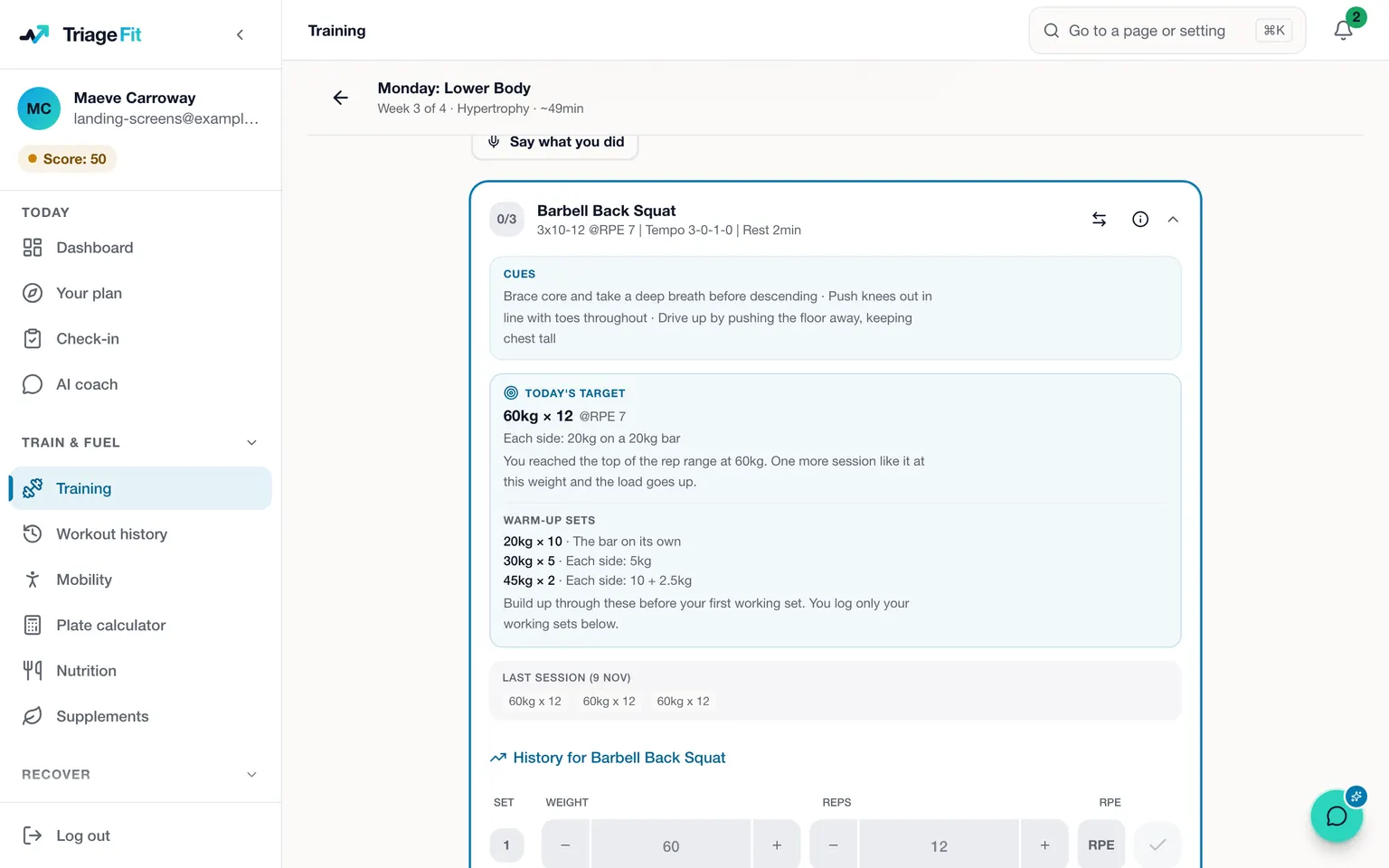
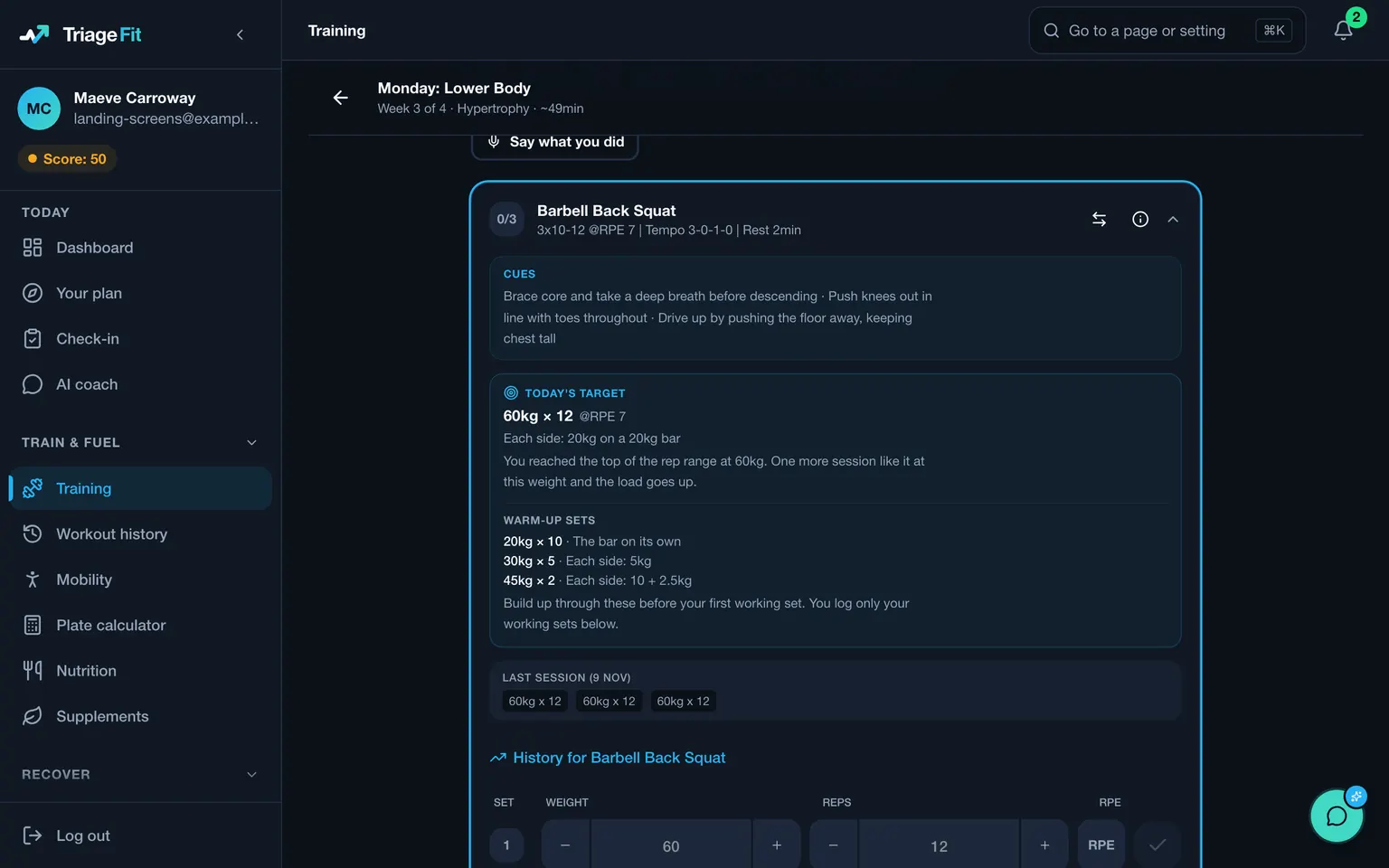
A TriageFit session lists your exercises in the order your programme gives them, each with the figures from the last time you did it, set by set. For every set you enter the weight, the reps and a score for how hard the set felt. A hold takes seconds in place of reps, and a bodyweight exercise needs no weight. The tick waits until all of a set's figures are in, and the app tells you which one is missing.
When a session is going to plan, a button called Fill remaining as prescribed puts the plan's figures into the empty boxes of every set still to do, and leaves any set you added yourself alone. When your plan gives an exercise a rest between sets, the rest timer starts as you tick each set. You can add or take off time, pause it, restart it or mute it.
Before you start, you can change the warm-up from a list screened for your body, swapping, removing or adding moves. If the machine you need is taken, you can swap the exercise for today only or for the rest of the block, the swap is labelled on the session row as your own, and you can add a set to any exercise. When you finish, the Session complete card shows your total time, sets, volume and exercises, then lists each lift that went up on last session, with what it was before. A short note from the AI coach follows, on what it noticed about the session, and the app picks out the session's best moment. Underneath it is a method our coaches have built over 20+ years of working with real clients, and the AI coach brings it to you at any hour, tailored to your week.
Training outside your plan counts too. From the Training page you can log an extra session, as strength work or as cardio such as a run, a row, a ride or a class, and it counts in the picture of your week. Your workout history shows every lifting session, newest first and set by set, marked as complete, partial or skipped, with your extra strength sessions among them. You can correct a mistake in a recent set, and a set you forgot to log can be added afterwards. Today counts the weeks you have trained and whether you have kept to never missing twice, beside your daily streak, and TriageFit installs to your phone's home screen from settings, so the log is one tap away in the gym.
Records, charts and links to share
TriageFit counts a personal record in two ways: a new best estimated one-rep max for a lift, or a single set whose weight times reps beats every earlier set of that lift. Each new record lands on your Achievements page as you log it, and the Progress tab in Insights shows your recent records with the size of each improvement, plus a Deep dive link to the progress of every lift.
Each lift has its own Progression chart, covering every session you have completed on it, which you can switch between estimated one-rep max, top set and volume. Each lift also gets a stall check, so one that has gone a few weeks without a new best is flagged, and a strength overview ranks your lifts with weekly charts behind each. On that page, Share progress makes a link that anyone can open to see the chart and your record for the lift. Each link runs out after a fixed period, and Turn off links you shared before closes every link you have made for that lift.
If you wear an Apple Watch, Garmin, Whoop, Oura ring or Fitbit, you can export its data and upload the file to TriageFit. The import takes readings such as your sleep, resting heart rate and steps, and an Apple Health export also brings in the cardio sessions your watch recorded. Your recovery figures then help set how hard each session asks you to work.
When you need more than a log
A log records what happened. Deciding what happens next, whether to add weight, hold it, change the rep range or move to a new phase, is a planning job, and it is the job the coached services take on.
Trainwell's app tracks your sets, pacing and range of motion as you train, while your trainer's voice tells you what to do next and corrects your pacing and form. Trainwell recommends an Apple Watch from Series 5 onwards, or a Wear OS 3 watch or newer, for its motion tracking. It costs $149 a month, billed in three-month increments, after a 14-day free trial (checked 3 November 2026).
In Future's app, you can flag an exercise to swap it for another, report your reps, adjust your weight, replay the spoken cues and film a set with Record My Form, and a flagged exercise sends your feedback straight to your coach. Future's coaching costs $50 for the first month and $199 a month after that (checked 3 November 2026). Future is a service open only in the United States, where signing up needs a US payment method, a US phone number and access to the US App Store.
Caliber's Premium Coaching costs from $200 a month and includes a dedicated one-to-one coach, a training and nutrition programme the coach designs for you, messages and video messages in the app, video form reviews and a weekly progress review (checked 19 November 2026).
Our coaches designed the phases TriageFit builds your programme from. Each runs for four to six weeks, and the next one follows on for as long as you stay a member. Your exercises come from a library of 494, picked to suit your kit and experience, and each has coaching cues, with the main lifts filmed. Once a lift has enough history, a Today's target card in the session gives the weight and reps to aim for and says whether that is up on last time, held or down, and why.
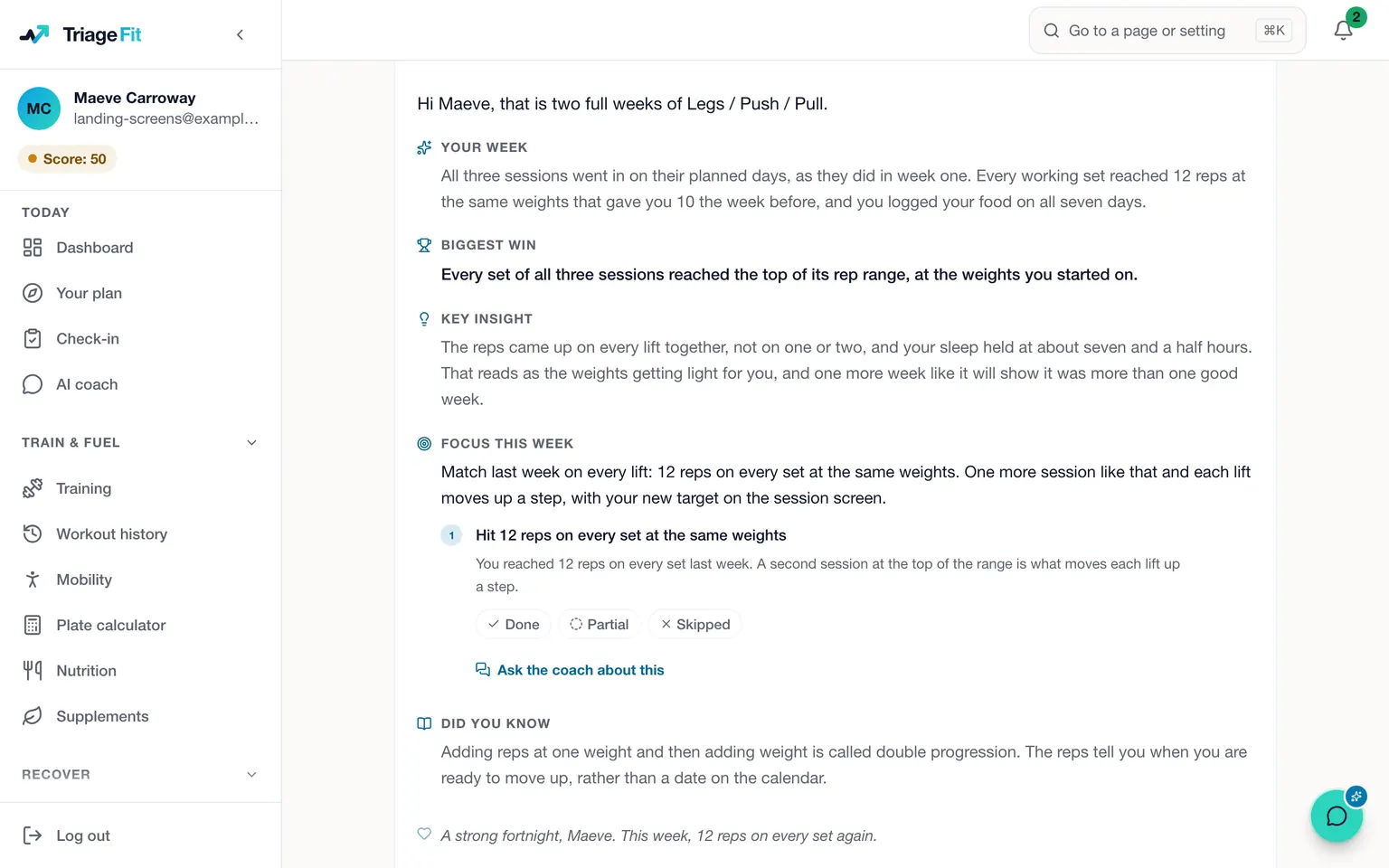
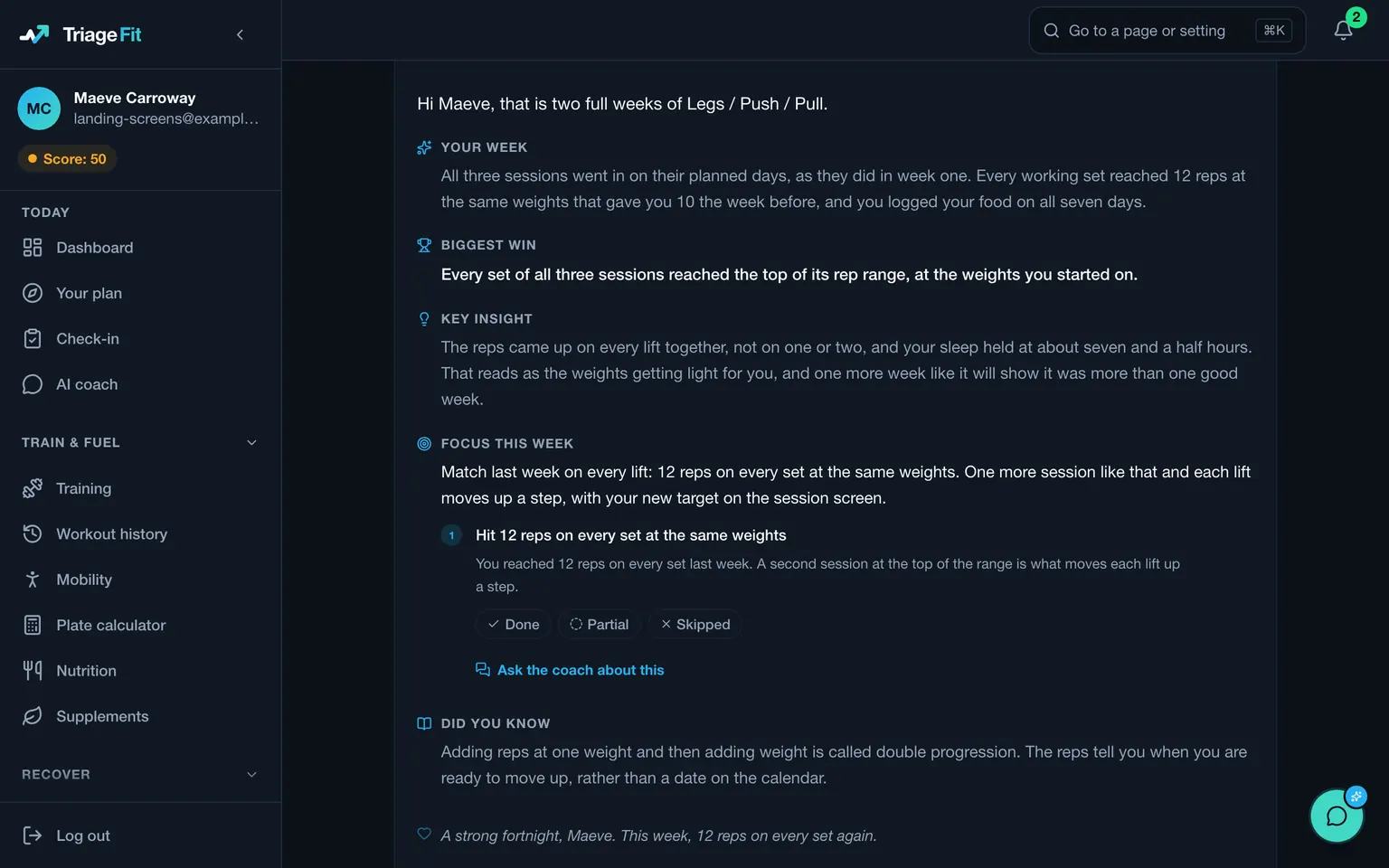
After missed reps the target comes down, and while your daily check-ins keep showing short sleep, high stress or low energy it holds. When fatigue builds across several lifts and your check-ins, TriageFit suggests a lighter week, which only happens once you accept it from your Training page. When the signs are stronger, it eases your coming sessions itself and tells your coach. Real coaches answer questions in your group, you can send a video of a lift for a coach to check your form, and the AI coach answers at any hour.
A week of logging at TriageFit
Say you lift three evenings a week and like a Saturday run of your own. Your daily check-ins have shown short sleep on several days of the past week, so on Monday the target on your squat holds at the weight you lifted last time, and the card says that is why. You log each set as you go, and the rest timer starts as you tick it.
On Wednesday the cable machine is busy, so you swap that exercise for today only, and the rest of your block stays as it was. On Friday you have a few spare minutes, so you add a set to your rows, and the Session complete card lists the lifts that went up on last session, with the AI coach's note under it. Your Saturday run goes in as an extra cardio session, so it counts in your week.
When your weekly check-in comes round, you rate the week's energy, recovery, motivation, sleep and stress. The AI coach writes back, real coaches answer questions in your group, and once you are sleeping better, the squat target can climb again.
What each tracker costs
The prices below are in dollars, the currency most of these apps quote.
| Tracker | What it costs |
|---|---|
| Caliber's free version | Free |
| Caliber Plus | $12 a month or $72 a year (checked 19 November 2026) |
| Ladder | $29.99 a month, or $179.99 a year, which works out at $14.99 a month (checked 3 November 2026) |
| Peloton's Strength+ | $9.99 a month, the US price (checked 24 September 2026) |
| Fitbod | $15.99 a month, or $95.99 a year, on its website (checked 25 September 2026) |
| MacroFactor's workout app | $11.99 a month, $47.99 every six months or $71.99 a year (checked 19 November 2026) |
| Trainwell | $149 a month, billed in three-month increments (checked 3 November 2026) |
| Caliber's Premium Coaching | from $200 a month (checked 19 November 2026) |
| Future | $50 for the first month and $199 a month after that (checked 3 November 2026) |
| TriageFit | $55 every 4 weeks, or $550 a year |
The table sets TriageFit's dollar price beside Caliber Plus, Ladder, Strength+, Fitbod, MacroFactor's workout app and a trainer of your own at Trainwell, at Caliber or at Future, whose first month is priced on its own. Paid in euro, it is €50 every 4 weeks including VAT, or €500 a year, and in the UK it is £45 every 4 weeks. You can cancel the block plan whenever you like or pause it for one to three months, and coaching starts with your first payment.
That price also covers your food, with a calorie target matched to your metabolism and macro targets reviewed every week.
How to start
The pricing page has both plans, and your intake opens once the first payment has gone through. Online fitness coaching explains how your plan is built from the intake and rebuilt from each check-in, and weekly check-in coaching shows what happens after you send one. The best workout apps sorts every kind of training app, and the best strength training apps compares what each one does when a lift stalls. For one rival at a time, read what Fitbod, Caliber, MacroFactor, Ladder or Peloton costs.
Questions people ask
- What is the best workout tracker app?
- That depends on who you want writing the sessions you log. Caliber's free version suits a lifter who plans their own training, Ladder and Peloton's Strength+ give you a ready-made plan to log against, and Fitbod and MacroFactor's workout app write the next session from your log. TriageFit logs every set too, and pairs the log with phases our coaches designed, real coaches in your group, a weekly check-in answered within seconds and an AI coach at any hour, for €50 every 4 weeks.
- Is there a free workout tracker app?
- Yes. Caliber's free version includes unlimited workouts that you build and track yourself, more than 800 exercises with video tutorials, private workout chats with friends and family, and a link to Apple Health for cardio, food, steps and body measurements. Several of the paid trackers start with a trial, and Fitbod, for example, has a 7-day free trial when you first sign up, with nothing charged until it ends. At TriageFit, coaching starts with your first payment, and you can cancel the block plan whenever you like.
- Can TriageFit track workouts I do outside my plan?
- Yes. On the Training page you can log an extra session, either strength work or cardio such as a run, a row, a ride or a class. Extra strength sessions appear in your workout history beside the sessions from your plan, and both kinds count in what TriageFit makes of your week. If you train with an Apple Watch, the cardio sessions it recorded come in too when you upload your Apple Health export.
- Can I share my progress from TriageFit?
- Yes. Every lift has its own Progression chart, and Share progress on that page makes a link that anyone can open to see the chart and your record for the lift. A link runs out after a fixed period, and Turn off links you shared before, on the same page, closes every link you have made for that lift.
- How does TriageFit's price compare with tracker apps?
- In the US, TriageFit costs $55 every 4 weeks. Caliber Plus costs $12 a month or $72 a year and Fitbod $15.99 a month on its website, while Trainwell costs $149 a month and Caliber's Premium Coaching starts from $200 a month (prices checked 25 September 2026, 3 November 2026 and 19 November 2026). For its price, TriageFit gives you coach-designed phases, targets worked out from what you log, calorie and macro targets, a weekly check-in answered within seconds and an AI coach at any hour.
Sources
- Caliber's App Store listing (Ireland), checked 3 November 2026
- Caliber help centre, account management guide (June 2024), checked 19 November 2026
- Ladder, pricing, checked 3 November 2026
- Ladder, home page, checked 3 November 2026
- Peloton support, the Strength+ app, checked 24 September 2026
- Peloton, memberships (US), checked 24 September 2026
- Fitbod help, how a workout is built, checked 4 November 2026
- Fitbod, questions and answers, checked 25 September 2026
- Fitbod help, how the trial works, checked 4 November 2026
- MacroFactor, the workout app, checked 3 November 2026
- MacroFactor, what the workout app costs, checked 19 November 2026
- Fitbod terms of use, checked 25 September 2026
- Trainwell, questions and answers, checked 3 November 2026
- Future help, what to expect from a workout, checked 3 November 2026
- Future, home page, checked 3 November 2026
- Future help, availability outside the US, checked 3 November 2026
Caliber, Ladder, Peloton, Fitbod, MacroFactor, Trainwell, Garmin, Whoop, Oura and Future are trademarks of their owners. TriageFit is independent of each of them, and none of them has reviewed or endorsed this page.
Read next
- The best online personal trainers, judged on what you pay forOnline personal trainers compared on a plan built around you, an AI coach reading your check-ins, feedback on your form and the price, TriageFit included.
- The best AI personal trainer apps, by what the AI can changeAI personal trainer apps compared on how each builds the plan, what its AI can change, whether a person is involved and what it costs, TriageFit included.
- The best personal trainer apps, from set programmes to a coach of your ownPersonal trainer apps sorted from set programmes to AI to a coach of your own, with what each costs and what it does when you stall, TriageFit included.
- How much does a personal trainer cost, and what does the same money buy?What a personal trainer costs for a session, a package and four weeks in Ireland, the UK and the US, and what the same money buys with TriageFit.