What the Peloton app costs in the UK and the US
In the UK, the Peloton app costs £12.99 a month for App One and £28.99 a month for App+, and if you are new to Peloton you can start either tier with a free trial, which becomes a paid monthly membership unless you cancel before it ends (checked 24 September 2026). Peloton publishes no Irish price, and the Irish App Store has no listing for the Peloton app. TriageFit costs £45 every 4 weeks in the UK, and for that it builds your training around your equipment and injuries, coaches your food beside it and has the AI coach read each weekly check-in.
By TriageFit · Updated
Peloton sells its app in two tiers, App One and App+, and its support pages list prices for the US, Canada, the UK, Germany, Austria and Australia. Ireland is not on that list, the Irish App Store has no listing for the Peloton app, and Peloton's UK membership terms say you must live in the UK to buy a membership there, so this page gives the UK and US prices Peloton publishes for its app.
What the Peloton app costs
| Tier | UK | US |
|---|---|---|
| App One, paid monthly | £12.99 a month (checked 24 September 2026) | $12.99 a month |
| App One, paid yearly | £129 a year (checked 24 September 2026) | $129 a year |
| App+, paid monthly | £28.99 a month (checked 24 September 2026) | $28.99 a month |
| App+, paid yearly | £289 a year (checked 24 September 2026) | $289 a year |
On either tier, paying for the year costs about as much as ten months paid one at a time. In the US, App One costs $15.99 a month or $159.99 a year if you buy it through Apple's iOS (checked 24 September 2026). Peloton's UK terms say its fees include VAT, that a membership renews automatically, at the fee in force on the renewal date, and that Peloton gives at least 30 days' notice of a new fee, and the right to cancel.
An app membership gives no access to content on a Peloton machine's touchscreen, which needs All-Access. All-Access costs £45 a month in the UK, and in the US it costs $49.99 a month, with App+ and Strength+ included (checked 24 September 2026). Peloton's US app page also says students, medical professionals and some other groups may pay less. An app membership is for one person and cannot be shared, and it works on the web, Apple's iOS, Android, Amazon and Roku.
What each tier includes
Both tiers include strength, cardio, Pilates, yoga, outdoor walking and running, and stretching classes, activity tracking and live metrics, Peloton's programmes and monthly challenges, stats from an Apple Watch or a Wear OS watch, and a heart rate monitor connection. They differ on the classes for Peloton's cardio machines. App One allows three Bike, Tread or Row classes a month. Each of those is counted as taken once you have been in it for three minutes, and cannot then be removed or swapped for another. App+ gives you as many classes as you like, Bike, Tread and Row classes included.
Peloton's US app page describes App+ as everything in App One, plus Strength+. The same page lists Peloton IQ, a feature Peloton describes as AI that builds personalised workout plans, gives insights into your performance and recommends what to do next, and a library of more than 15 types of workout and thousands of classes.
Strength+ is Peloton's separate app for strength training. Its support page lists multi-week programmes, one-off workouts, a workout generator it says is tailored to your goals, video tutorials, form demonstrations, audio guides in your ear, and optional warm-ups and cool-downs. The app works with barbells, dumbbells and cable machines, and you add the weight and reps you lift to track your progress. It is only available in the US and Canada. On its own it costs $9.99 a month, the US price, after a 14-day free trial, and it is free for All-Access and App+ members, including during an App+ trial (checked 24 September 2026).
Strength training on the app
Strength classes are part of both tiers, alongside Peloton's programmes and monthly challenges. In the US and Canada, Strength+ adds multi-week programmes that work with barbells, dumbbells and cable machines, where you log the weight and reps you lift.
Starting the trial and cancelling
In the UK, Peloton offers a 30-day free trial of either tier. Trials are for new members only, and they come with no upfront cost, though you need a payment method on file. Peloton's support page says a trial turns into a paid monthly membership on the tier you chose when the trial ends, unless you cancel during it. Its UK terms also give you 14 days to change your mind, with a refund within 14 days of telling Peloton.
If you bought the membership from Peloton, you cancel on the My Membership page of Peloton's website, by choosing to cancel, giving a reason and confirming. If you bought it through Apple's iOS or Apple TV, Android or Android TV, Amazon or Roku, it has to be changed or cancelled on the platform it was bought through, and once you cancel, you keep access until the next billing date, when it ends and the billing stops. The UK App Store listing says a membership bought there renews automatically unless auto-renew is turned off at least 24 hours before the period ends. It adds that you cannot cancel the current period partway through, and cancelling during a month stops the next month's charge. Peloton's UK terms say you can update your payment details, pause or cancel at any time in your account settings. Moving from App+ down to App One brings no refund and takes effect at the end of the current billing cycle.
How TriageFit coaches you
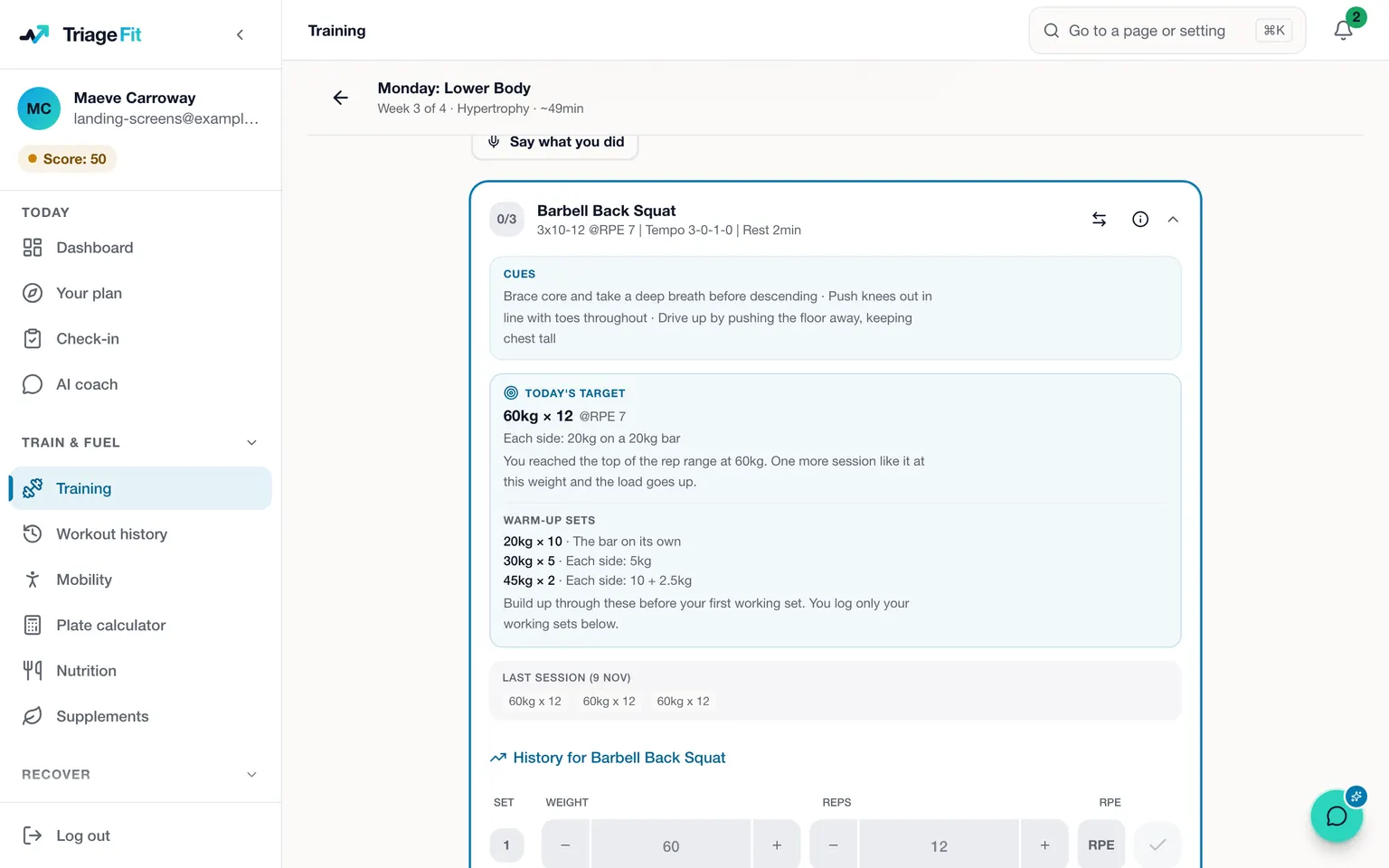
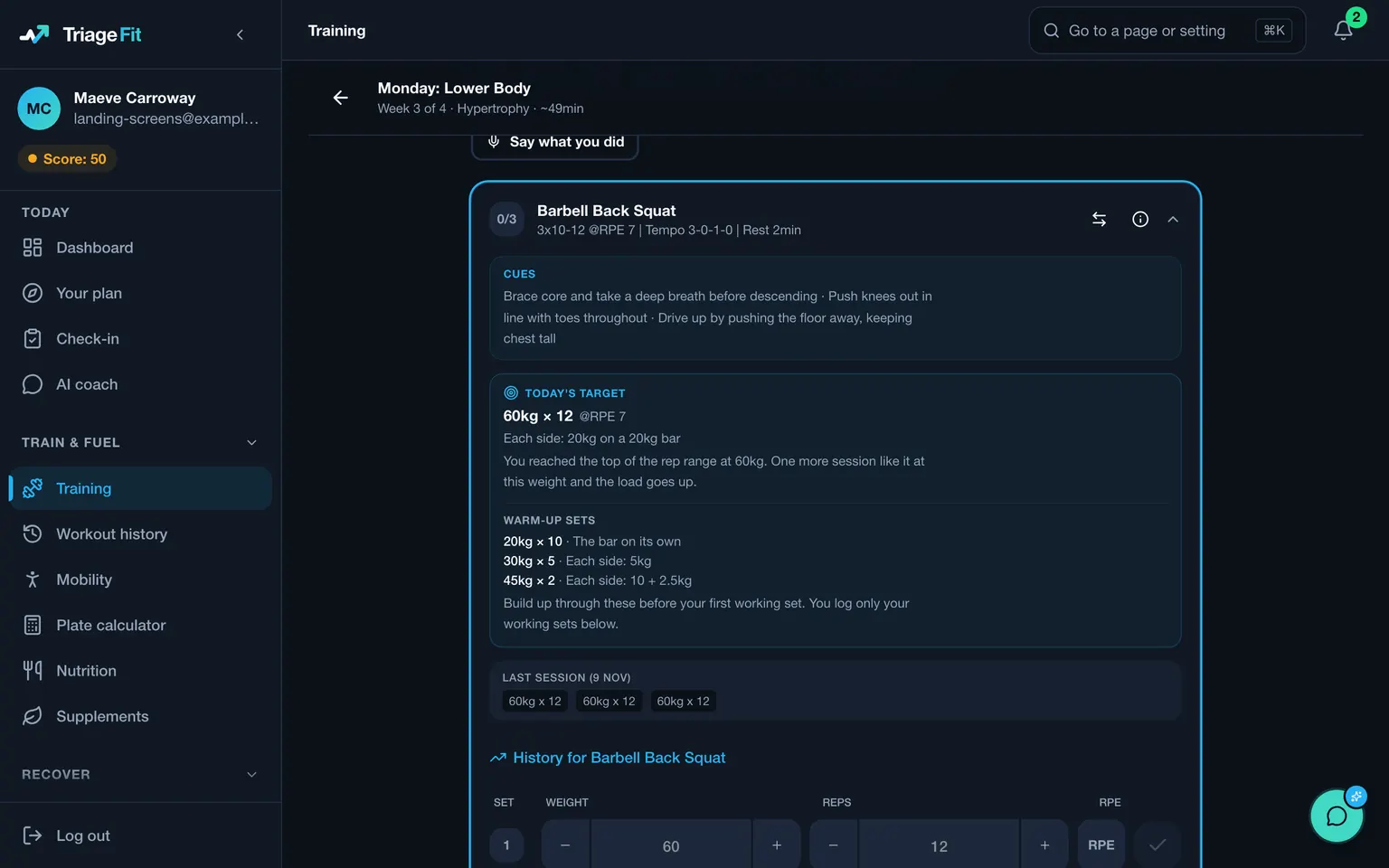
Joining TriageFit starts with an intake that takes about half an hour, and you can stop partway and pick it up later. It covers your goal, your training history, the equipment you can use, any injury you are working around and the days you are free to train. Your answers give you a programme in phases our coaches wrote, each four to six weeks long, and the next phase follows on for as long as you stay a member. The sessions are drawn from 494 exercises, matched to your equipment and your level. Each exercise comes with coaching cues, and the main lifts have video.
How an injury shapes your sessions rests on two answers you give about it, how much it limits you, as mild, moderate or severe, and whether it is improving, about the same or getting worse. For an injury in one of the areas the programme checks, which include the shoulder, elbow, wrist, neck, lower back, hip, knee, ankle and foot, a severe grade or a moderate one that is getting worse means the exercises that could aggravate it are replaced by others that train the same muscles. A milder grade keeps them, and each carries a warning to stay in a pain-free range, stop the set rather than work through pain and tell your coach if the area is still sore the next day. The body map in the intake's quick movement check is stricter. An area you mark there as painful has those exercises replaced whatever score you give the pain, except a lower-back mark that your other answers in the check clear for hip hinging.
Food sits in the same account as your training. The intake sets a calorie target matched to your metabolism, and your macros are adjusted each week from your check-in. Protein is spread across your day, and the meals you eat again and again can be saved along with their macros.
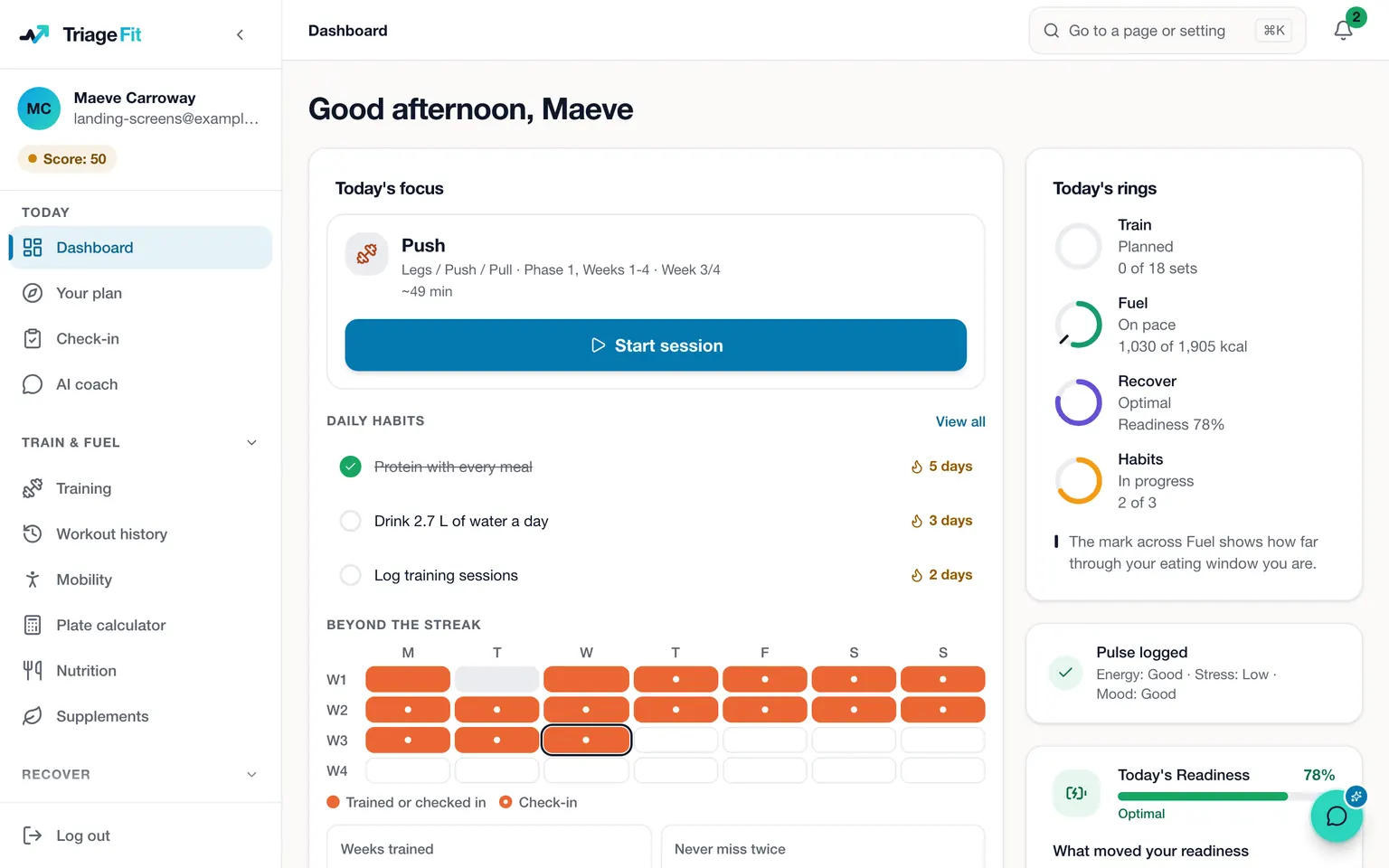
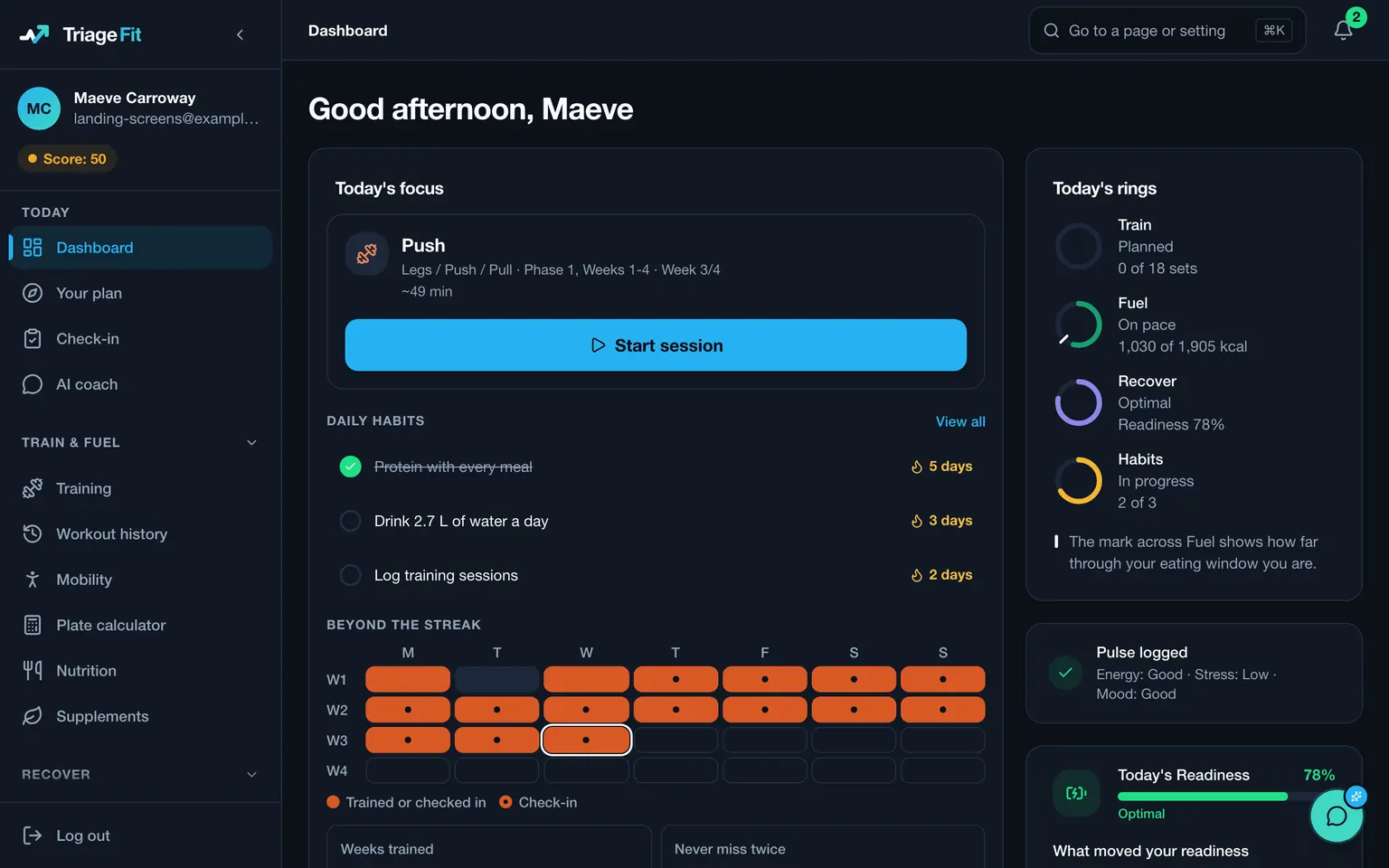
Each week brings a check-in on the day you set. It opens with the programme sessions you logged already in place, asks you to score your energy, recovery, motivation, sleep and stress, and leaves room for a note if you want to add one. A reply is with you within seconds, and real coaches answer questions in your group.
When you want a lift checked, you film a set and a coach reviews it. The AI coach is there at any hour, and when your day changes it can propose a shorter session, a different exercise or another day to train, which goes into your programme once you confirm it. What the AI coach works from is 20+ years of coaching real clients, set out in coach-designed phases tailored to your goals, your equipment and your week. You also join a group with coaches in it, where questions get answered in the open and there are group challenges to take part in.
Progress shows on the body page, where your weight sits beside your waist, hip and chest measurements and your progress photos, and the trend over the weeks comes before any single weigh-in. If you track with Apple Health, Garmin, Whoop, Oura or Fitbit, you export your data and upload it, and your recovery readings adjust how hard your sessions ask you to work.
From bike classes to a barbell
Say you are a chef in Bristol who has had App+ for a year, riding Peloton's Bike classes from your phone on a second-hand exercise bike at home, and the habit has stuck. Now you want to lose some fat and get stronger, so you join TriageFit. In the intake you put down the gym near the restaurant, with its barbells and cable machines, the Mondays, Tuesdays and Thursdays you have free, and a left wrist that aches in a push-up, which you grade as mild and improving, with nothing marked on the body map.
Your programme puts a session on each of those days. With the wrist graded mild, push-ups and the other exercises that could bother it can still be chosen, and any that appear in a session carry the warning to keep to a pain-free range, stop the set rather than work through pain and tell your coach if the wrist is still sore the next day. You keep a Sunday ride on the bike at home and record it with Log a session on the Progress tab. In the first week you save the porridge you eat before every shift and the chicken and rice you batch-cook for your breaks, with the macros for each. In the second week you film a set of Romanian deadlifts, and a coach reviews it. In the third week someone is on the cable machine you need, so you ask the AI coach, it offers a different exercise, and the swap goes in once you confirm it.
At your Monday check-in the week's three sessions are already listed. You rate your sleep low after two late finishes and say so in the note, and the reply is back within seconds. You wear an Apple Watch, so you export your Apple Health data and upload it, and your recovery readings adjust how hard the sessions ask you to work. On the body page your waist measurement sits beside your weight, with the trend over the weeks shown first.
What TriageFit costs
In the UK, TriageFit costs £45 every 4 weeks, against £12.99 a month for App One and £28.99 a month for App+, and in the US the same 4 weeks cost $55 (checked 24 September 2026). In Ireland it is €50 every 4 weeks with VAT included, or €500 if you pay for the year. There is no contract on the block plan, so you can leave when you like, and a pause of one to three months covers an injury or a trip.
Which one suits you
Peloton suits someone who enjoys following classes and wants thousands to choose from, and on App+ they can take as many Bike, Tread and Row classes as they like, at the App+ prices in the table, against TriageFit's £45 every 4 weeks in the UK and $55 in the US. TriageFit suits someone who wants their training built around their equipment, their injuries and the days they are free, with their food coached beside it and an AI coach reading each weekly check-in, for £45 every 4 weeks in the UK.
How to start
Choose a plan on the pricing page, create your account and pay, and the intake opens. Online strength coaching goes through the phases on the main lifts and how your progress shows, and coaching for shift workers covers moving sessions around a rota. If you are comparing app prices, what the Ladder app costs goes through another strength app's plans, and what a personal trainer costs sets TriageFit beside paying a trainer by the session.
Questions people ask
- How much does the Peloton app cost a month?
- In the UK, App One costs £12.99 a month and App+ costs £28.99 a month (checked 24 September 2026). In the US they cost $12.99 a month and $28.99 a month, although App One bought through Apple's iOS costs $15.99 a month or $159.99 a year. On either tier, paying for a year costs about as much as ten months. TriageFit costs £45 every 4 weeks in the UK and $55 in the US, and in Ireland it is €50 with VAT included.
- What is the difference between App One and App+?
- Both tiers include strength, cardio, Pilates, yoga, outdoor walking and running, and stretching classes, activity tracking and live metrics, Peloton's programmes and monthly challenges, stats from an Apple Watch or a Wear OS watch, and a heart rate monitor connection. The difference is in the classes for Peloton's cardio machines: App One allows three Bike, Tread or Row classes a month, and App+ gives you as many classes as you like, Bike, Tread and Row classes included. In the US, App+ also brings Strength+, Peloton's app for strength training, which is only available in the US and Canada.
- Can I get the Peloton app in Ireland?
- Peloton's support pages list app prices for the US, Canada, the UK, Germany, Austria and Australia, and Ireland is not among them. The Irish App Store has no listing for the Peloton app, and Peloton's UK terms say you must live in the UK to buy a membership there. TriageFit costs €50 every 4 weeks in Ireland with VAT included, or €500 for the year.
- How do I cancel the Peloton app?
- If you bought it from Peloton, you cancel on the My Membership page of Peloton's website, by choosing to cancel, giving a reason and confirming. If you bought it through Apple's iOS or Apple TV, Android or Android TV, Amazon or Roku, it has to be changed or cancelled on the platform it was bought through, and you keep access until the next billing date, when it ends and the billing stops. Peloton's UK terms also say you can update your payment details, pause or cancel at any time in your account settings. TriageFit's block plan has no contract, and if you only need a break, you can pause for one to three months.
- Is there a free trial of the Peloton app?
- In the UK, Peloton offers a 30-day free trial of either tier. It is for new members only, and it comes with no upfront cost, though you need a payment method on file. A trial turns into a paid monthly membership on the tier you chose when the trial ends, unless you cancel during it. TriageFit begins with your first payment, and as the block plan has no contract, you can stop when you like.
- What does TriageFit include for the price?
- For £45 every 4 weeks in the UK, you get training built from your intake, in phases of four to six weeks that our coaches wrote, fitted to your equipment and any injury. Your food is coached in the same account, with a calorie target matched to your metabolism and macros adjusted each week. Each weekly check-in is read and answered within seconds by the AI coach, a coach reviews any set you film, and the AI coach can change a session once you confirm it.
Sources
- Peloton support, app memberships, checked 24 September 2026
- Peloton on the App Store (Ireland), checked 24 September 2026
- Peloton membership terms (UK), checked 24 September 2026
- Peloton, memberships (UK), checked 24 September 2026
- Peloton, the app (US), checked 24 September 2026
- Peloton support, the Strength+ app, checked 24 September 2026
- Peloton, memberships (US), checked 24 September 2026
- Peloton support, managing an app membership, checked 24 September 2026
- Peloton support, app memberships bought through a store, checked 24 September 2026
- Peloton on the App Store (UK), checked 24 September 2026
Peloton, Garmin, Whoop, Oura and Ladder are trademarks of their owners. TriageFit is independent of each of them, and none of them has reviewed or endorsed this page.
Read next
- What MacroFactor costs on each plan, and for both appsWhat MacroFactor's nutrition and workout apps cost in US dollars, what each does, how the trial and refunds work, and what TriageFit adds for the money.
- What MyFitnessPal Premium costs, and where coaching comes inMyFitnessPal Premium's prices in euro and sterling, what it adds to the free app, how its trial and refunds work, and what TriageFit's coaching costs.
- What Fitbod costs, and how its trial, cancelling and refunds workFitbod costs from €13.49 a month or €81.99 a year on the Irish App Store. How its trial, cancelling and refunds work, and what TriageFit costs.
- How much does a personal trainer cost, and what does the same money buy?What a personal trainer costs for a session, a package and four weeks in Ireland, the UK and the US, and what the same money buys with TriageFit.