What MacroFactor costs on each plan, and for both apps
MacroFactor's nutrition app costs $11.99 a month, $47.99 every six months or $71.99 a year, its workout app costs the same, and a bundle costs $89.99 a year for both apps (prices checked 3 November 2026 and 19 November 2026). Its prices are listed in US dollars on the page that prices both apps, and may vary with your local exchange rate and tax. Each app starts with a 7-day free trial. TriageFit costs €50 every 4 weeks with VAT included, and for that your food and training are coached in one account, with real coaches in your group.
By TriageFit · Updated
MacroFactor sells two apps, one for nutrition and one for training, at the same prices, and a bundle covers both. The MacroFactor facts on this page come from its website, its help centre and its listing on the Irish App Store.
What MacroFactor costs
| Plan | What you pay | Works out at |
|---|---|---|
| Monthly | $11.99 a month (checked 19 November 2026) | $11.99 a month |
| Every six months | $47.99 every six months (checked 3 November 2026) | $7.99 a month |
| Yearly | $71.99 a year (checked 3 November 2026) | $5.99 a month (checked 19 November 2026) |
MacroFactor's listing on the Irish App Store quotes its prices in US dollars only, and says prices in other countries may vary, so the dollar prices are the ones given here. Those prices are for either app, and a bundle costs $89.99 a year for both apps (checked 19 November 2026). The bundle is for anyone who started using MacroFactor on or after 1 January 2026, and you find it in either app, under More and then Subscription. The workout app is free up to 12 January 2027 for anyone who has stayed subscribed since before 1 January 2026, after which both apps together cost the bundle price.
MacroFactor has no free version, and no plan for one. There is also no lifetime plan or one-off payment, and you can switch between the monthly, six-month and yearly plans.
What the nutrition app does
The nutrition app works out how much energy you burn from the calories you log and the change in your trend weight, and it does not use expenditure data from smartwatches or activity trackers, which it says estimate expenditure poorly. It offers three programme styles, Coached, Collaborative and Manual. In Coached, the app sets your targets from your goals, what you eat and your trend weight, adjusts them each week, and keeps a calorie floor and a sensible amount of fat. In Collaborative, the app sets your calories for the week and you set the daily targets yourself, with no calorie floor or fat safeguard. In Manual, you set every target yourself and nothing is adjusted, the style MacroFactor suggests if you work with a nutrition coach. You can switch styles at any time without losing any data.
MacroFactor runs a weekly check-in on a day you choose, at which the app's algorithm reviews your progress and recommends raising or lowering your calorie and macro targets, and you can turn the recommendation down. It supports low-carb, keto, carb-focused and balanced diets, different macros on different days, and fasting days, and its goals cover bulking, cutting or maintaining, with an estimate of when you will reach your goal.
To record what you eat, the app offers logging from a photo with AI, barcode and food-label scanners, recipes imported from a web address, speech-to-text, custom foods and recipes, and copy and paste. MacroFactor says its barcode support is strong in the US, Canada, the UK, Australia, Ireland, New Zealand, Japan, France and Spain. It tracks macros, weight, habits, micronutrients, body measurements, progress photos and steps, and it shows no warnings or red numbers when you eat over your target. It has no ads, and MacroFactor says it never sells your data.
It runs as an app on your phone, and there is no version for a computer yet, which it says is planned. On the Irish App Store it is a free download with in-app purchases, for iPhone, iPad and Apple Watch, rated 9+ and needing iOS 15.6 or later. It connects to Apple Health and Google's Health Connect, reading and writing your nutrition and weight and reading your steps, and its Fitbit integration has been removed.
What the workout app does
Training has an app of its own. MacroFactor's workout app builds a programme fitted to your goals, your level and your gym's equipment, whose progressive overload adjusts itself and tells you when to add reps or weight. It has more than 900 exercises with tips, cues and technique videos, along with gym profiles, a custom programme builder, smart swaps, rest timers, a plate calculator, warm-up suggestions, and trackers for personal records and volume. It costs $11.99 a month, $47.99 every six months or $71.99 a year, the same as the nutrition app (checked 19 November 2026). Food and training sit in separate apps, so having both means paying for each, or for the bundle.
Where a coach fits in
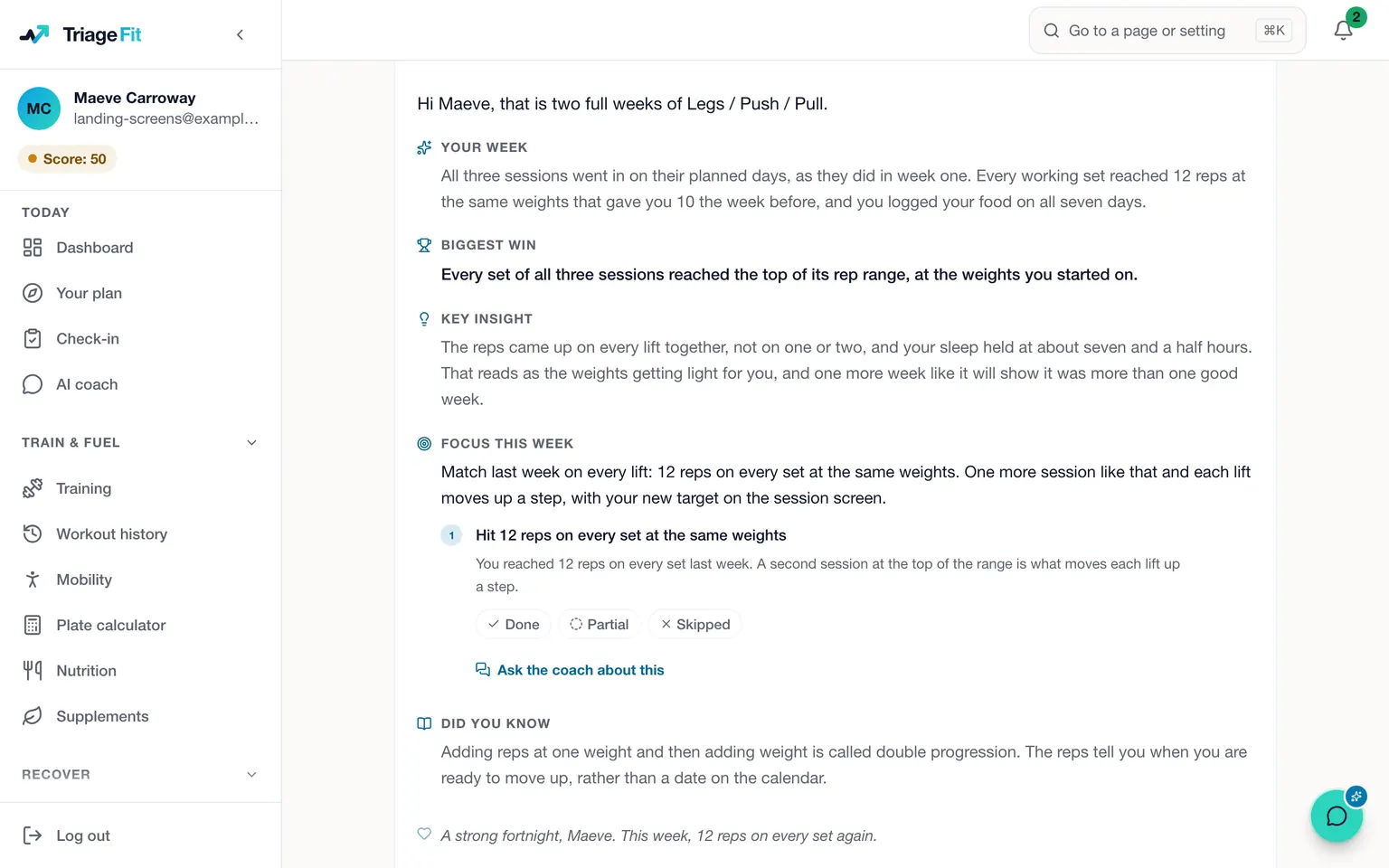
MacroFactor has no built-in portal for coaches. Instead, you can export your daily weight, calories and macros to a spreadsheet to send to a coach, and in the Manual style you set every target yourself and nothing is adjusted, the style MacroFactor suggests if you work with a nutrition coach. At TriageFit, the AI coach reads your weekly check-in inside the same account that holds your food and training logs. What the AI coach works from is 20+ years of coaching real clients, set out in coach-designed phases tailored to your goals, your equipment and your week.
The trial, cancelling and refunds
Each app starts with a 7-day free trial. You pay through the App Store or Google Play, and you cancel in your phone's app store, which is also where payment details are changed. A subscription bought on the App Store renews automatically unless you cancel at least 24 hours before the period ends, in your Apple account settings.
If you bought through Apple, a refund is requested from Apple, because MacroFactor cannot cancel, manage or refund an Apple purchase. If you bought through Google Play, a refund is available from Google Play within 48 hours of buying, and MacroFactor can refund a Google Play purchase itself if you email its support team. Stopping loses nothing you have logged, since your data stays when a subscription lapses, unless you delete it in the app, and you can come back with the same email address.
How TriageFit coaches you
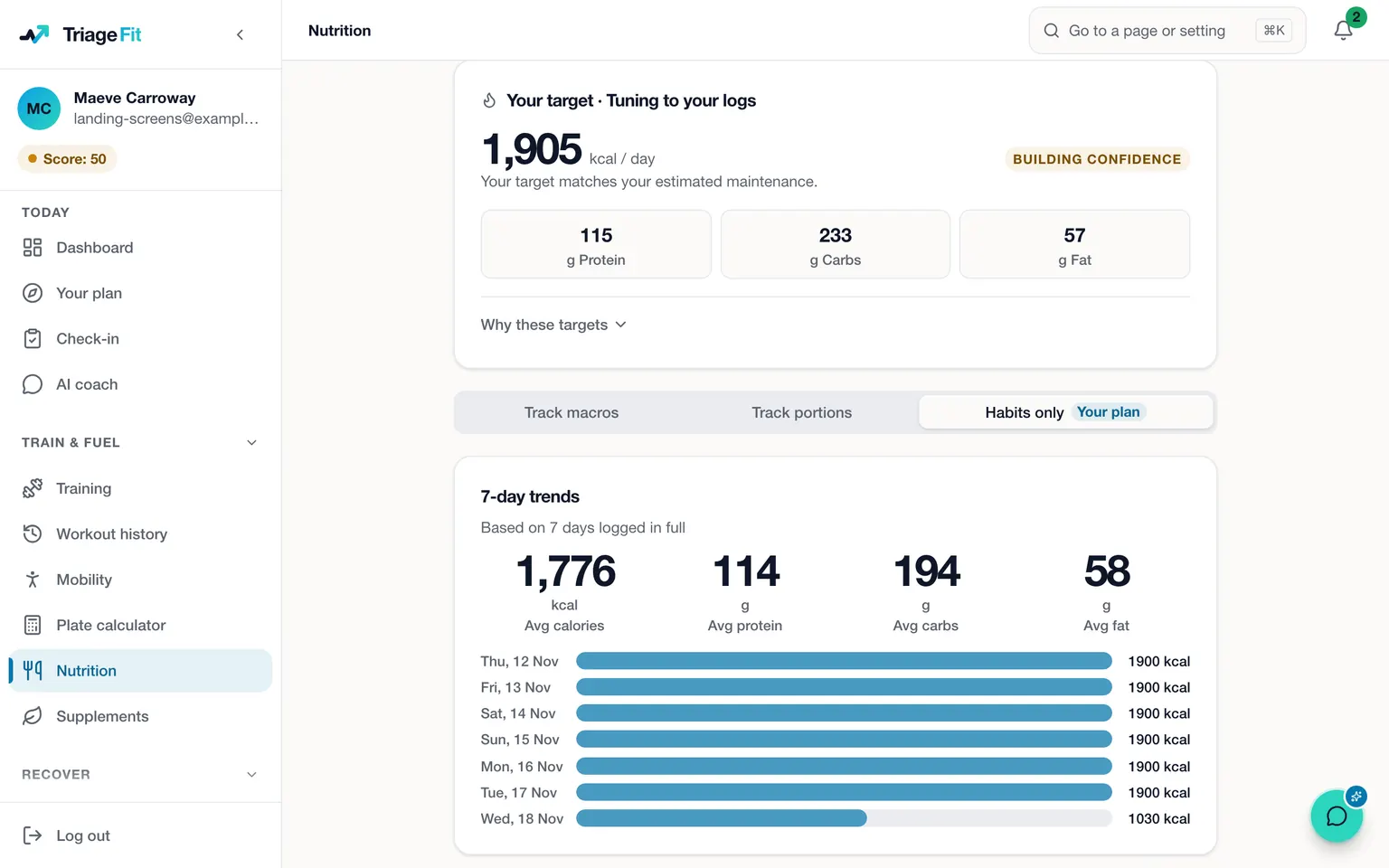
TriageFit coaches your food and your training in one account, with real coaches in your group. It starts with an intake of about half an hour, which you can save and finish later. From your answers you get a calorie target matched to your metabolism, with your protein spread across the day, and your macros are adjusted each week from your check-in. To log a meal, you search our food database, log a saved recipe as a serving or tap a meal you had recently to log it again, and a food that is not in the database can be added by name with its macros.
The same intake asks about your goal, your training history, your equipment, any injury you are working around and the days you can train. Your programme comes in phases our coaches wrote, each four to six weeks long, one following another for as long as you are a member, and the sessions are drawn from 494 exercises fitted to your equipment and your level. Every exercise has coaching cues, and the main lifts are on video.
Any injury you list is graded twice, once for how much it limits you, as mild, moderate or severe, and once for whether it is improving, about the same or getting worse. Where the injury is in one of the areas the programme screens, the shoulder, elbow, wrist, neck, lower back, hip, knee, ankle and foot among them, a severe grade, or a moderate one that is getting worse, takes the exercises that could aggravate it out of your sessions and puts other exercises for the same muscles in their place. A lighter grade leaves them in, each marked with a warning to keep to a pain-free range, stop the set rather than work through pain and let your coach know if the area is still sore the next day. A painful area you mark on the body map, in the intake's quick movement check, is read more strictly, and in those same areas it takes the exercises out however badly you score the pain, apart from a lower-back mark that your other answers in the check clear for hip hinging.
Your check-in comes once a week on the day you set. The calories and macros you logged that week are already filled in, beside your programme's sessions for the week, and you rate your energy, recovery, motivation, sleep and stress, with space for a note. The reply comes within seconds, and real coaches answer questions in your group. A week with too little logged leaves your targets where they were, and after a long stall a diet break at maintenance is offered, which starts once you confirm it.
The AI coach answers at any hour. It can shorten a session, swap an exercise, move a session to another day or set your protein and fat to the grams you name, with your calories unchanged, and nothing changes until you confirm it. For a lift you want checked, you film a set and a coach reviews it. You also join a group with coaches in it, where questions are answered in the open and there are challenges to take part in.
Your progress sits on the body page, where your weight is shown beside your waist, hip and chest measurements and your progress photos, with the trend over the weeks ahead of any single weigh-in. Data from Apple Health, Garmin, Whoop, Oura or Fitbit comes in as an export you upload, and your recovery readings adjust how hard your sessions ask you to work. TriageFit runs in your browser, so you can use it on your phone or on a computer.
From a cut to building muscle
Say you are an accountant in Limerick who has used MacroFactor's Collaborative style through a cut, and you now want to build muscle, with an AI coach reading your week. You join TriageFit, and in the intake you put down the rack, barbell and bench in your garage, a pair of adjustable dumbbells and the Tuesdays, Thursdays and Saturdays you can train, along with a right elbow that flares up with pull-ups, which you also mark on the body map.
Your programme puts a session on each of those days. Because the elbow is marked on the body map, pull-ups, chin-ups and barbell curls are set aside however you graded it, and other exercises for the same muscles fill their slots. With no cable machine in the garage, the dumbbell kickback can stay for your triceps in a lighter form, with a note to use a neutral grip, keep your elbows tucked in at your sides and stop just short of a hard lockout. In the first week you log the overnight oats you have most mornings, and from then on a tap on your recent meals logs them again. The beef chilli you batch-cook on a Sunday goes in as a recipe that logs as a serving. You are used to setting your own protein and fat, so you ask the AI coach to set both to the grams you have in mind. It proposes the change with your calories left as they were, and the new targets go in once you confirm it. In the third week you film a set of bench press, and a coach reviews it.
At your Friday check-in, the week's calories and macros are already filled in beside your three sessions. It is month-end at work, so you rate your stress high and say so in the note, and the reply is back within seconds. Your Garmin data goes in as an upload, and your recovery readings adjust the effort each session asks of you. On the body page, your chest measurement sits beside a weight trend that is rising slowly, as you hoped.
What TriageFit costs
In Ireland, TriageFit costs €50 every 4 weeks with VAT included, or €500 for the year, and MacroFactor charges $89.99 a year for both apps (checked 19 November 2026). In the UK it costs £45 every 4 weeks, and in the US $55. The block plan has no contract, so you can leave whenever you like, and you can pause for one to three months if work or an injury gets in the way.
Which one suits you
MacroFactor suits someone who wants to manage their own nutrition with an app, with photo and barcode logging and targets its algorithm adjusts each week, and its workout app adds a programme for their gym. TriageFit suits someone who wants their food and their training coached together, with an AI coach reading each weekly check-in and a coach reviewing the lifts they film, on a phone or a computer, for €50 every 4 weeks.
How to start
Choose a plan on the pricing page, create your account and pay, and the intake opens. Macro coaching explains how your targets are set and moved from week to week, and coaching for food and training together shows how the two fit in one programme. For another app's prices, what Noom costs covers its plans, and what a personal trainer costs puts TriageFit beside a trainer paid by the session.
Questions people ask
- How much does MacroFactor cost?
- The nutrition app costs $11.99 a month, $47.99 every six months or $71.99 a year, which works out at $5.99 a month on the yearly plan (prices checked 3 November 2026 and 19 November 2026). The workout app costs the same, and a bundle costs $89.99 a year for both apps, for anyone who started using MacroFactor on or after 1 January 2026. The prices are listed in US dollars on the page that prices both apps, and may vary with your local exchange rate and tax. TriageFit costs €50 every 4 weeks in Ireland with VAT included.
- Is there a free version of MacroFactor?
- MacroFactor has no free version, and no plan for one. Each app starts with a 7-day free trial, and a subscription bought on the App Store renews automatically unless you cancel at least 24 hours before the period ends, in your Apple account settings. There is also no lifetime plan or one-off payment. TriageFit begins with your first payment, and you can leave whenever you like, since the block plan has no contract.
- Does MacroFactor charge in euro?
- MacroFactor's prices are listed in US dollars on the page that prices both apps, and may vary with your local exchange rate and tax. Its listing on the Irish App Store also quotes them in US dollars only. TriageFit is priced in euro, at €50 every 4 weeks with VAT included, or €500 for the year, and in the UK it is £45 every 4 weeks.
- How do I cancel MacroFactor and get a refund?
- You cancel in your phone's app store, which is also where payment details are changed. If you bought through Apple, a refund is requested from Apple, because MacroFactor cannot cancel, manage or refund an Apple purchase. If you bought through Google Play, a refund is available from Google Play within 48 hours of buying, and MacroFactor can refund a Google Play purchase itself if you email its support team. With TriageFit there is no contract on the block plan, and a break of one to three months can be taken as a pause instead of cancelling.
- Does MacroFactor include workouts?
- Training is in MacroFactor's second app, the workout app, which builds a programme fitted to your goals, your level and your gym's equipment, whose progressive overload adjusts itself and tells you when to add reps or weight. It costs $11.99 a month, $47.99 every six months or $71.99 a year, the same as the nutrition app, and the bundle costs $89.99 a year for both apps (checked 19 November 2026). TriageFit coaches your food and your training in one account, for €50 every 4 weeks in Ireland.
- What does TriageFit include for the price?
- For €50 every 4 weeks in Ireland, with VAT included, your food and training are coached in one account. You get a calorie target matched to your metabolism, macros adjusted each week and a programme in phases of four to six weeks that our coaches wrote, fitted to your equipment and any injury. The AI coach reads your weekly check-in and answers it within seconds, any set you film gets a coach's review, and the AI coach can move a session or reset your protein and fat, with nothing changing until you confirm it.
Sources
- MacroFactor, the nutrition app, checked 3 November 2026
- MacroFactor, what the workout app costs, checked 19 November 2026
- MacroFactor on the App Store (Ireland), checked 24 September 2026
- MacroFactor help, subscriptions and bundles, checked 24 September 2026
- MacroFactor help, lifetime subscriptions, checked 24 September 2026
- MacroFactor help, changing the subscription length, checked 24 September 2026
- MacroFactor help, programme styles, checked 3 November 2026
- MacroFactor help, check-ins, checked 3 November 2026
- MacroFactor help, integrations, checked 24 September 2026
- MacroFactor, the workout app, checked 3 November 2026
- MacroFactor help, refunds, checked 3 November 2026
- MacroFactor help, managing a subscription, checked 3 November 2026
MacroFactor, Garmin, Whoop, Oura and Noom are trademarks of their owners. TriageFit is independent of each of them, and none of them has reviewed or endorsed this page.
Read next
- What MyFitnessPal Premium costs, and where coaching comes inMyFitnessPal Premium's prices in euro and sterling, what it adds to the free app, how its trial and refunds work, and what TriageFit's coaching costs.
- What Fitbod costs, and how its trial, cancelling and refunds workFitbod costs from €13.49 a month or €81.99 a year on the Irish App Store. How its trial, cancelling and refunds work, and what TriageFit costs.
- What Trainwell costs a month, and what a trainer of your own comes withTrainwell costs $149 a month, billed in three-month increments. What the price covers, how the free trial and cancelling work, and how TriageFit compares.
- How much does a personal trainer cost, and what does the same money buy?What a personal trainer costs for a session, a package and four weeks in Ireland, the UK and the US, and what the same money buys with TriageFit.