MacroFactor vs MyFitnessPal: database, targets and price
MacroFactor vs MyFitnessPal sets a tracker with no free version beside one with a free tier, and this page compares both from their own pages. TriageFit is €50 every 4 weeks with VAT included, for macros adjusted each week inside a coach-designed training programme.
By TriageFit · Published
MacroFactor and MyFitnessPal are both food-tracking apps. This MacroFactor vs MyFitnessPal comparison reads each app's own help centre, terms and App Store listing on the dates in the sources.
MacroFactor and MyFitnessPal at a glance
| MacroFactor | MyFitnessPal | |
|---|---|---|
| Free version | no free version, and no plan for one | tracking for your food, your weight and your exercise |
| Food database | Barcodes in the US, Canada, the UK, Australia, Ireland, New Zealand, Japan, France and Spain | more than 20.5 million foods, restaurant dishes among them |
| How the target changes | the app's algorithm reviews your progress and recommends raising or lowering your calorie and macro targets, and you can turn the recommendation down | recommends weighing in about once a week, and each new weight you log adjusts your calorie goal to it |
| Monthly | $11.99 a month (checked 19 November 2026) | €19.99 a month in Ireland (checked 3 November 2026) |
| Yearly | $71.99 a year (checked 3 November 2026) | €79.99 a year in Ireland (checked 3 November 2026) |
| Ads | no ads, and MacroFactor says it never sells your data | Premium adds barcode and meal scanning, voice logging, macro tracking with goals of your own, logging without ads, intermittent fasting, and insights into your food with comparisons |
Getting food in
MacroFactor has logging from a photo with AI, barcode and food-label scanners, recipes imported from a web address, speech-to-text, custom foods and recipes, and copy and paste. It handles low-carb, keto, carb-focused and balanced diets, different macros on different days, and fasting days.
MyFitnessPal's database holds more than 20.5 million foods, restaurant dishes among them. On the free version you can add recipes by typing them in, from a web address or by importing several at once, and free also includes measurements and your past progress, your own foods, meals and recipes, a view of your macros, diary sharing and partner apps. Premium adds barcode and meal scanning, voice logging, macro tracking with goals of your own, logging without ads, intermittent fasting, and insights into your food with comparisons, and with Premium you can log the same food on up to 7 days at once.
How the targets are set and changed
MacroFactor works out how much energy you burn from the calories you log and the change in your trend weight, and it does not use expenditure data from smartwatches or activity trackers, which it says estimate expenditure poorly. There is a weekly check-in on a day you choose, and at that check-in the app's algorithm reviews your progress and recommends raising or lowering your calorie and macro targets, and you can turn the recommendation down. You choose between three programme styles, Coached, Collaborative and Manual.
MyFitnessPal sets you a daily net calorie goal from your fitness profile. It recommends weighing in about once a week, and each new weight you log adjusts your calorie goal to it. It connects to more than 35 apps and fitness devices, among them Apple Watch, Fitbit, Garmin, Samsung Health, Google Fit, Health Connect and smart scales, which bring in your steps, calories burned, weight and sleep, and it adds calories to your day when the tracker expects you to burn more than MyFitnessPal's own estimate. On the free version, macro goals are set as percentages, in steps of five, while Premium lets you set macro goals in grams or as percentages, give each day of the week its own goals, quick-log the carbs, fat, protein and calories of a meal, and follow your progress on the dashboard.
So MacroFactor's target comes from your own intake and weight trend, while MyFitnessPal's starts from your profile and can move with a fitness tracker.
The AI help in each
MyFitnessPal has an AI nutrition assistant, still rolling out, for Premium and Premium+ members on iPhone, in English, in the US, the UK, Ireland, Canada, Australia and New Zealand. It uses your diary for today and the last couple of weeks, your calorie and macro goals, your saved meals and recipes, MyFitnessPal's food database and recipes, and your steps. MyFitnessPal says it cannot log food for you or see your weight history yet, and it cannot edit your goals, which you change yourself in the Goals section of the settings.
MacroFactor's recommendations come from its algorithm at the weekly check-in. It has no built-in portal for coaches.
What each costs
MacroFactor lists $11.99 a month, $47.99 every six months or $71.99 a year, after a 7-day free trial (prices checked 3 November 2026 and 19 November 2026). MacroFactor lists its prices in US dollars on the page that prices both apps, and may vary with your local exchange rate and tax. What MacroFactor costs has every plan.
MyFitnessPal Premium in Ireland is €19.99 a month or €79.99 a year, and in the UK £15.99 or £64.99 (prices checked 25 September 2026 and 3 November 2026). There is a 7-day free trial, open to anyone who has not had Premium or a Premium trial before. MyFitnessPal notes that going back to the free version keeps your logs, recipes and progress history, and you lose only the paid features. What MyFitnessPal Premium costs covers each tier.
Food and training planned together
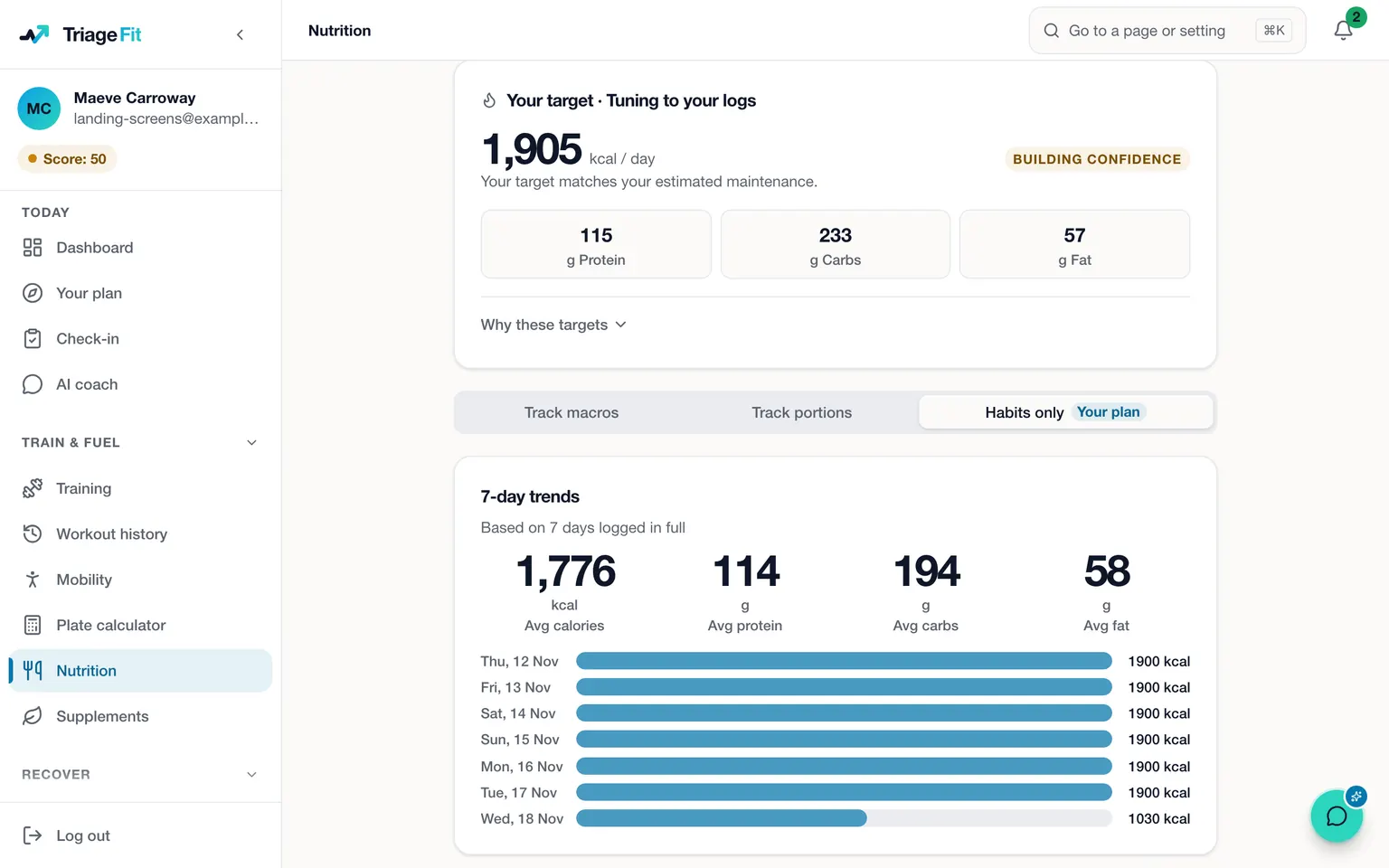
TriageFit plans food and training together. It begins with an intake of about half an hour that saves as you go, covering your goal, your training background, your equipment, the days you can train and any injuries, graded mild, moderate or severe.
You get a calorie target matched to your metabolism, protein spread across your day, and phases of training of four to six weeks that our coaches designed and fitted to you. You log food from the database, your recent meals, saved recipes or a named food with its macros. Your history comes across from a MyFitnessPal, MacroFactor or Cronometer export.
On the check-in day you choose, the check-in opens with your food and sessions filled in. You rate energy, recovery, sleep, stress and motivation, a reply arrives within seconds, and the AI coach reads it. Your macros adjust for the week ahead. The AI coach works from 20+ years of coaching real clients and is there at any hour.
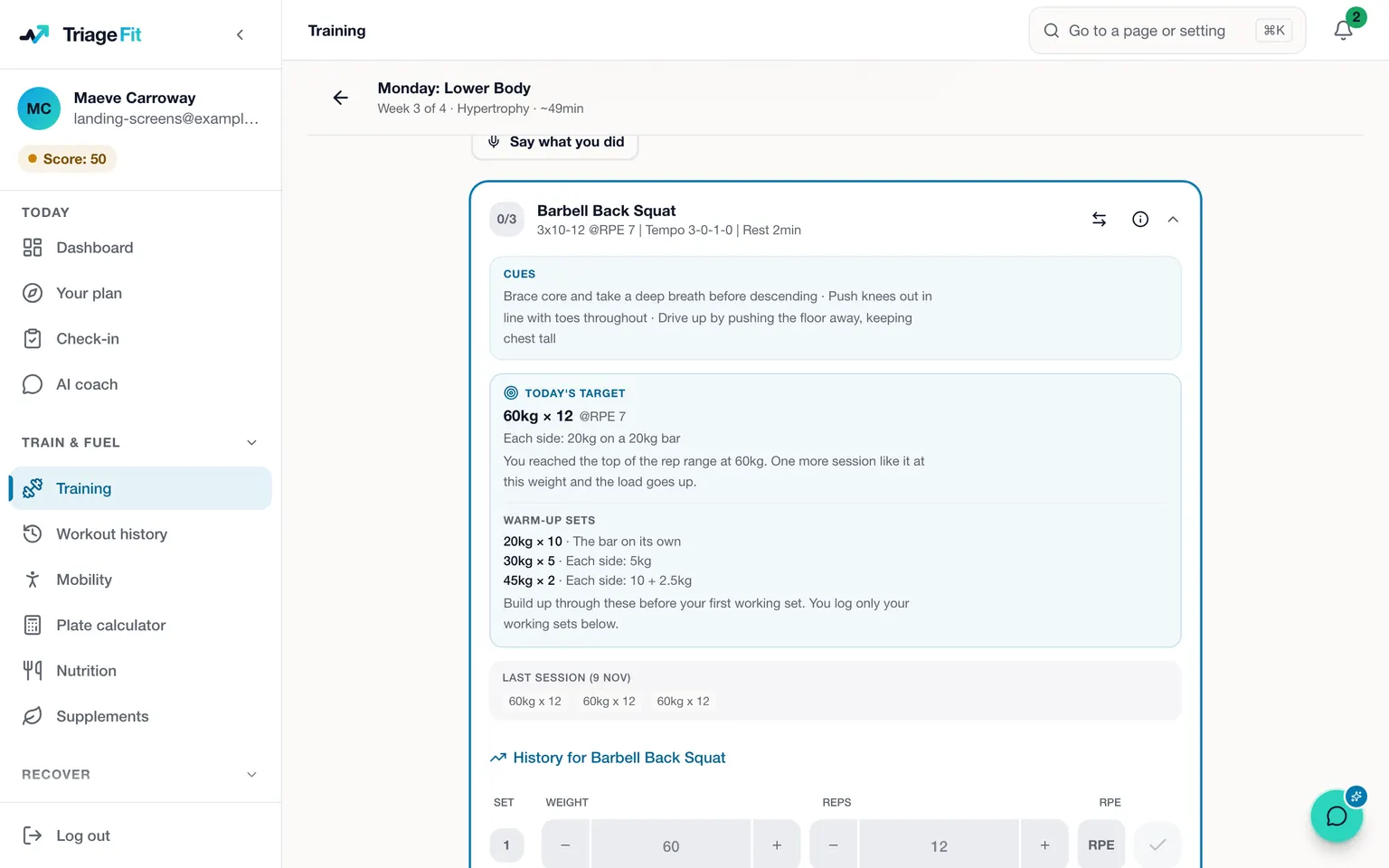
In the gym, every session suggests your next weight and reps from your logs, and the loads hold when your daily check-ins show poor sleep or stress. There are 494 exercises, each with coaching cues and the main lifts on video, and a coach reviews any set you film.
A retail manager in Derry
Picture a retail manager in Derry who has logged food on and off for six years, switching between trackers each January. The logging was never the problem. What kept stalling was the gym, where they ran the same three sessions for two years.
On TriageFit, they import their food history, and the intake records four days at a gym near the shop and a mild knee. Their first phase works around the knee, and when the run-up to Christmas cuts their sleep, the check-in shows it and the AI coach holds the loads that week.
Which to choose
Choose MacroFactor if you want targets that adapt from your own data and you are happy to pay from the start. Choose MyFitnessPal if you want a large database and a free tier to begin with. Choose TriageFit if you want food and training planned together and read each week. TriageFit vs MyFitnessPal and TriageFit vs MacroFactor go into each in detail, and the MacroFactor review looks at MacroFactor on its own.
TriageFit's price
TriageFit is €50 every 4 weeks in euro with VAT included, £45 in the UK and $55 in the US, or €500, £450 or $550 a year. There is no free trial, so coaching starts with your first payment. The block plan has no contract, you cancel in the app, and you can pause for one to three months. Choose a plan on the pricing page.
Questions people ask
- Is MacroFactor better than MyFitnessPal?
- They suit different people. MacroFactor works out how much energy you burn from the calories you log and the change in your trend weight and has a weekly check-in on a day you choose, and it has no free version, and no plan for one. MyFitnessPal's free version includes tracking for your food, your weight and your exercise, its database holds more than 20.5 million foods, restaurant dishes among them, and Premium adds barcode and meal scanning, voice logging, macro tracking with goals of your own, logging without ads, intermittent fasting, and insights into your food with comparisons.
- Is MyFitnessPal free?
- MyFitnessPal has a free version, with tracking for your food, your weight and your exercise. Premium adds barcode and meal scanning, voice logging, macro tracking with goals of your own, logging without ads, intermittent fasting, and insights into your food with comparisons.
- Can I move my MacroFactor or MyFitnessPal data to TriageFit?
- Yes. TriageFit imports exports from MyFitnessPal, MacroFactor and Cronometer, so your food history comes across. Your calorie target is matched to your metabolism and your macros change after each weekly check-in.
- Does TriageFit include training?
- Yes. You get phases of training our coaches designed, fitted to your intake, with each session suggesting your next weight and reps from your logs. A coach reviews any set you film, and the AI coach reads every weekly check-in.
Sources
- MacroFactor, the nutrition app, checked 3 November 2026
- MyFitnessPal Premium, prices and features, checked 25 September 2026
- MyFitnessPal on the App Store (Ireland), checked 25 September 2026
- MacroFactor help, check-ins, checked 3 November 2026
- MyFitnessPal help, how the app works, checked 25 September 2026
- MyFitnessPal help, the free version, checked 25 September 2026
- MyFitnessPal help, what each tier includes, checked 25 September 2026
- MacroFactor help, programme styles, checked 3 November 2026
- MyFitnessPal help, calorie adjustments, checked 25 September 2026
- MyFitnessPal help, the nutrition assistant, checked 25 September 2026
- MacroFactor, what the workout app costs, checked 19 November 2026
MacroFactor, MyFitnessPal, Garmin and Cronometer are trademarks of their owners. TriageFit is independent of each of them, and none of them has reviewed or endorsed this page.
Read next
- Hevy app review: the workout logger, Pro and what it costsA Hevy app review from Hevy's own pages: what the free logger and Pro do, what Pro costs, and the step to take when you want the programme written for you.
- MacroFactor review: how its adaptive targets work, and what it costsA MacroFactor review from its own pages: how the adaptive targets and weekly check-in work, what it costs, and what changes with a coached programme too.
- Hevy vs Strong: logging, limits and price side by sideHevy vs Strong from their own pages: logging, free limits, Pro features and prices side by side, and where a coached programme differs.
- How much does a personal trainer cost, and what does the same money buy?What a personal trainer costs for a session, a package and four weeks in Ireland, the UK and the US, and what the same money buys with TriageFit.