MacroFactor review: how its adaptive targets work, and what it costs
This MacroFactor review reads MacroFactor's own help pages and store listing to explain how its targets adapt, how the weekly check-in works and what each plan costs. TriageFit is €50 every 4 weeks with VAT included, for macros that adjust each week inside a coach-designed training programme, with an AI coach reading every check-in.
By TriageFit · Published
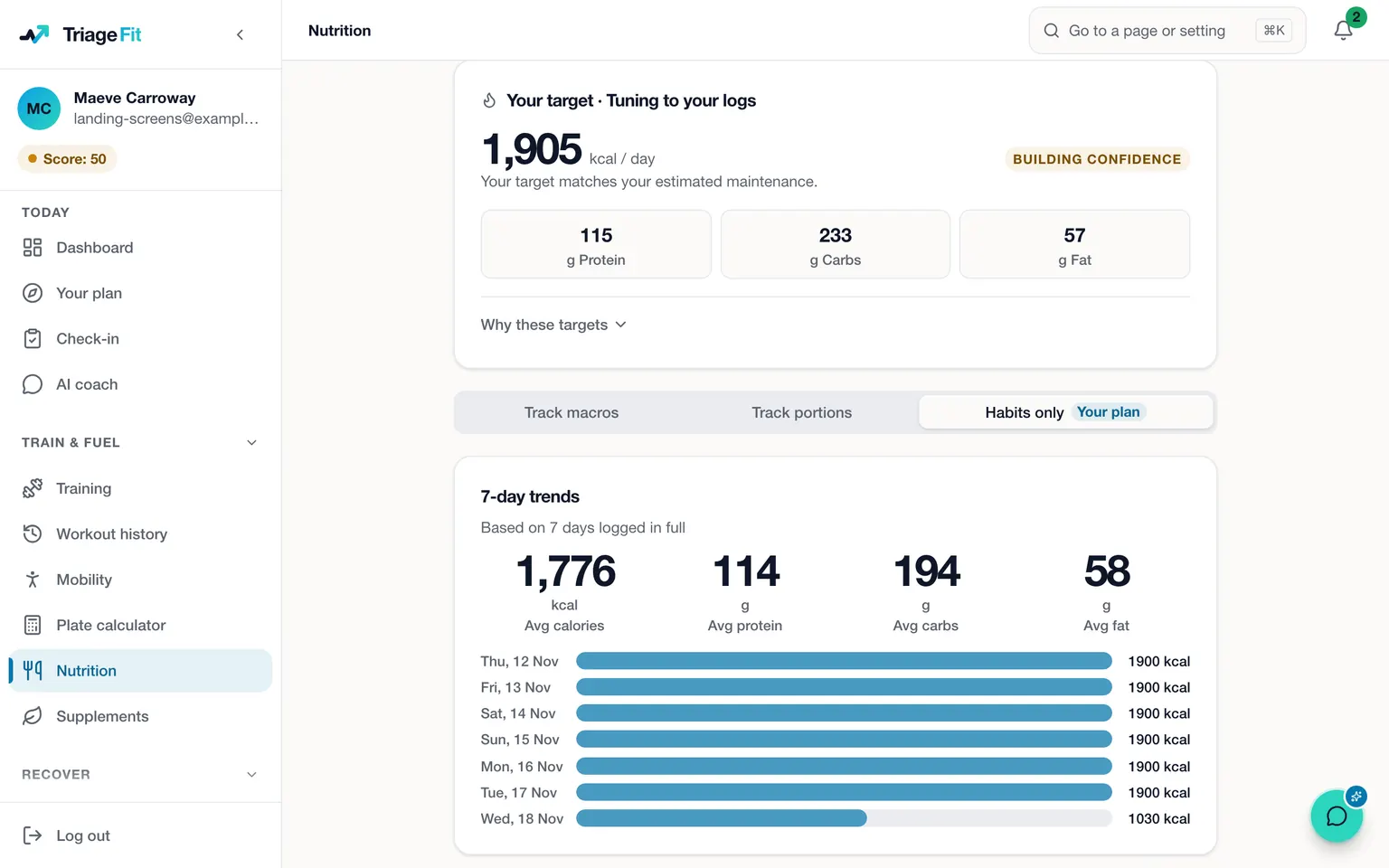
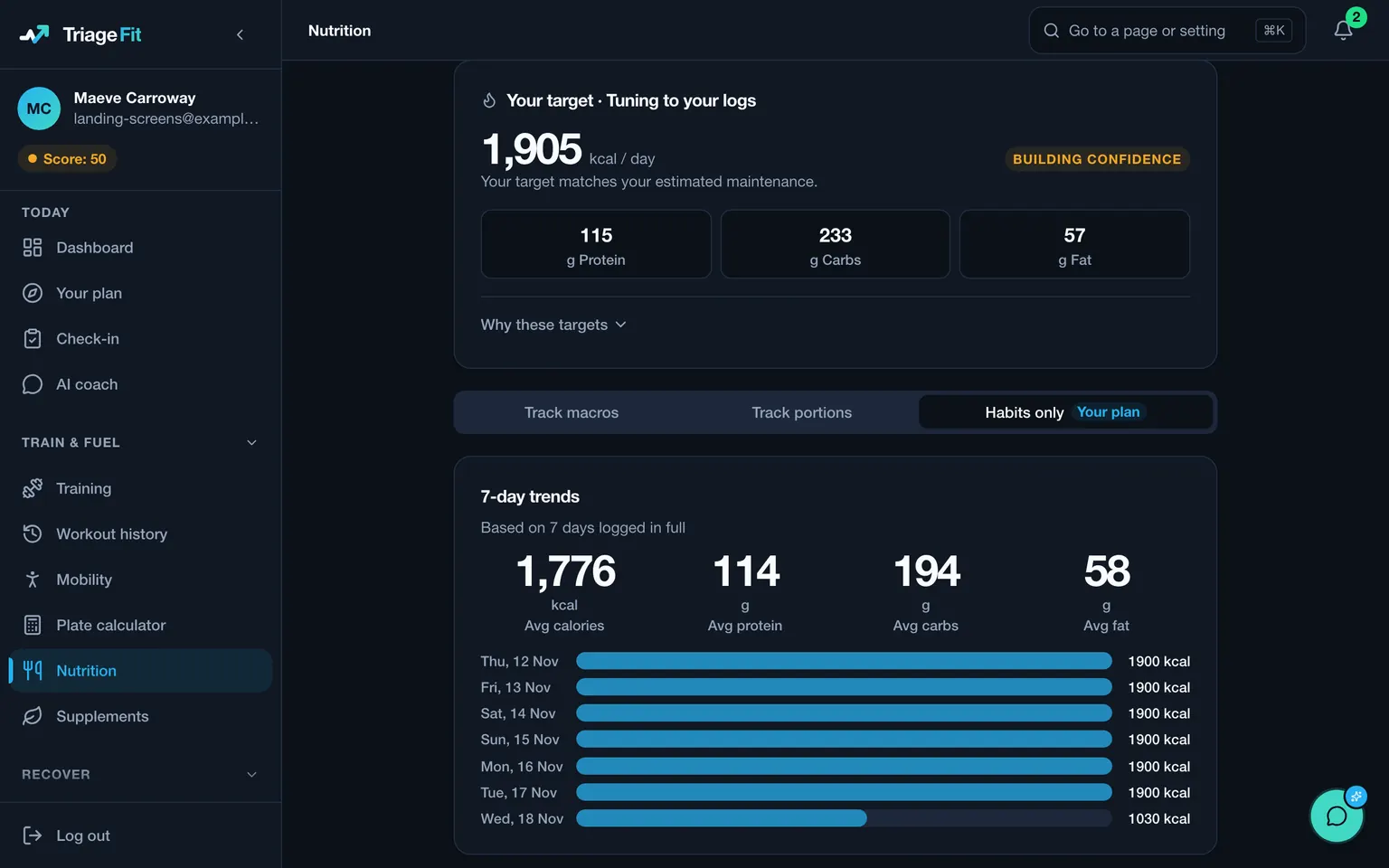
MacroFactor is a food-tracking app. This review sticks to what MacroFactor says about itself on its website, in its help centre and in its App Store listing, on the dates in the sources. It covers how the adaptive side works, the three programme styles, what you pay and how it works with a coach, and then what changes when the food sits inside a coached training programme.
How MacroFactor's adaptive targets work
MacroFactor works out how much energy you burn from the calories you log and the change in your trend weight. It does not use expenditure data from smartwatches or activity trackers, which it says estimate expenditure poorly. You set bulking, cutting or maintaining, with an estimate of when you will reach your goal.
There is a weekly check-in on a day you choose. At the check-in, the app's algorithm reviews your progress and recommends raising or lowering your calorie and macro targets, and you can turn the recommendation down. MacroFactor also shows no warnings or red numbers when you eat over your target.
The three programme styles
MacroFactor offers three programme styles, Coached, Collaborative and Manual. In Coached, the app sets your targets from your goals, what you eat and your trend weight, adjusts them each week, and keeps a calorie floor and a sensible amount of fat. In Collaborative, the app sets your calories for the week and you set the daily targets yourself, with no calorie floor or fat safeguard. In Manual, you set every target yourself and nothing is adjusted, the style MacroFactor suggests if you work with a nutrition coach. You can switch styles at any time without losing any data.
Logging and tracking
For getting food in, MacroFactor has logging from a photo with AI, barcode and food-label scanners, recipes imported from a web address, speech-to-text, custom foods and recipes, and copy and paste. Barcode scanning covers the US, Canada, the UK, Australia, Ireland, New Zealand, Japan, France and Spain. It handles low-carb, keto, carb-focused and balanced diets, different macros on different days, and fasting days, and tracks macros, weight, habits, micronutrients, body measurements, progress photos and steps.
It links to Apple Health and Google's Health Connect, reading and writing your nutrition and weight and reading your steps. The app has no ads, and MacroFactor says it never sells your data. It also has no version for a computer yet, which it says is planned.
What MacroFactor costs
MacroFactor has no free version, and no plan for one. The plans are $11.99 a month, $47.99 every six months or $71.99 a year, after a 7-day free trial (prices checked 3 November 2026 and 19 November 2026). MacroFactor lists its prices in US dollars on the page that prices both apps, and may vary with your local exchange rate and tax, and there is no lifetime plan or one-off payment. You cancel in your phone's app store, which is also where payment details are changed. What MacroFactor costs has every plan, including the bundle.
MacroFactor Workouts
MacroFactor now has a second app for training. MacroFactor Workouts offers a programme fitted to your goals, your level and your gym's equipment, whose progressive overload adjusts itself and tells you when to add reps or weight. It has more than 900 exercises with tips, cues and technique videos, and gym profiles, a custom programme builder, smart swaps, rest timers, a plate calculator, warm-up suggestions, and trackers for personal records and volume. Each app is $11.99 a month, $47.99 every six months or $71.99 a year, or $89.99 a year for both apps, for anyone who started using MacroFactor on or after 1 January 2026 (checked 19 November 2026).
So the food and the lifting can both come from MacroFactor, as two apps you run side by side.
MacroFactor and coaches
MacroFactor has no built-in portal for coaches, and if you work with a coach you can export your daily weight, calories and macros to a spreadsheet to send to a coach.
Food and training in one coached plan
TriageFit puts both in one plan and has a coach read it. You start with an intake of about half an hour that saves as you go. It asks about your goal, how long you have been training, your equipment, the days you can train and any injuries, graded mild, moderate or severe.
From that you get a calorie target matched to your metabolism, with protein spread across your day, and phases of training of four to six weeks that our coaches designed and fitted to you. Your MacroFactor history comes with you, as TriageFit imports a MacroFactor export, along with MyFitnessPal and Cronometer.
Each week, on the day you pick, your check-in opens with your food and sessions already filled in. You rate energy, recovery, sleep, stress and motivation and get a reply within seconds. The AI coach reads it, and your macros change for the week ahead. The AI coach draws on 20+ years of coaching real clients, and it can move, shorten or swap a session once you say yes.
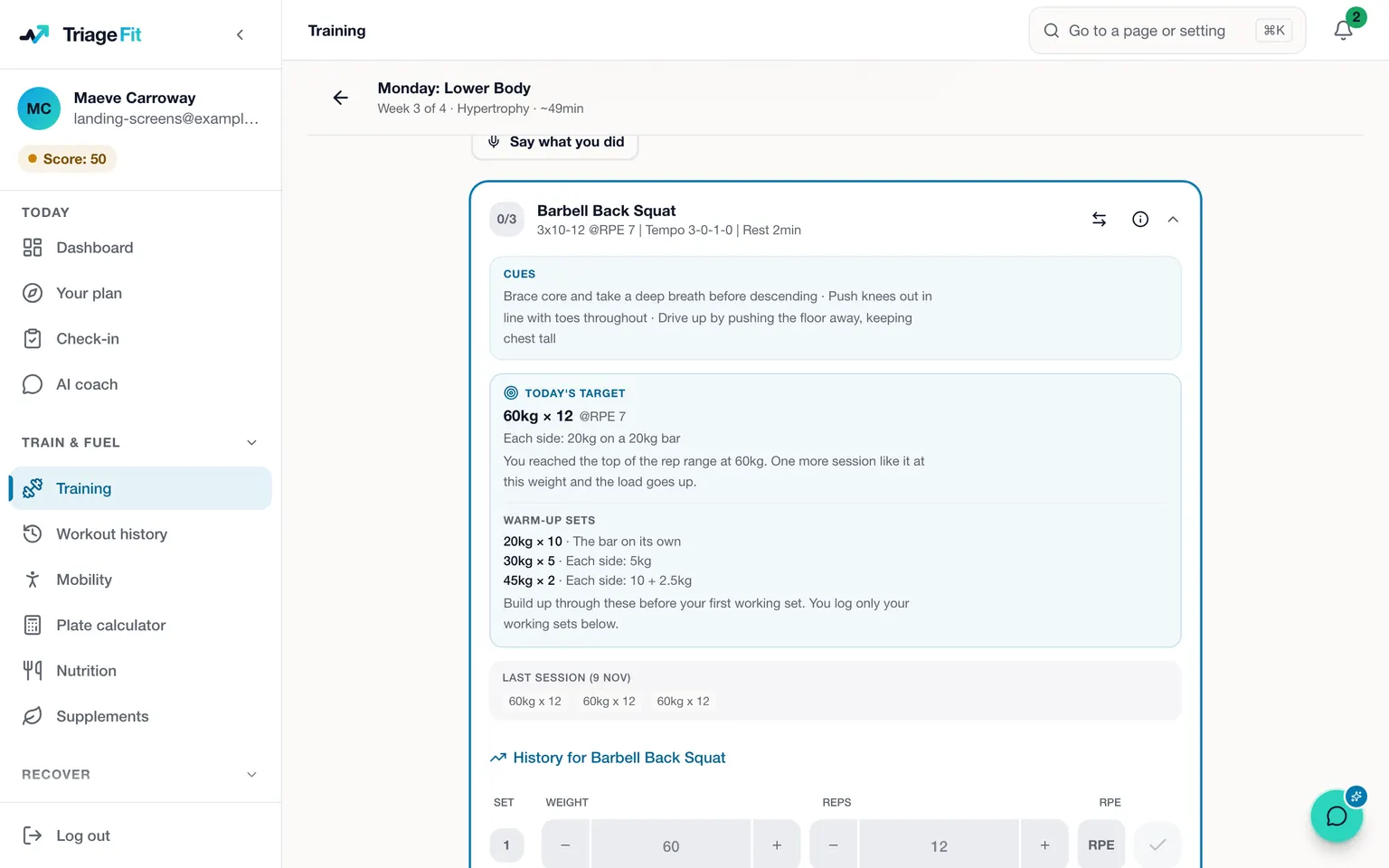
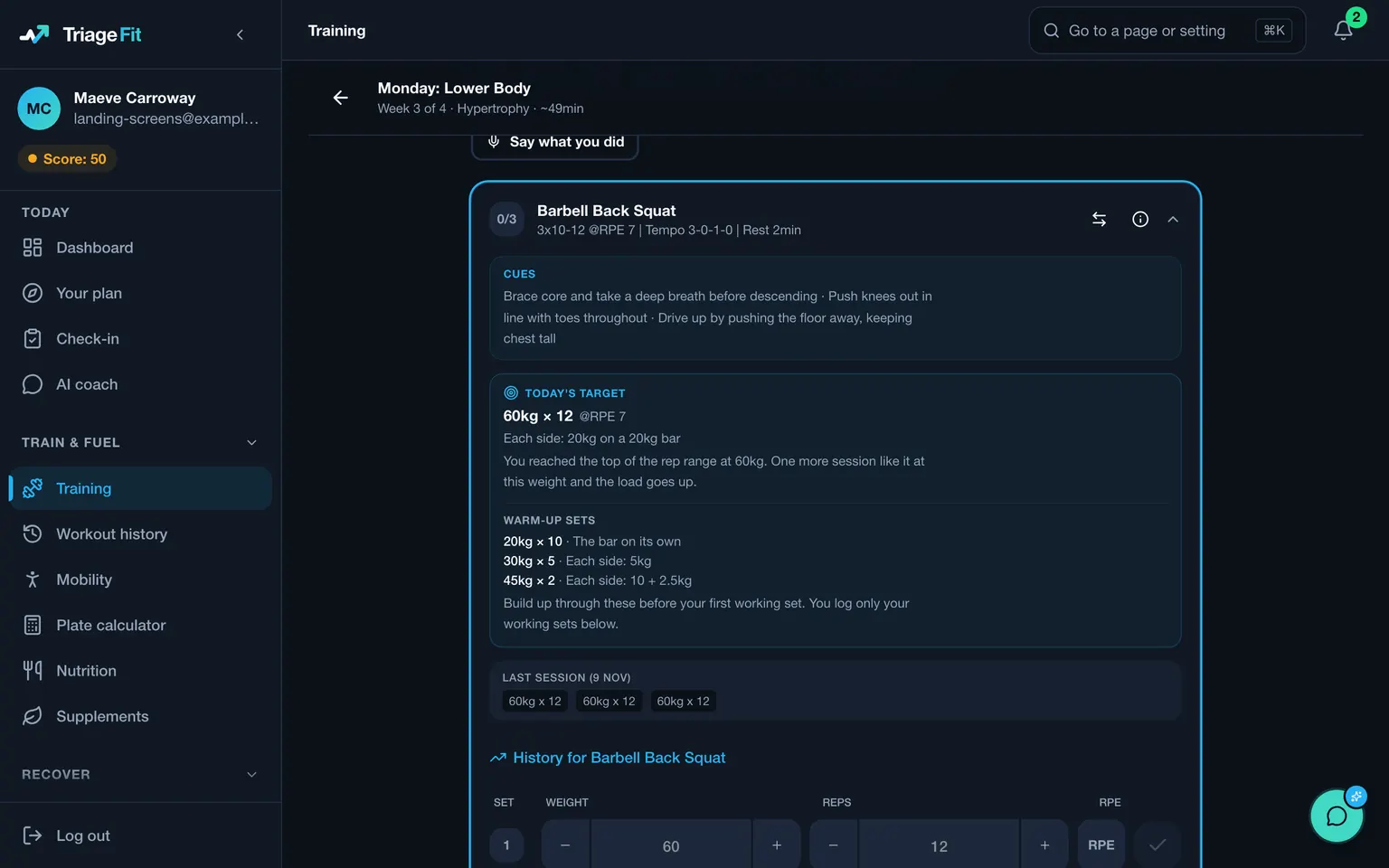
In the gym, each session suggests the next weight and reps from your logs, and the loads hold when your daily check-ins show poor sleep or stress. There are 494 exercises with coaching cues and the main lifts on video, and a coach reviews any set you film.
A civil engineer in Waterford
Picture a civil engineer in Waterford who has tracked every meal in an adaptive tracker for a year and lost the weight they set out to lose. Now they want to build muscle, and they have been running a programme copied from a forum. The food numbers are tidy, while the training has no plan behind it.
On TriageFit, they import their food history, and the intake records three mornings at a gym before work. When a site visit week cuts sleep short, the check-in shows it, the loads hold, and the AI coach sees the food and the sessions side by side.
MacroFactor or TriageFit
Stay with MacroFactor if you want an adaptive food tracker and are happy to plan your training yourself or in a second app. Move to TriageFit if you want food and training in one coach-designed plan, read each week by an AI coach. TriageFit vs MacroFactor compares them in detail, and MacroFactor vs MyFitnessPal sets it beside a bigger tracker.
TriageFit's price
TriageFit is €50 every 4 weeks in euro with VAT included, £45 in the UK and $55 in the US, or €500, £450 or $550 a year, with food and training both included. There is no free trial, so coaching starts with your first payment. The block plan has no contract, you cancel in the app, and you can pause for one to three months. See the pricing page to start.
Questions people ask
- Is MacroFactor worth it?
- That depends on what you want from it. MacroFactor works out how much energy you burn from the calories you log and the change in your trend weight, and it has a weekly check-in on a day you choose. It has no free version, and no plan for one, and no built-in portal for coaches. TriageFit adjusts your macros each week inside a coach-designed training programme.
- How much does MacroFactor cost?
- MacroFactor lists $11.99 a month, $47.99 every six months or $71.99 a year in US dollars, after a 7-day free trial (prices checked 3 November 2026 and 19 November 2026). TriageFit is €50 every 4 weeks in euro with VAT included, for food and training together.
- Can I bring my MacroFactor data into TriageFit?
- Yes. TriageFit imports a MacroFactor export, as well as exports from MyFitnessPal and Cronometer, so your food history comes across. Your calorie target is matched to your metabolism, and your macros change after each weekly check-in.
- Does MacroFactor work with a coach?
- MacroFactor has no built-in portal for coaches. In its Manual style, you set every target yourself and nothing is adjusted, the style MacroFactor suggests if you work with a nutrition coach. You can export your daily weight, calories and macros to a spreadsheet to send to a coach. On TriageFit, the AI coach reads every weekly check-in.
Sources
- MacroFactor, the nutrition app, checked 3 November 2026
- MacroFactor help, check-ins, checked 3 November 2026
- MacroFactor on the App Store (Ireland), checked 24 September 2026
- MacroFactor help, programme styles, checked 3 November 2026
- MacroFactor help, integrations, checked 24 September 2026
- MacroFactor, what the workout app costs, checked 19 November 2026
- MacroFactor help, lifetime subscriptions, checked 24 September 2026
- MacroFactor help, managing a subscription, checked 3 November 2026
- MacroFactor, the workout app, checked 3 November 2026
MacroFactor, MyFitnessPal and Cronometer are trademarks of their owners. TriageFit is independent of each of them, and none of them has reviewed or endorsed this page.
Read next
- Hevy vs Strong: logging, limits and price side by sideHevy vs Strong from their own pages: logging, free limits, Pro features and prices side by side, and where a coached programme differs.
- Gravl vs Fitbod: how two AI workout apps plan your trainingGravl vs Fitbod from their own pages: how each builds the plan, what changes from one session to the next, what each costs, and where coaching comes in.
- Cronometer vs MacroFactor: nutrient detail or adaptive targetsCronometer vs MacroFactor from their own pages: nutrient detail against adaptive targets, what each plan costs, and where coached training fits beside.
- How much does a personal trainer cost, and what does the same money buy?What a personal trainer costs for a session, a package and four weeks in Ireland, the UK and the US, and what the same money buys with TriageFit.