Fitbod app review: how its AI builds your workouts
This Fitbod app review reads Fitbod's own help pages and store listings to explain how its AI picks exercises and loads, what a subscription costs, and what its terms say about advice. TriageFit is €50 every 4 weeks with VAT included, for coach-designed training phases, food targets adjusted weekly and an AI coach reading every check-in.
By TriageFit · Published
Fitbod is an AI workout app, and the question most people bring to a Fitbod app review is simple: does the AI actually make good workouts? The fairest way to answer is from Fitbod's own explanation of how it works. This page reads Fitbod's help centre, terms and App Store listing on the dates in the sources. It covers how the plan is built, how it changes, what it costs and what its terms say about advice, and then where TriageFit fits.
How Fitbod builds a workout
Fitbod builds each workout from the settings in your plan and the training you have already logged. The settings are your goal, your experience level, your equipment, your training split and your workout preferences. To choose exercises it uses data on how well exercises work from millions of logged workouts, filtered by your equipment, shaped by your feedback and limited to the muscles that have recovered.
It is built for resistance and strength training, with goals for strength, muscle growth, circuit training, general fitness, powerlifting and Olympic weightlifting. You pick how long a workout lasts, such as 30, 45 or 60 minutes. Each exercise comes with a recorded video and step-by-step written cues, and you can swap any exercise, and the app learns your preferences from what you change.
How the plan changes from session to session
Fitbod adds weight or reps when you finish an exercise comfortably and eases off after a set you struggle with. It varies intensity and volume from one session to the next on purpose, with some days lighter and higher in reps and others heavier. It gives each muscle group a recovery percentage between 0 and 100, based on what you have logged, and favours the fresher muscles, and it schedules max-effort days from time to time to check where your strength is.
For someone new, it starts new users on cautious sets, reps and weights estimated from millions of logged workouts, then adjusts as they log. It suggests lighter weights after a break from training, and every exercise you skip, replace, delete or add feeds into the next workout it builds. Progress shows as personal records, estimated strength, volume trends and streaks.
What Fitbod costs
The App Store in Ireland lists ten in-app purchases, from €7.99 to €99.99 (checked 4 November 2026). Its monthly plans read €13.49 and €17.99, and its yearly plans €81.99 and €99.99. On Fitbod's website the plans are $15.99 a month or $95.99 a year, and Fitbod charges in US dollars, and your bank converts the charge (checked 25 September 2026). There is a 7-day free trial when you first sign up, with nothing charged until it ends.
After the trial, you can still look back at past workouts, but logging a new one or generating a workout from your history needs a subscription. Fitbod also sells a Duo plan for two people and a Family plan for up to five, at $159.99 and $359.99, and family plans are sold as yearly subscriptions only. What Fitbod costs has every price (checked 19 November 2026).
What Fitbod's terms say about advice
Fitbod's terms say it does not work as a personal trainer and does not give medical or fitness advice, and they present the app as free general information, and ask you not to act on its suggestions until you have checked with a trainer in your area or made sure they are safe for you. For questions, it has fitness trainers who answer strength training questions by email.
Where TriageFit fits
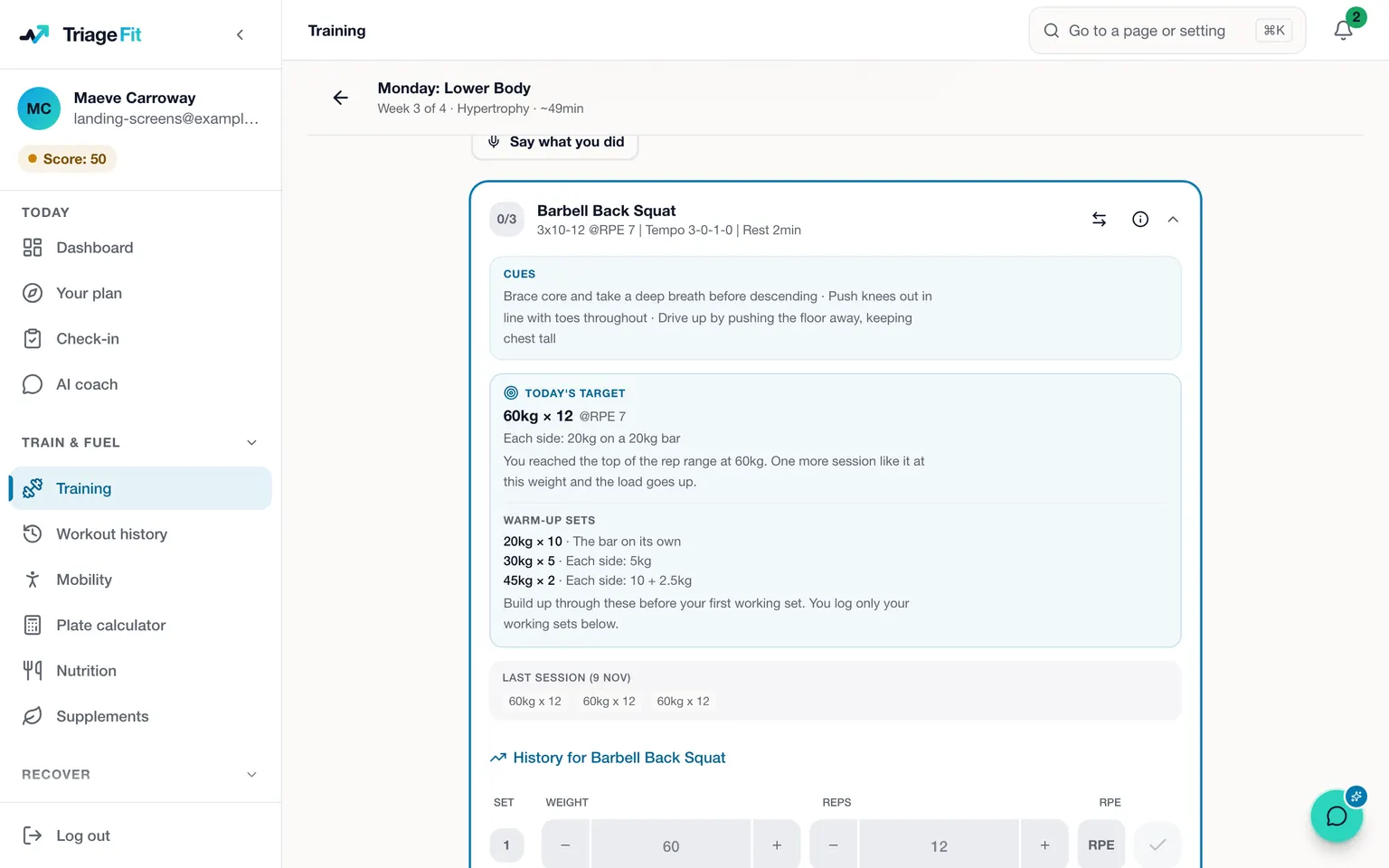
TriageFit is for someone who likes the idea of an app planning the training but also wants the food, the form and the weekly read. It starts with an intake of about half an hour, saved as you go, covering your goal, your lifting history, your equipment, the days you can train and any injuries, each graded mild, moderate or severe.
TriageFit gives you phases of four to six weeks that our coaches designed, fitted to your intake, so you can see next week's sessions ahead of time. Within a phase, each session suggests the next weight and reps from your logs. If your daily check-ins show short sleep or high stress, the loads hold instead of climbing. If a movement hurts, you are offered a swap to accept or turn down.
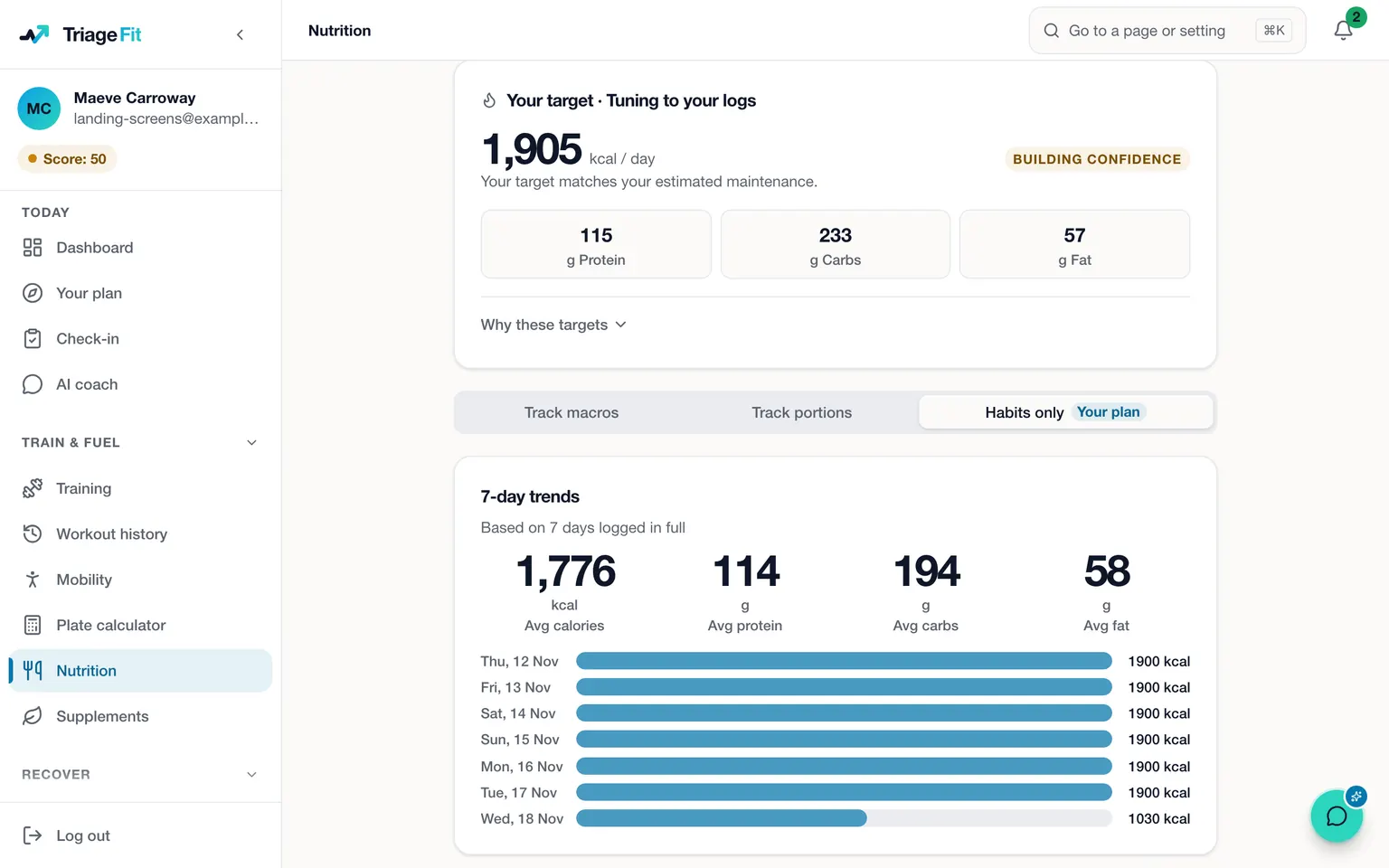
The food sits in the same plan: a calorie target matched to your metabolism and protein spread across your day, with macros adjusted after your weekly check-in. That check-in, on the day you choose, has you rate energy, recovery, sleep, stress and motivation, and the AI coach reads it with your sessions and food. The AI coach works from 20+ years of coaching real clients, and it can move, shorten or swap a session once you say yes. A coach reviews any set you film.
There are 494 exercises, each with coaching cues and the main lifts on video. If you already log in the Strong app or Hevy, your lift history comes in from an export.
A warehouse supervisor in Swindon
Take a warehouse supervisor in Swindon who has trained from an app for eight months and now wants their food and form looked at too. They eat whatever is in the canteen, their shifts swing between early and late, and a shoulder twinges on overhead pressing.
On TriageFit, their intake records the shoulder, graded mild, four days in a commercial gym and the shift pattern. Their first phase keeps the pressing with a note to stay pain-free, food targets come with it, and each week the check-in shows the AI coach which nights were short, so the loads for the following week reflect it.
Fitbod or TriageFit
Pick Fitbod if you want a strength workout generated for you each time you open the app. Pick TriageFit if you want coach-designed phases, food targets that move each week, form checks and an AI coach reading your whole week. TriageFit vs Fitbod goes deeper, and Fitbod vs Gravl sets Fitbod beside another AI workout app.
TriageFit's price
TriageFit is €50 every 4 weeks in euro with VAT included, £45 in the UK or $55 in the US. A year is €500, £450 or $550. Training and food are both in that price. There is no free trial, so coaching starts with your first payment, and the block plan has no contract. You cancel in the app and can pause for one to three months. Start from the pricing page.
Questions people ask
- Is Fitbod good for building muscle?
- Fitbod builds strength workouts from your goal, equipment and logged history, and adds weight or reps when you finish an exercise comfortably. TriageFit plans training and food together and adjusts your macros every week.
- Does Fitbod have a real trainer?
- Fitbod's terms say the app does not work as a personal trainer and does not give medical or fitness advice. It has fitness trainers who answer strength training questions by email. On TriageFit, a coach reviews any set you film and your group has coaches in it.
- Can I move my lifting history from another app to TriageFit?
- TriageFit imports lift history from Strong and Hevy exports. Your first training phase is then fitted to your intake, and each session suggests your next weight and reps from what you log.
- How is TriageFit's plan different from an AI-generated workout?
- TriageFit gives you phases of four to six weeks that our coaches designed, fitted to your intake, so you can see next week's sessions in advance. Loads adjust from your logs and hold when your check-ins show poor sleep or stress, and the AI coach reads every weekly check-in.
Sources
- Fitbod help, how a workout is built, checked 4 November 2026
- Fitbod, questions and answers, checked 25 September 2026
- Fitbod on the App Store (Ireland), checked 4 November 2026
- Fitbod help, how the trial works, checked 4 November 2026
- Fitbod family plans, checked 25 September 2026
- Fitbod terms of use, checked 25 September 2026
Fitbod, Strong, Hevy and Gravl are trademarks of their owners. TriageFit is independent of each of them, and none of them has reviewed or endorsed this page.
Read next
- Noom review: the programme, the prices and the coaching in itA Noom review built from Noom's own pages: the prices, what its coaching covers, the add-ons billed apart, and how a coached plan compares.
- MacroFactor vs MyFitnessPal: database, targets and priceMacroFactor vs MyFitnessPal from their own pages: food database, how targets adapt, what is free and what each costs, with coached training beside.
- Hevy app review: the workout logger, Pro and what it costsA Hevy app review from Hevy's own pages: what the free logger and Pro do, what Pro costs, and the step to take when you want the programme written for you.
- How much does a personal trainer cost, and what does the same money buy?What a personal trainer costs for a session, a package and four weeks in Ireland, the UK and the US, and what the same money buys with TriageFit.