TriageFit vs Fitbod, an algorithm's workout or a coached programme
Fitbod builds each workout from the settings in your plan and the training you have already logged, and its Irish App Store listing shows monthly plans at €13.49 and €17.99 (checked 4 November 2026). TriageFit costs €50 every 4 weeks with VAT included, for a programme built from phases our coaches designed, coached food in the same account and real coaches in your group, where a stalled lift is a question you can ask in the open.
By TriageFit · Updated
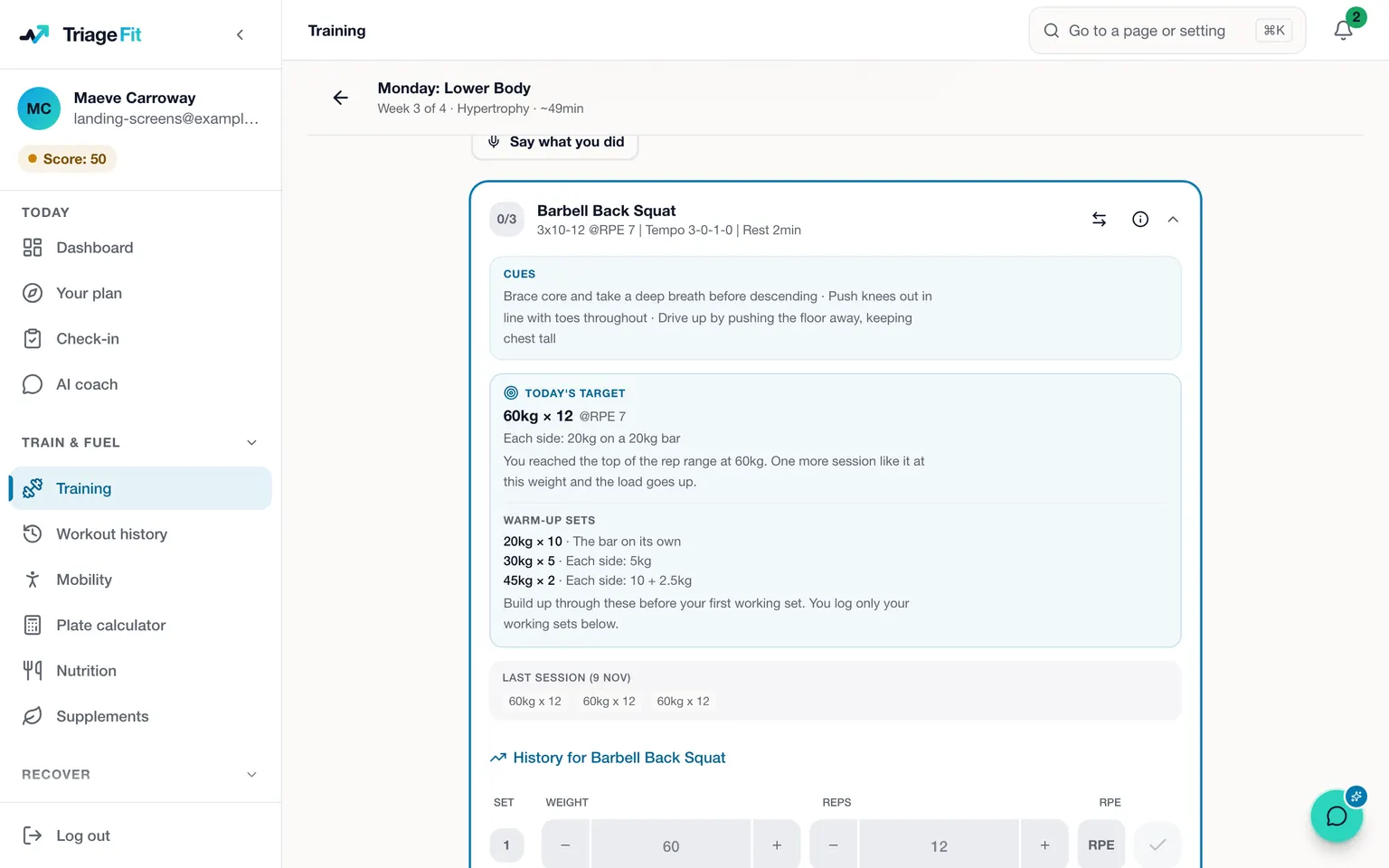
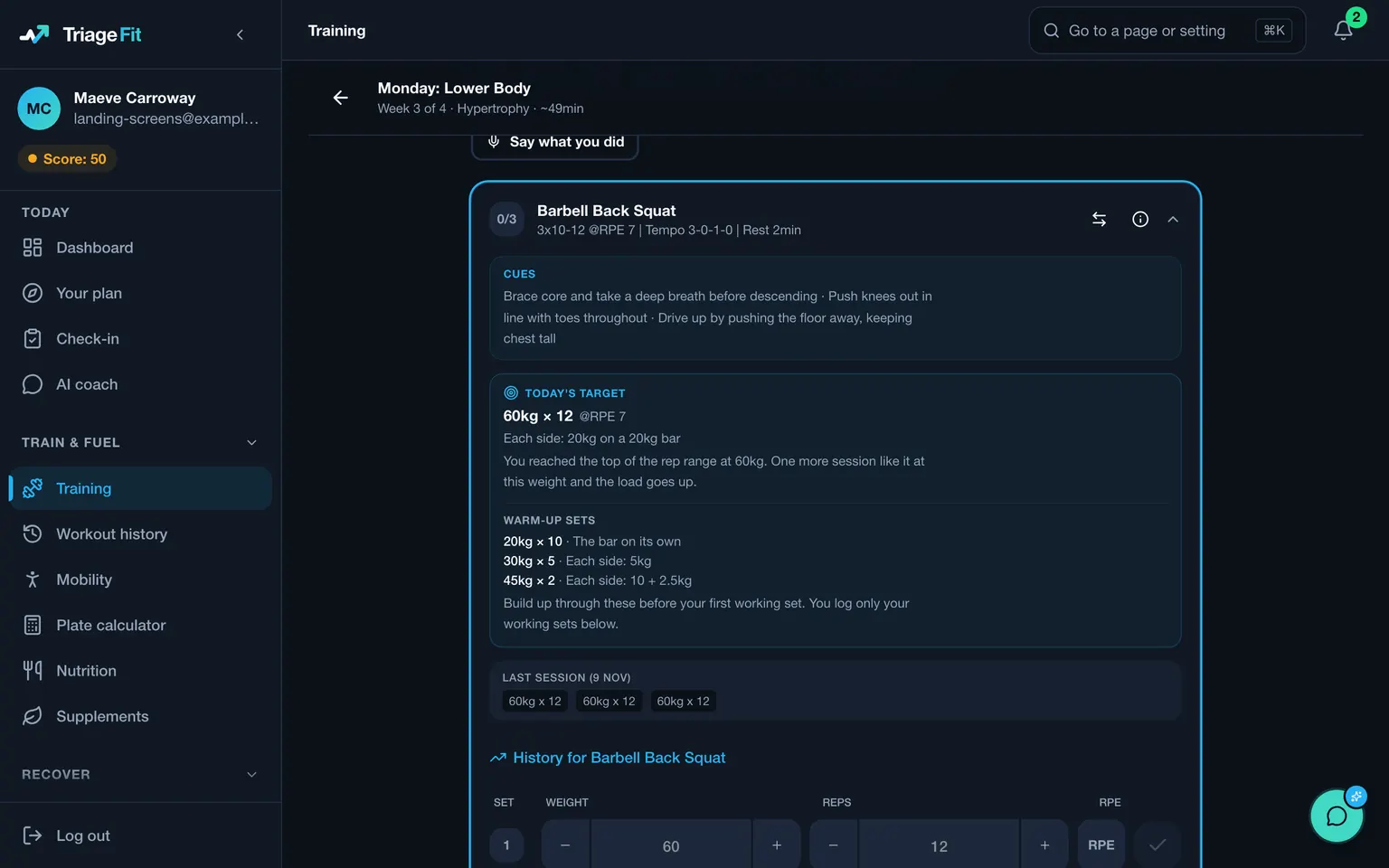
Fitbod and TriageFit both tell you what to lift next. Fitbod builds each workout from your settings and your log, and TriageFit works inside phases our coaches designed, with your food coached alongside and an AI coach reading your week. This page sets the two side by side on price, on how each plans your training and on what each does when progress stalls. Fitbod's facts come from its Irish App Store listing and its help centre, and each source is listed at the foot of the page.
How Fitbod plans your training
Fitbod's help centre says the app builds each workout from the settings in your plan and the training you have already logged. Those settings are your goal, your experience level, your equipment, your training split and your workout preferences. To choose exercises it uses data on how well exercises work from millions of logged workouts, filtered by your equipment, shaped by your feedback and limited to the muscles that have recovered, and every exercise you skip, replace, delete or add feeds into the next workout it builds.
As you log, Fitbod adds weight or reps when you finish an exercise comfortably and eases off after a set you struggle with, and it varies intensity and volume from one session to the next on purpose, with some days lighter and higher in reps and others heavier. It gives each muscle group a recovery percentage between 0 and 100, based on what you have logged, and favours the fresher muscles. It schedules max-effort days from time to time to check where your strength is, and it suggests lighter weights after a break from training. For someone new, it starts new users on cautious sets, reps and weights estimated from millions of logged workouts, then adjusts as they log.
The listing mentions fitness trainers who answer strength training questions by email. The help centre says the features are the same wherever you subscribe, and only the place you manage the subscription changes.
How TriageFit plans your training
TriageFit begins with an intake of about half an hour, which saves as you go. It asks about your goal, the training you have done, the equipment you can reach, the days you have free and any injuries, and an injury in one of the common problem areas is graded by how bad it is and which way it is heading. A severe one, or a moderate one getting worse, has the exercises most likely to aggravate it swapped for others for the same muscles, and a milder one keeps them with a note to stay in a pain-free range.
Your programme is built from phases our coaches designed, each lasting four to six weeks, with one leading into the next for as long as you stay. The coaches decided the split, the order of the movements, the rep range of each phase, the tempo and the rest between sets, and within those limits your sessions draw on 494 exercises matched to your equipment and level, each with coaching cues and the main lifts on video.
When your lifts stall
Fitbod answers a stall with the next workout it builds. It adds weight or reps when you finish an exercise comfortably and eases off after a set you struggle with, and it gives each muscle group a recovery percentage between 0 and 100, based on what you have logged, and favours the fresher muscles.
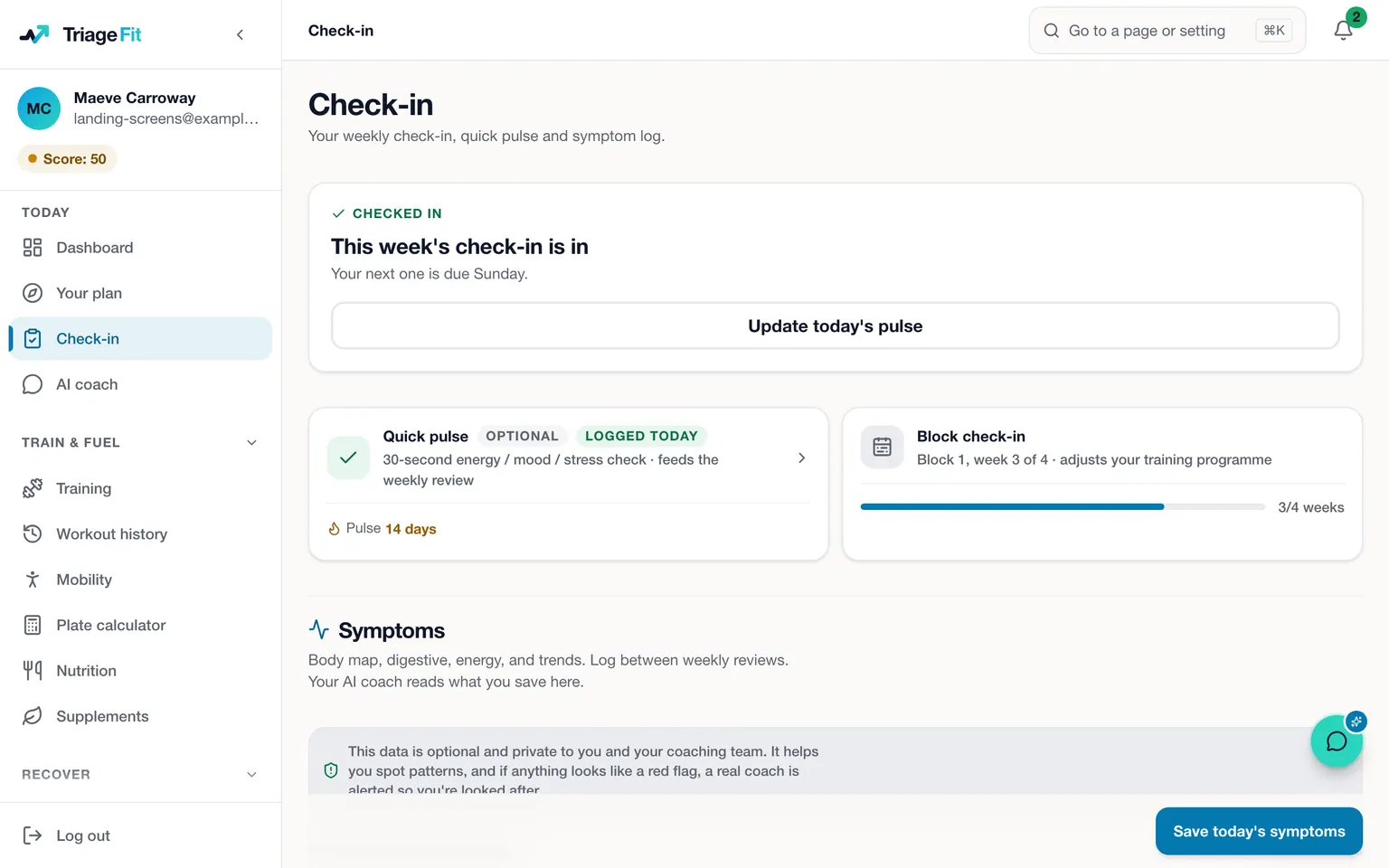
At TriageFit, once an exercise has enough history, the session shows a target for the weight and reps, up, held or down on last time, with the reason. Miss reps and the next target comes down, so you can get every rep with good form and build back up. When your daily check-ins show short sleep, high stress or low energy on several days in a week, your loads hold until those signs ease. When signs of fatigue pile up, such as several lifts stalling at once beside poorer sleep or lower readiness over recent weeks, TriageFit suggests a lighter week, which changes nothing until you accept it. The AI coach reads the same check-in, so the stall is read beside your food, your sleep and your week. The phases, the progression and the food targets come from 20+ years of coaching real clients, and the AI coach is how that method reaches you between check-ins.
Food
Fitbod's help centre lists the settings it builds from as your goal, your experience level, your equipment, your training split and your workout preferences. At TriageFit the intake sets a calorie target matched to your metabolism and spreads your protein across the day. You log meals from the food database, your recent meals or recipes you have saved, and your macros are adjusted at each weekly check-in. After a long stall in your weight, a diet break at maintenance can be offered, and it starts only once you confirm it.
What each costs
| Plan | Fitbod | TriageFit |
|---|---|---|
| Monthly or every 4 weeks | €13.49 or €17.99 on the Irish App Store (checked 4 November 2026) | €50 every 4 weeks, VAT included |
| Yearly | €81.99 or €99.99 on the Irish App Store (checked 4 November 2026) | €500 |
| In US dollars | $15.99 a month or $95.99 a year, as its help centre lists them (checked 4 November 2026) | $55 every 4 weeks |
| Free trial | a 7-day free trial when you first sign up, with nothing charged until it ends | None, coaching starts with your first payment |
The Irish listing shows ten in-app purchases, from €7.99 to €99.99, including legacy prices at €7.99, €10.49 and €61.99, and the help centre says prices can vary by region, by promotion and by platform (checked 4 November 2026). TriageFit's price covers your training, your food and real coaches in your group, and in the UK it is £45 every 4 weeks.
Side by side
| Compared on | Fitbod | TriageFit |
|---|---|---|
| Who designs the programme | The app, from your settings and your log | Our coaches, as phases of four to six weeks |
| Next weight and reps | Raised after a comfortable exercise, eased after a hard set | A target up, held or down on last time, with the reason |
| Recovery | A recovery percentage for each muscle group | Your daily check-ins and any recovery data you upload |
| Food | Settings for goal, experience, equipment, split and workout preferences | Calorie target, protein spread and macros adjusted each week |
| Who reads your week | You, with trainers who answer questions by email | A reply in seconds, and real coaches answer questions in your group |
| Injuries | Exercises you skip or replace shape the next workout | Graded at the intake, with aggravating exercises swapped when it is severe or getting worse |
Between check-ins
The AI coach answers at any hour, and it can shorten a session, swap an exercise or move a session to another day once you say yes. A coach reviews any set you film, and coaches answer questions in the members' group, where everyone can read the answer. If you wear an Apple Watch, a Garmin, a Whoop, an Oura ring or a Fitbit, you can export its data and upload the file, and your recovery readings then adjust how hard your sessions push. TriageFit runs in your browser, on a phone or a computer.
A nurse in Kilkenny weighing the two
Think of a nurse in Kilkenny who has used Fitbod for a year around rotating shifts. Their squat has sat at the same weight for three months and their eating on night shifts has drifted. They want someone to look at the training and the food together.
They join TriageFit and give the intake the barbell and dumbbells at their gym, a right knee they grade as mild and the three days a week their roster usually allows. The first phase gives them three sessions with the squat kept in and a note to stay pain-free, and a calorie target with protein spread across shifts. When a run of nights leaves them short of sleep, their check-ins show it and the loads hold, and on Sunday the AI coach reads the week, food and training together.
Which one suits you
Fitbod suits someone who wants an app to build every workout from their own log, with variety from session to session and a recovery percentage for each muscle group. TriageFit suits someone who wants a programme from coaches fitted to their equipment, injuries and free days, their food coached in the same place and real coaches in their group.
How to start
Choose a plan on the pricing page, create your account and pay, and the intake opens. What Fitbod costs lists every Fitbod price, Fitbod alternatives compares other options, and online strength coaching covers the coach-designed phases and form checks.
Questions people ask
- Is TriageFit a replacement for Fitbod?
- For planning and logging your training, yes. TriageFit builds your sessions from phases our coaches designed, fitted to your equipment and injuries, and sets the next weight and reps from what you log. It also coaches your food, and a real coach is there as back-up when something needs a person.
- How does Fitbod decide what I lift?
- Fitbod's help centre says it builds each workout from the settings in your plan and the training you have already logged, and that it adds weight or reps when you finish an exercise comfortably and eases off after a set you struggle with. It also gives each muscle group a recovery percentage between 0 and 100, based on what you have logged, and favours the fresher muscles.
- Does Fitbod coach my nutrition?
- Fitbod's help centre lists the settings it builds from as your goal, your experience level, your equipment, your training split and your workout preferences. At TriageFit, the intake sets a calorie target and protein, and your macros are adjusted at each weekly check-in.
- Is there a free trial of TriageFit like Fitbod's?
- Fitbod offers a 7-day free trial when you first sign up, with nothing charged until it ends. TriageFit has no free trial, and coaching starts with your first payment. The block plan has no contract, so you can cancel in the app at any time, or pause for one to three months.
Sources
- Fitbod help, how a workout is built, checked 4 November 2026
- Fitbod on the App Store (Ireland), checked 4 November 2026
- Fitbod help, subscribing in the app or on the website, checked 4 November 2026
- Fitbod help, how the trial works, checked 4 November 2026
- Fitbod help, subscribing, checked 4 November 2026
Fitbod, Garmin, Whoop and Oura are trademarks of their owners. TriageFit is independent of each of them, and none of them has reviewed or endorsed this page.
Read next
- TriageFit vs MacroFactor, an adaptive macro app or coaching for food and trainingMacroFactor's adaptive nutrition and workout apps beside TriageFit, which coaches food and training together, on price, targets and how your week is read.
- TriageFit vs BetterMe, on price, renewal terms and what you getTriageFit and BetterMe side by side on price, renewal terms, refunds and what each includes, for someone choosing where to spend on fat loss and fitness.
- TriageFit vs Weight Watchers, on price, renewal and what each week asks of youWeight Watchers' Core beside TriageFit on price, renewal, what each week holds and what each does about medication, with its figures from its own pages.
- How much does a personal trainer cost, and what does the same money buy?What a personal trainer costs for a session, a package and four weeks in Ireland, the UK and the US, and what the same money buys with TriageFit.