TriageFit vs Ladder, a team's plan against a programme written from your intake
Ladder costs $29.99 a month, or $179.99 a year, which works out at $14.99 a month, and each of its teams gets a new seven-day plan every week, written by the team's coach (checked 3 November 2026). TriageFit costs $55 every 4 weeks in the US, with no contract, and writes your programme from an intake about your goals, injuries, equipment and free days, with your food coached beside it and real coaches in your group.
By TriageFit · Published
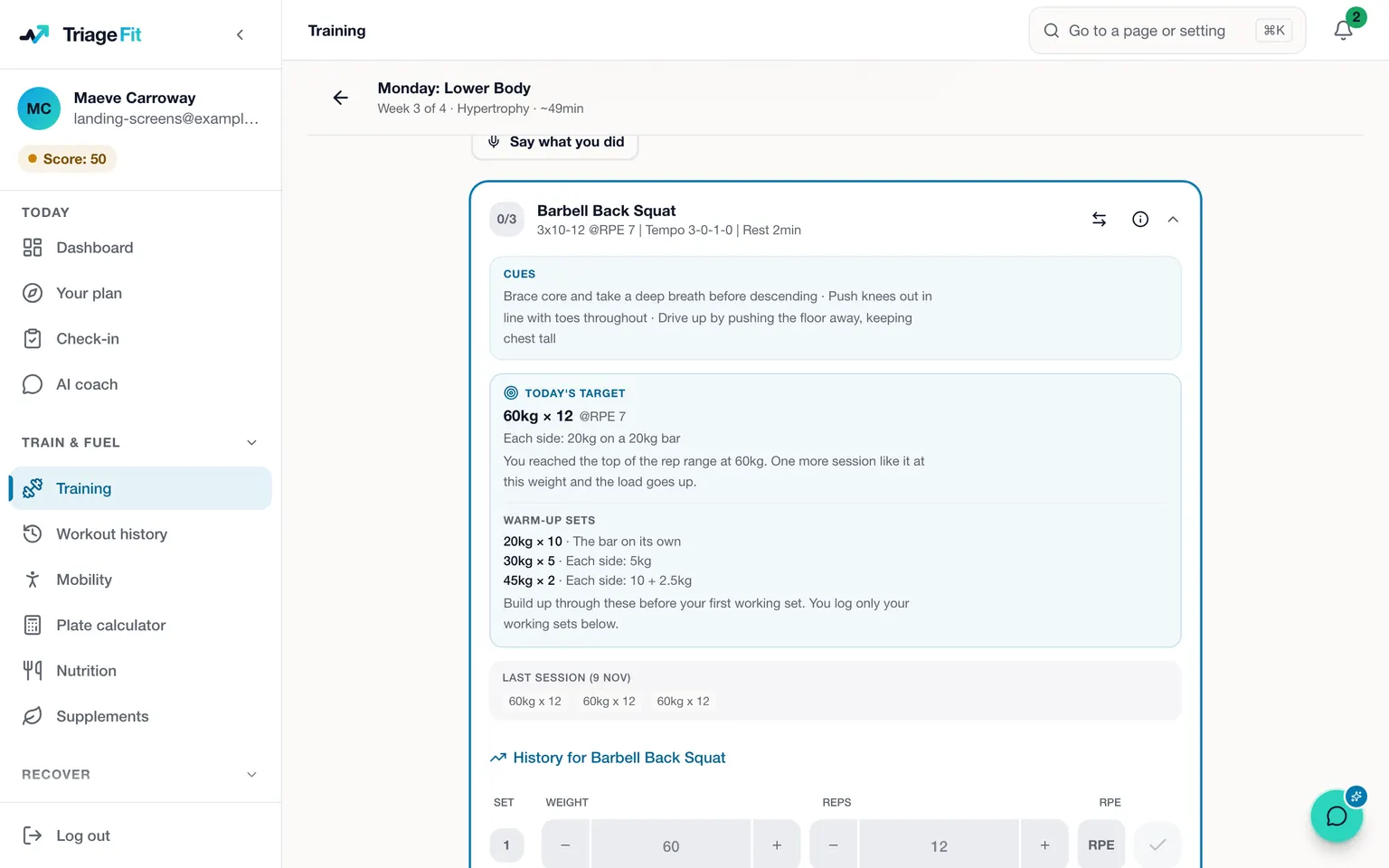
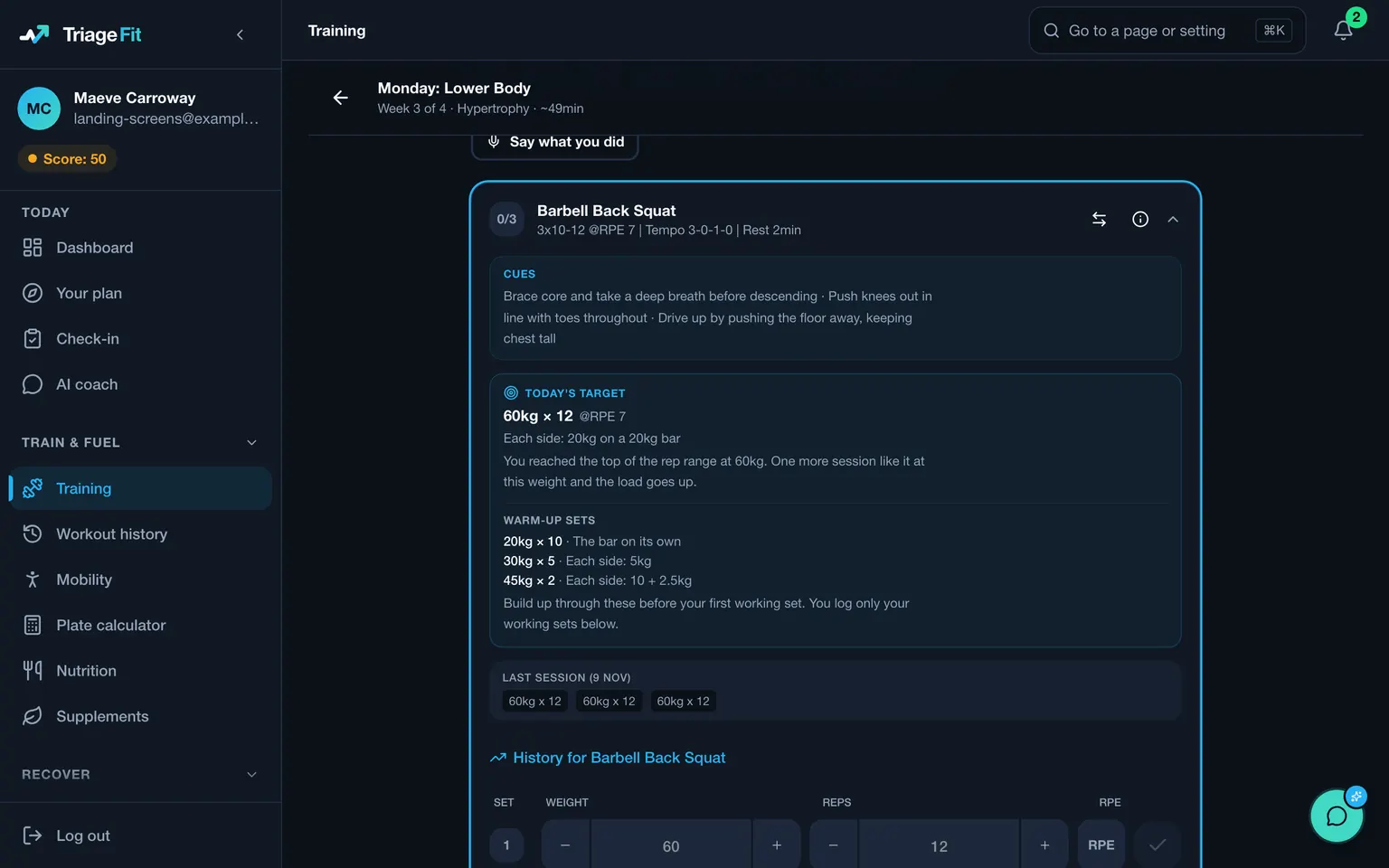
Ladder and TriageFit both give you a strength plan to follow each week. Ladder's plans come from coach-led teams, and TriageFit writes a programme for one person from what that person told it. The Ladder facts here come from its home page, its pricing page, its terms, its App Store listing in Ireland and the page for one of its teams, and the sources at the foot of the page carry the date each was read.
How Ladder works
Ladder offers coach-led programmes it calls teams, in bodybuilding, HIIT, pilates with strength, kettlebell, hybrid training and yoga with strength, at intensities from beginner to advanced. You begin with a team quiz that matches you with a coach and a team from your goals and preferences, and you can train at home, in the gym, outside or across all three. Each team gets a new seven-day plan every week, written by the team's coach. Its Endure team, for example, is a dumbbell-only plan for home or the gym, with sessions averaging 30 minutes, a set split for each day of the week with Sunday as the rest day, and a new plan every week.
In the workout itself you get in-ear audio cues from the coach who wrote the workout, and video demonstrations for every movement, and the app offers rep and weight logging as you go, with your progress and personal records tracked over time. It also offers food logging by photo, typed description or barcode, with water, body weight and steps, in the iOS app only. The App Store listing describes the app as free to download, with in-app purchases.
What each costs
Ladder's monthly membership is $29.99 a month, and it gives you a weekly workout plan, in-ear coaching and video demonstrations, progress tracking in the Ladder Journal, a link to an Apple Watch and to Spotify or Apple Music, and coach tips and motivation in the team chat, with one team at a time, which you can change twice a month (checked 3 November 2026). The annual membership is $179.99 a year, which works out at $14.99 a month, with every team and every workout, as many team changes as you like and unlimited saved workouts to replay. Before either, Ladder offers seven days free, with no card needed to start and no payment taken until the trial ends, covering every team's plan to try, plan recommendations made for you, introductory welcome workouts, as many workouts as you like and all of Ladder's communities to explore. When it ends, you are billed from the day you choose a membership, and if you don't choose one during the trial your access may end.
TriageFit is $55 every 4 weeks in the US, or $550 for a year. In the UK it is £45 every 4 weeks or £450 a year, and in Ireland €50 or €500, with VAT included. There is no free trial, because your first payment opens the intake. The table sets the two prices side by side, and TriageFit's pays for a programme written for you, coached food and an AI coach reading your week.
Side by side
| Compared on | Ladder | TriageFit |
|---|---|---|
| Price | $29.99 a month, or $179.99 a year, which works out at $14.99 a month (checked 3 November 2026) | $55 every 4 weeks in the US |
| How the plan is written | a new seven-day plan every week, written by the team's coach | Written for you from your intake, with injuries graded |
| Food | food logging by photo, typed description or barcode, with water, body weight and steps, in the iOS app only | A calorie target, protein through the day and macros adjusted weekly |
| Who reads your week | Coach tips in the team chat | A reply in seconds, and real coaches answer questions in your group |
| Where it runs | A phone app | A browser on your phone or computer |
How TriageFit writes your plan
TriageFit begins with an intake of about half an hour that you can save and return to. It asks what you are aiming for, how long you have been training, which equipment you have, the injuries you carry and the days you are free.
Each injury is graded there. In the common problem areas, a severe injury, or a moderate one that is getting worse, has the exercises that could aggravate it set aside and others for the same muscles put in their place. A milder one keeps its exercises, each with a note to stay in a pain-free range.
From those answers comes a programme in phases our coaches designed, four to six weeks long, running one into the next while you stay. Its sessions are chosen from 494 exercises to suit your kit and experience, all with coaching cues and the main lifts on video. Your logged sets are kept, and every exercise shows what you managed on it the time before.
Food and the weekly check-in
On food, TriageFit sets a calorie target matched to your metabolism, spreads your protein across the day and adjusts your macros after each check-in. Meals are logged from our food database, your recent meals or saved recipes, on any phone or computer.
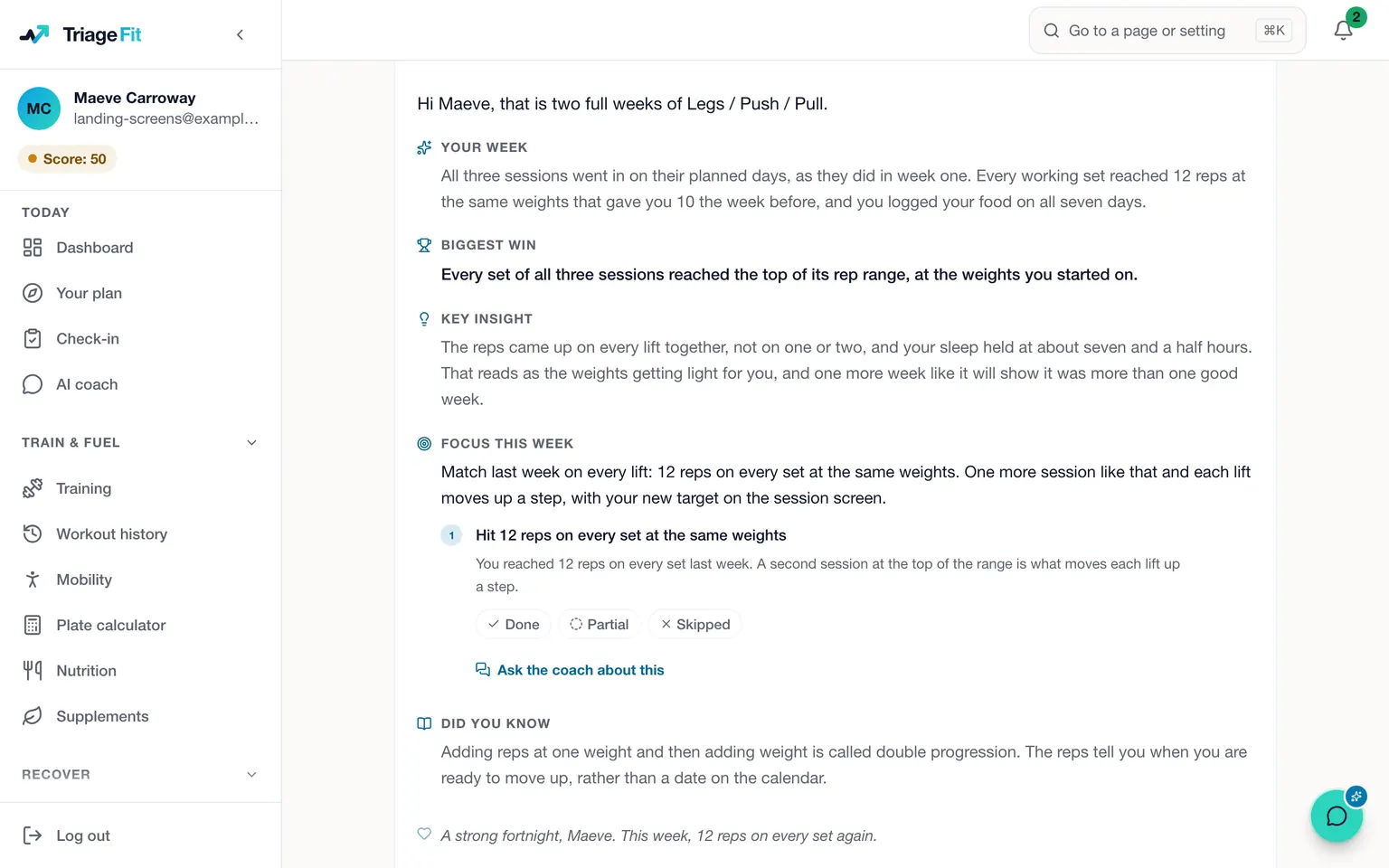
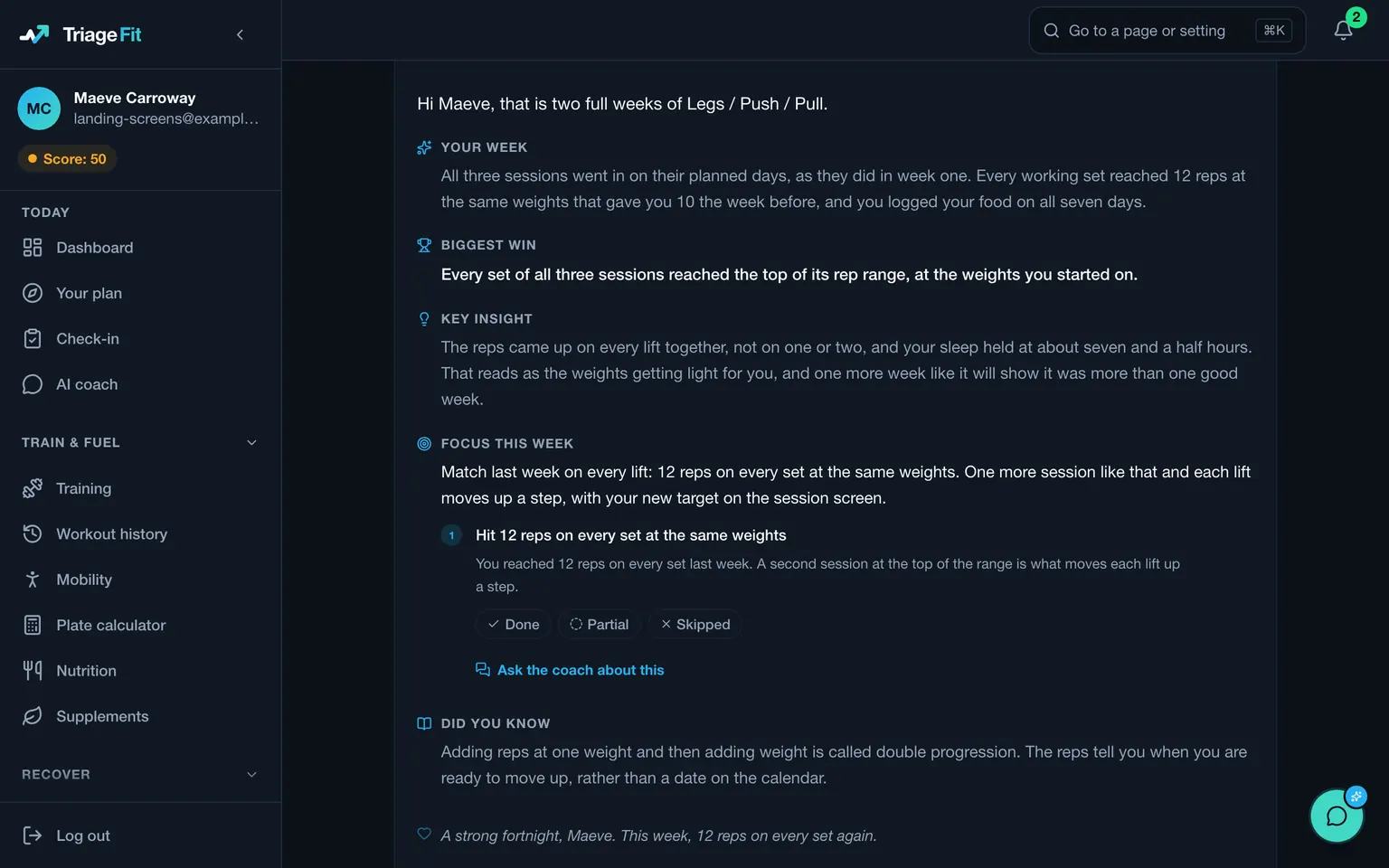
The check-in lands on the day you pick, already holding the week's food and sessions. You rate energy, recovery, sleep, stress and motivation, the reply arrives in seconds. Between check-ins the AI coach can shorten a session, swap an exercise or move a session to another day, and none of it happens until you agree. Underneath it is a method our coaches have built over 20+ years of working with real clients, and the AI coach brings it to you at any hour, tailored to your week. Film a set and a coach reviews your form, and the group has coaches in it answering questions in the open. Readings from an Apple Watch, a Garmin, a Whoop, an Oura ring or a Fitbit come in as an export you upload, and they set how hard your sessions push.
Renewing and cancelling
A Ladder membership renews automatically for another term of the same length until you cancel, and its price can change at any time, and a new price starts from the next term. You cancel at least three days before the next term starts, by logging into your account or emailing Ladder's support team, or through Apple if you pay through the App Store, and after cancelling you keep the membership until the end of the term you have paid for. On refunds, its terms say fees are non-refundable, and there is no refund or credit for unused time unless the law requires one, with any other refund at Ladder's discretion.
TriageFit bills every 4 weeks with no contract on the block plan, so you can stop when you choose, and a pause of one to three months covers an injury, a holiday or a heavy stretch at work.
Moving from a Ladder team
Say you are a nurse in Leeds on rotating shifts, and you have followed a Ladder dumbbell team for six months. Your rota changes from week to week, and your right knee has started to niggle. You cancel Ladder three days before your next term, join TriageFit, list the adjustable dumbbells and bench you have at home, grade the knee as moderate and getting worse, and choose Monday, Wednesday and Saturday.
The first phase fits those days and that kit, with the exercises that could aggravate the knee set aside and others for the same muscles in their place. When a shift swap takes your Wednesday, the AI coach moves the session to Thursday once you say yes. You film a set of split squats for a coach to look at. On Sunday the check-in already holds the week, and the AI coach's reply comes straight back.
Which one suits you
Ladder suits someone who wants a coach in their ear, a team to train with and a monthly price of $29.99 a month (checked 3 November 2026). TriageFit suits someone who wants the programme written around their injuries, kit and days, their food coached in the same place and real coaches in their group, for one price with no contract.
How to start
Choose a plan on the pricing page, create your account and pay, and the intake opens. What Ladder costs goes through its memberships in detail, and alternatives to Ladder sets it beside other apps. Online strength coaching explains how TriageFit coaches lifting.
Questions people ask
- Is TriageFit more expensive than Ladder?
- Yes. Ladder costs $29.99 a month, or $179.99 a year, which works out at $14.99 a month (checked 3 November 2026). TriageFit costs $55 every 4 weeks in the US. The difference pays for a programme written from your own intake, food coaching with weekly macro changes and real coaches in your group.
- Does Ladder write a plan around my injuries?
- Ladder starts you with a team quiz that matches you with a coach and a team from your goals and preferences, and each team gets a new seven-day plan every week, written by the team's coach. TriageFit grades each injury in its intake, sets aside exercises that could aggravate a severe or worsening one in the common problem areas, and puts others for the same muscles in their place.
- Does TriageFit have a free trial like Ladder?
- Ladder offers seven days free, with no card needed to start and no payment taken until the trial ends. TriageFit has no free trial, because your first payment opens the intake that your programme is written from. The block plan has no contract, so you can stop whenever you choose, or pause for one to three months.
- How do I cancel Ladder?
- Ladder's terms say you cancel at least three days before the next term starts, by logging into your account or emailing Ladder's support team, or through Apple if you pay through the App Store. After that, you keep the membership until the end of the term you have paid for. If you are moving to TriageFit, cancel before your next term starts, then choose a plan on the pricing page.
- Can I use TriageFit with my Apple Watch?
- Yes. Readings from an Apple Watch, a Garmin, a Whoop, an Oura ring or a Fitbit come in as an export you upload, and your recovery then sets how hard your sessions ask you to work. TriageFit runs in a browser on your phone or computer.
Sources
- Ladder, pricing, checked 3 November 2026
- Ladder, home page, checked 3 November 2026
- Ladder, the Endure team, checked 3 November 2026
- Ladder's App Store listing (Ireland), checked 3 November 2026
- Ladder terms of service (October 2025), checked 3 November 2026
Ladder, Garmin, Whoop and Oura are trademarks of their owners. TriageFit is independent of each of them, and none of them has reviewed or endorsed this page.
Read next
- TriageFit or a personal trainer, on price and on the days between sessionsTriageFit set against a personal trainer on price in Ireland, the UK and the US, on what happens between sessions, and on who is better off with each one.
- Anytime Fitness: cancel a membership the way your agreement asksHow to cancel an Anytime Fitness membership from its own FAQs: why your home club holds the rules, what to check in the agreement, freezes and transfers.
- How to cancel a gym membership: what to check before you give noticeHow to cancel a gym membership from gyms' own terms: minimum terms, notice periods, freezes, renewals and fees, and how to keep training once you leave.
- How much does a personal trainer cost, and what does the same money buy?What a personal trainer costs for a session, a package and four weeks in Ireland, the UK and the US, and what the same money buys with TriageFit.