What a nutritionist costs, and when coaching does the job
Nutritionist cost depends on who you see and why: a registered dietitian treating a medical condition is priced by the consultation, often with a referral from your GP, while nutrition coaching for training and fat loss is priced by the month. TriageFit is €50 every 4 weeks with VAT included, for calorie and macro targets adjusted each week alongside a coached training programme.
By TriageFit · Published
If you are looking up nutritionist cost, it helps to know first that two different jobs share the name. A registered dietitian is a regulated health professional who can treat a medical condition through food. Anyone can call themselves a nutritionist. Both are usually priced by the consultation. This page sets out what clinics in Ireland, the UK and the US list for a dietitian, when you should see one, and when coaching for training and body composition does the job you are after. It reads each clinic's own page on the dates in the sources.
Dietitian or nutritionist
In Ireland, INDI says the titles Registered Dietitian, Dietitian and Dietician are protected by law, and dietitians are the only nutrition professionals regulated by law, through CORU. It also says the term nutritionist is not currently protected by law. In the UK, the British Dietetic Association says the title dietitian is protected by law, and a dietitian must by law be registered with the Health and Care Professions Council. It describes the two jobs this way: dietitians assess, diagnose and treat dietary and nutritional problems, and nutritionists give support and guidance on how food and nutrition affect health and wellbeing.
So the title tells you something. A dietitian has a regulated qualification and can work with illness. A nutritionist may have a degree, a short course or neither, and the price on its own will not tell you which.
What a dietitian costs in Ireland
Blackrock Health in Dublin lists €190 for a one-hour first consultation and a 30-minute review on its female health and fertility programme, and €330 for four sessions on the same programme, a one-hour first visit and three follow-ups of about 30 minutes (checked 18 November 2026). It also runs a weight support clinic with a practical nutrition plan for weight loss and muscle health. Its page says you can refer yourself, or your GP or consultant can refer you, and that not all services are covered by health insurance, so check your policy before you book.
In the public system, the HSE's adult dietetic service in Wicklow lists weight management and a diagnosed nutritional deficiency among its adult referral types, and says referrals for weight management come through your GP or practice nurse. If you think you need a dietitian for a medical reason, your GP is the place to start.
What a dietitian costs in the UK
Royal Buckinghamshire Hospital lists initial consultations from £200 with a dietitian or nutritionist, and sees both insured and self-pay patients (checked 18 November 2026). It says the cost of ongoing support is discussed in advance. If you have private health insurance, ask your insurer what it covers before you pay yourself.
What a dietitian costs in the US
A self-pay form from a clinic in Mason, Ohio, lists $125 for a 60-minute first visit with a dietitian, $160 for a 90-minute first visit, and $35 to $70 for a follow-up of 30 to 60 minutes (checked 19 November 2026). Medicare Part B covers medical nutrition therapy if you have diabetes or kidney disease, or have had a kidney transplant in the last 36 months. Medicare says a doctor must refer you, and you pay nothing for these services if you qualify. Private insurers set their own rules, so check your plan.
How the cost adds up
A first consultation runs longer than the visits after it, because it is where the history is taken. Follow-ups are shorter. Most people see a dietitian a handful of times over a few months: a first visit, then reviews while the changes settle. The total depends on how many reviews you need and whether insurance or a public service picks up any of it.
When you need a dietitian
See your GP, and ask about a dietitian, if you have a medical condition that food affects, such as diabetes, kidney disease, coeliac disease or a digestive problem. The same goes if you are pregnant, if you have a history of disordered eating, or if you have lost weight without trying. A dietitian can work with your doctor on these, and coaching is not the right tool for them.
When coaching does the job
Many people who look for a nutritionist have no medical condition at all. They want to lose fat, build muscle or eat in a way that supports their training, and they want someone to set the numbers and change them when the week does not go to plan. That is coaching work, and it runs every week, not at a few appointments.
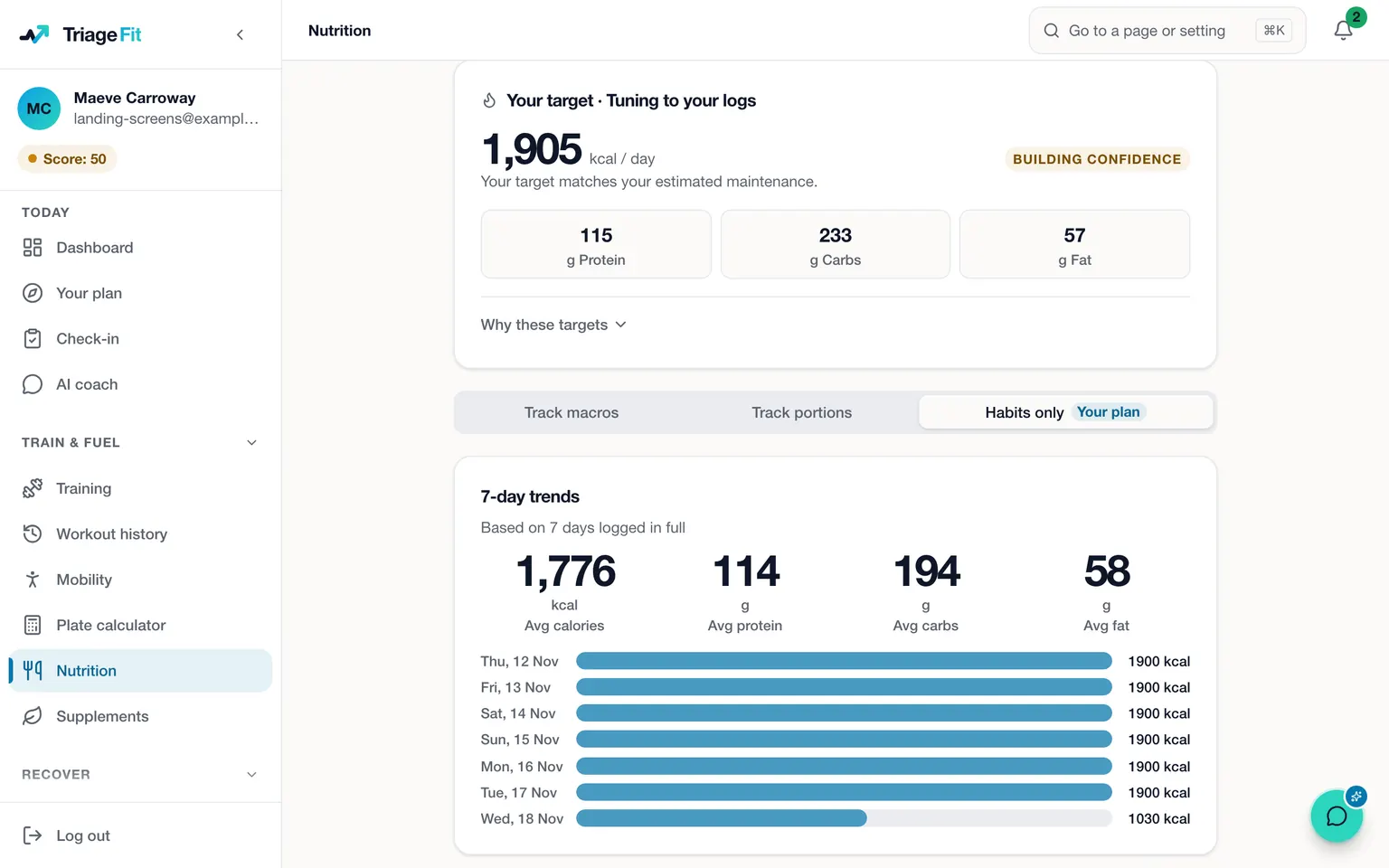
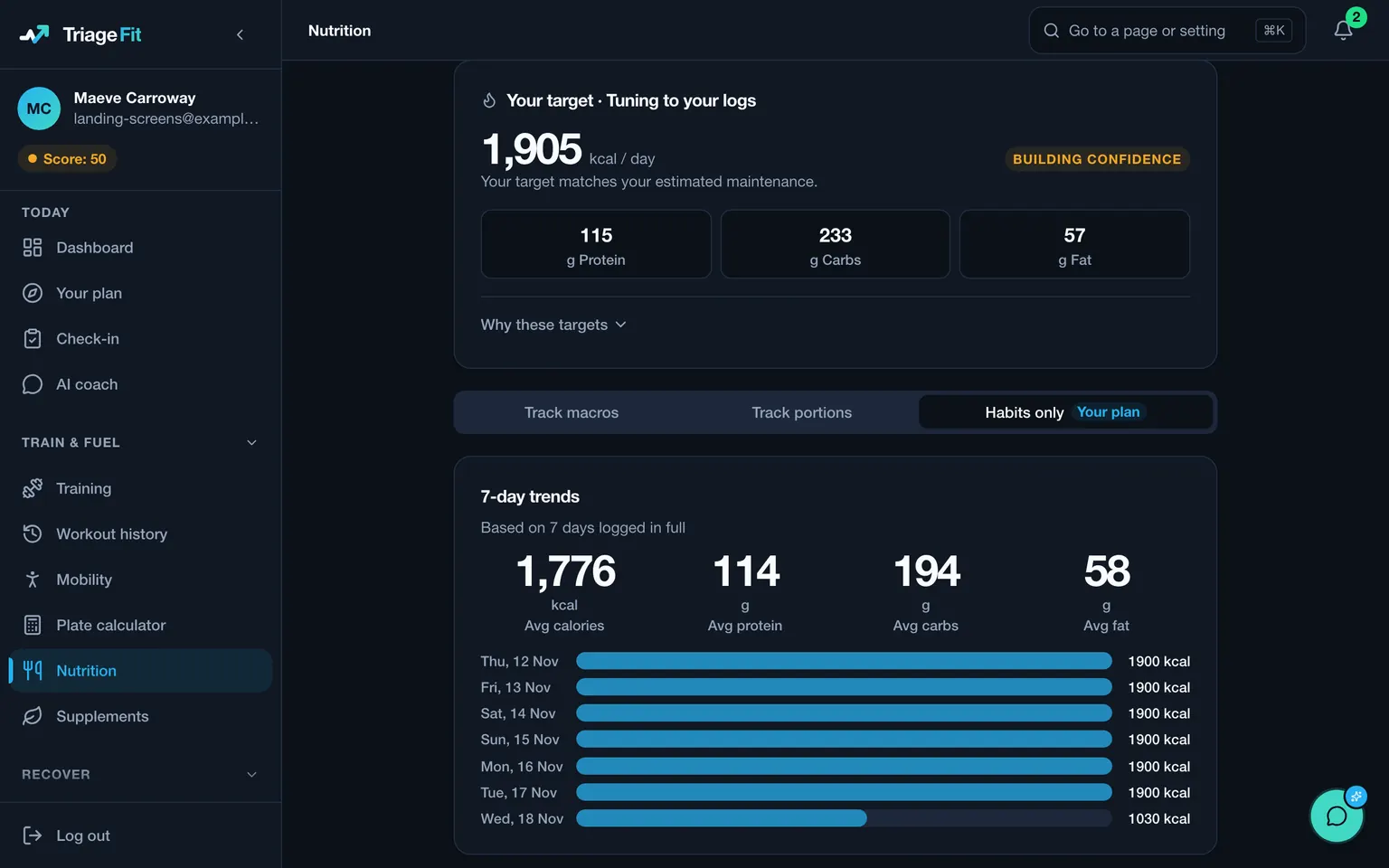
TriageFit starts with an intake of about half an hour, saved as you go, recording your goal, your training history, your equipment, the days you can train and any injuries, graded mild, moderate or severe. From that you get a calorie target matched to your metabolism, with protein, carb and fat targets set for your goal and protein spread across your day. If you are building muscle, you set your own pace for gaining.
You log from the food database, your recent meals, saved recipes or a named food with its macros, and you can save the meals you know the macros for. Your MyFitnessPal, Cronometer or MacroFactor history comes across from an export. When you have been in a deficit for a long stretch, the app spots it and offers a diet break at maintenance.
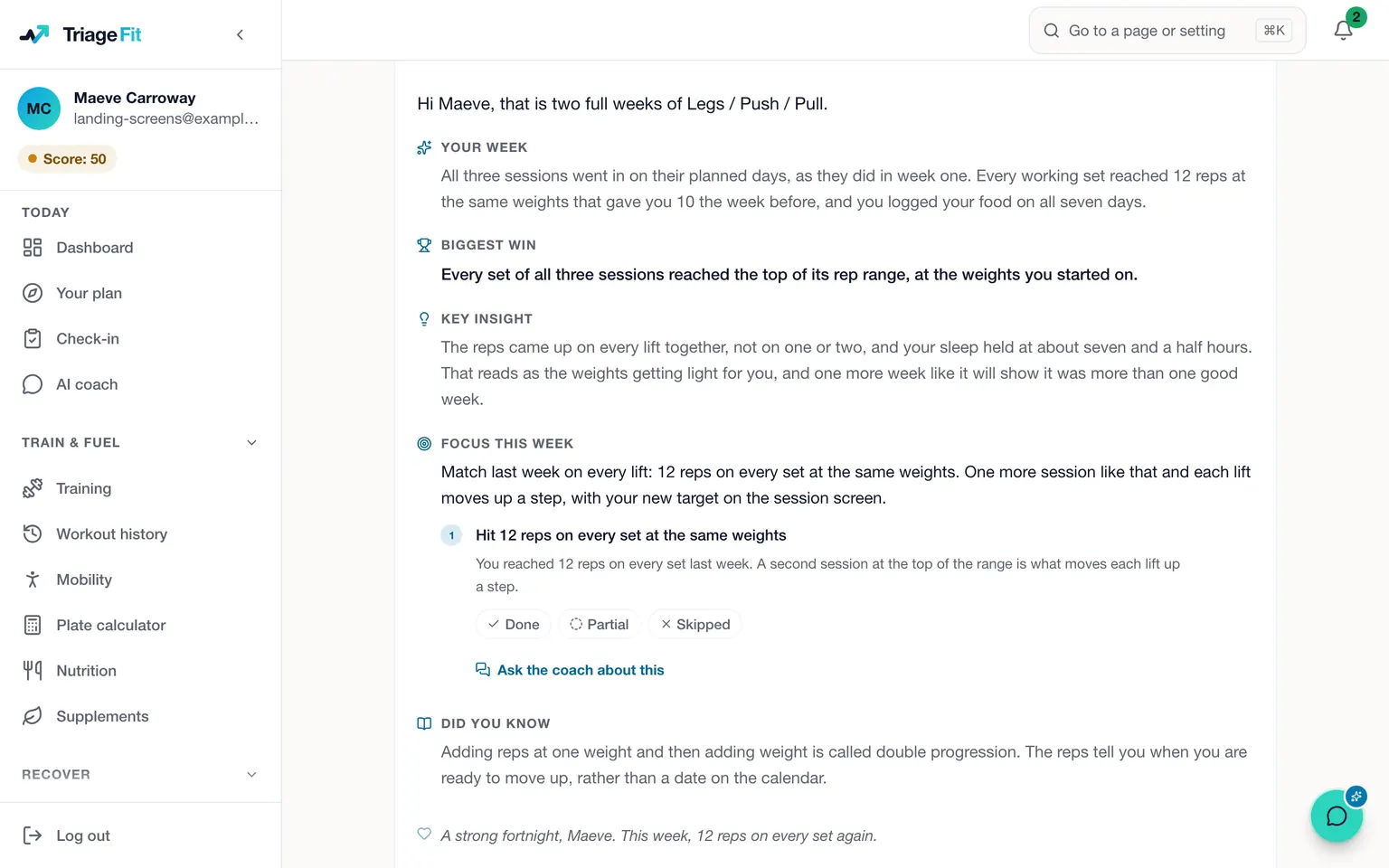
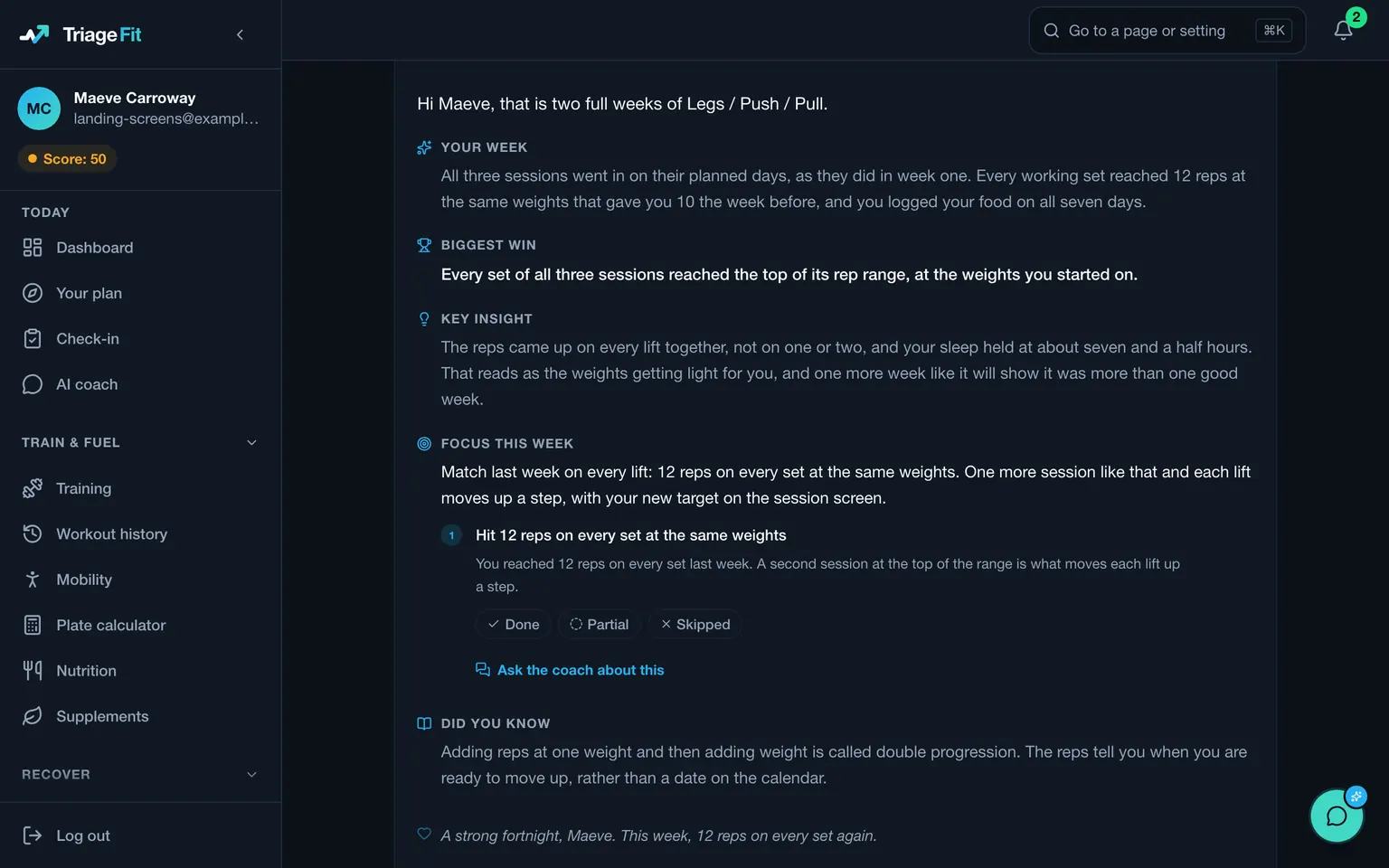
Your training is in the same plan: phases of four to six weeks that our coaches designed and fitted to you, with each session suggesting your next weight and reps from your logs. On the day you choose, you rate energy, recovery, sleep, stress and motivation, and the AI coach reads it with your food and sessions. Your macros adjust for the week ahead. The AI coach draws on 20+ years of coaching real clients, and real coaches answer questions in your group. Online nutrition coaching sets out how it works.
A chef in Galway
Picture a chef in Galway who wants to lose fat before a charity cycle in the spring. They have no medical condition, and their GP is happy for them to train. A nutritionist quoted a first consultation and monthly reviews, and they wondered what would happen in the weeks between, with late shifts and staff meals.
On TriageFit, the intake records a turbo trainer at home and three mornings a week. Their targets are set for fat loss, and they log the staff meal from their saved meals. The check-in on a Monday reads a week of double shifts in the sleep scores, and the macros and the sessions for the next week are set from the week they had.
What TriageFit costs
TriageFit is €50 every 4 weeks in euro with VAT included, £45 in the UK and $55 in the US, or €500, £450 or $550 a year. There is no free trial, so coaching starts with your first payment. The block plan has no contract, you cancel in the app, and you can pause for one to three months. What a nutrition coach costs compares coaching services, and you can choose a plan on the pricing page.
Questions people ask
- Is a nutritionist the same as a dietitian?
- No. In Ireland and the UK, dietitian is a title protected by law, and only people registered with CORU in Ireland or the Health and Care Professions Council in the UK can use it. The term nutritionist is not protected, so anyone can use it, whatever their training.
- Do I need a referral to see a dietitian?
- For a private dietitian, often not: Blackrock Health in Dublin says you can refer yourself. Public services and insurers usually need a referral, so start with your GP if you have a medical condition. In the US, Medicare covers medical nutrition therapy only when a doctor refers you.
- When should I see a dietitian rather than use a coach?
- See your GP and ask about a dietitian if you have a medical condition that food affects, such as diabetes, kidney disease or coeliac disease, if you are pregnant, or if you have a history of disordered eating. Coaching suits people training to lose fat or build muscle.
- What nutrition does TriageFit set for me?
- TriageFit sets a calorie target matched to your metabolism, with protein, carb and fat targets for your goal and protein spread across your day. Your macros adjust after each weekly check-in, and your training programme sits in the same plan.
Sources
- Irish Nutrition and Dietetic Institute, what is a dietitian, checked 18 November 2026
- British Dietetic Association, the differences between dietitians and nutritionists, checked 18 November 2026
- Blackrock Health, dietetics and nutrition, checked 18 November 2026
- HSE, adult dietetic service at Wicklow Town Primary Care, checked 18 November 2026
- Royal Buckinghamshire Hospital, dietetics, checked 18 November 2026
- Lindner Center of HOPE, self-pay dietitian services form, checked 19 November 2026
- Medicare.gov, medical nutrition therapy services, checked 18 November 2026
Blackrock Health, Royal Buckinghamshire Hospital, MyFitnessPal, Cronometer and MacroFactor are trademarks of their owners. TriageFit is independent of each of them, and none of them has reviewed or endorsed this page.
Read next
- What Equinox personal training costs, and what sets the priceHow Equinox prices personal training by trainer level, what its packs and subscription commit you to, and what TriageFit costs for the weeks around them.
- What personal training costs at the YMCA, branch by branchWhat two YMCAs charge for personal training on their own pages, what to ask at your own Y, and what TriageFit costs to coach you on its weights floor.
- What a personal trainer costs at The Gym Group, and what to ask oneHow personal trainer prices work at The Gym Group from its own pages, what its memberships cost, and a coached programme you can follow at your gym.
- Online fitness coaching from TriageFit, with a real coach alongsideOnline fitness coaching from TriageFit: a plan built from your intake, rebuilt every week from your check-in, with an AI coach reading along.