What the Gravl app costs, and what its AI trainer gives you
Gravl is free to download, with in-app purchases, and free to start, with full training plans, the Apple Watch app and analytics on Gravl Premium. In Ireland its App Store listing shows €14.99 a month, €34.99 for three months and yearly memberships at €59.99 and €79.99 (checked 3 November 2026). TriageFit costs €50 every 4 weeks with VAT included, for coach-designed training, coached food and real coaches in your group.
By TriageFit · Published
Gravl is a strength training app that writes and adjusts your workouts with AI. Its own site and its App Store listings say what it costs and what it does, and the sources at the foot of the page carry the date each was read. The App Store lists more than one price for some plan lengths, so the figure the app shows you on the day you subscribe is the one to go by.
What Gravl costs
| Plan | Ireland | US |
|---|---|---|
| Monthly | €14.99 a month (checked 3 November 2026) | $14.99 a month |
| Three months | €34.99 for three months (checked 3 November 2026) | $34.99 for three months |
| Yearly | yearly memberships at €59.99 and €79.99 (checked 3 November 2026) | yearly memberships at $59.99, $79.99 and $89.99 |
The app is free to download, with in-app purchases, and the listing says it is free to start, with full training plans, the Apple Watch app and analytics on Gravl Premium. The Irish listing also sells packs of 35 credits for €22.99 and 100 credits for €34.99 (checked 3 November 2026). Read the screen in the app for trial and renewal terms before you confirm a subscription.
What Gravl does
Gravl's site describes AI training plans adapted to your goals, experience, equipment and schedule. The App Store listing says it builds your plan, coaches you through every set and tells you how much weight to lift next time, and that it estimates your one-rep max from your logged history and prescribes the next session from it. Around the workouts it offers set logging, rest timers, weight suggestions and exercise swaps, AI feedback on your form from a video and a Strength Score, with your lifts compared with standards for your body weight and sex, across every muscle group. You get more than 300 trainer-led exercise videos, downloadable for offline use, and a standalone Apple Watch app for logging sets and reps, running rest timers and finishing a session. The site lists integrations with Apple Health, Health Connect, Garmin and Strava, apps for iOS and Android, and Gravl Macros, for calorie and macro tracking by photo.
What a programme from coaches adds
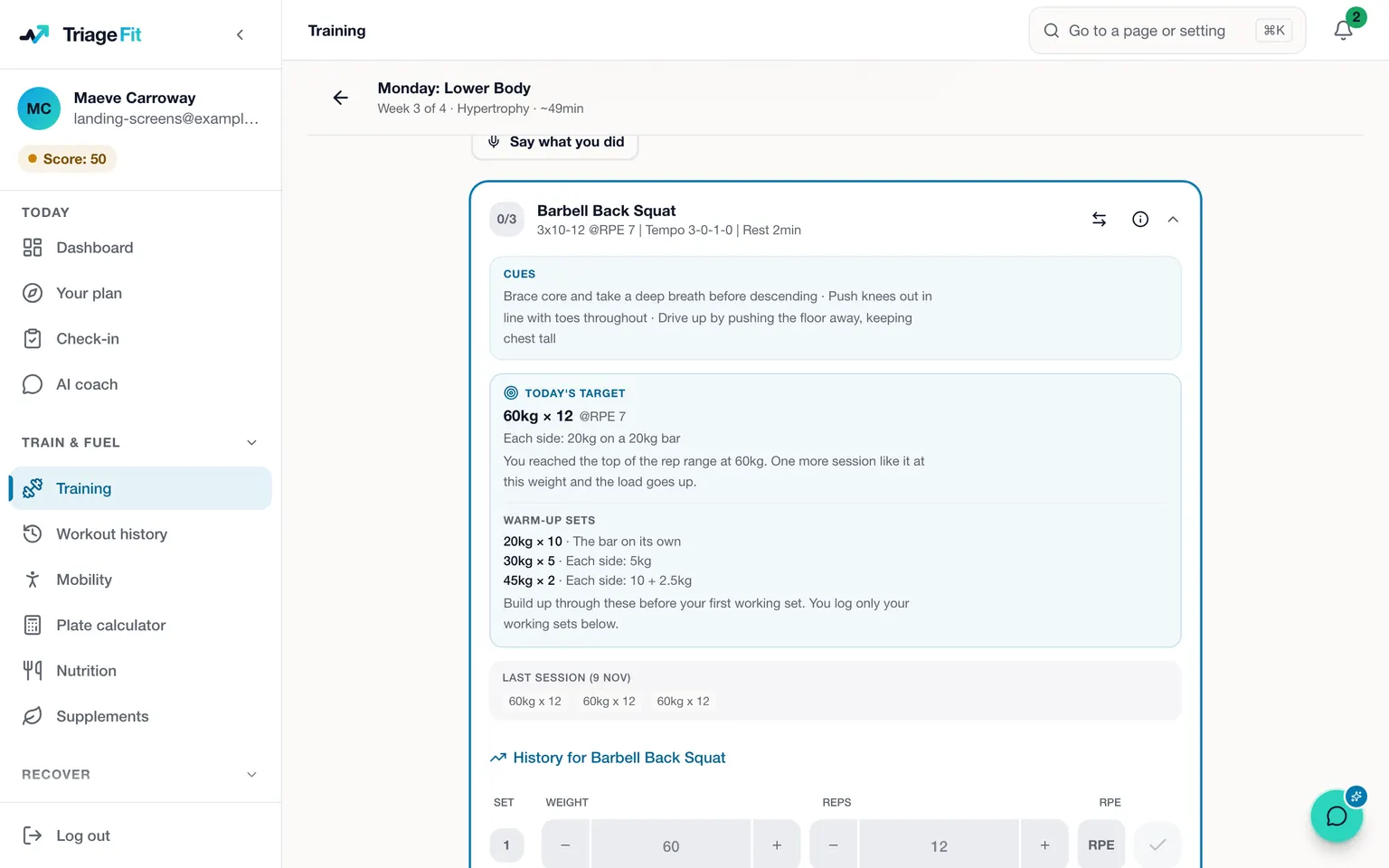
TriageFit's training runs in phases our coaches designed, and the weekly check-in that steers them is read and answered by the AI coach. Underneath it is a method our coaches have built over 20+ years of working with real clients, and the AI coach brings it to you at any hour, tailored to your week. Food is coached in the same place as the training, with targets set from your intake, and filmed sets are reviewed by a coach.
| Compared on | Gravl | TriageFit |
|---|---|---|
| Who writes the plan | AI training plans adapted to your goals, experience, equipment and schedule | Phases of four to six weeks that our coaches designed, fitted to your intake |
| Next weight | it estimates your one-rep max from your logged history and prescribes the next session from it | Your logged sets on record beside each exercise, with effort set by your recovery |
| Form | AI feedback on your form from a video | A coach reviews the sets you film |
| Food | Gravl Macros, for calorie and macro tracking by photo | A calorie target matched to your metabolism, with macros adjusted each week |
| Your week | set logging, rest timers, weight suggestions and exercise swaps | A weekly check-in, read and answered in seconds by the AI coach |
How TriageFit coaches you
You start with an intake of around half an hour that saves your answers as you go. It asks what you are training for, your lifting history, the equipment you can use, the injuries you carry and the days you have free. Each injury gets a grade, and in the common problem areas a severe one, or a moderate one that is getting worse, has the exercises likely to aggravate it replaced by others for the same muscles, while a milder one keeps them with a note to stay in a pain-free range.
Sessions come from 494 exercises matched to your kit, all with coaching cues and the main lifts on video. Sets you log stay on record, so each exercise shows what you managed last time. Your intake sets a calorie target with protein spread through the day, and meals go in from our food database, from what you ate recently or from recipes you saved.
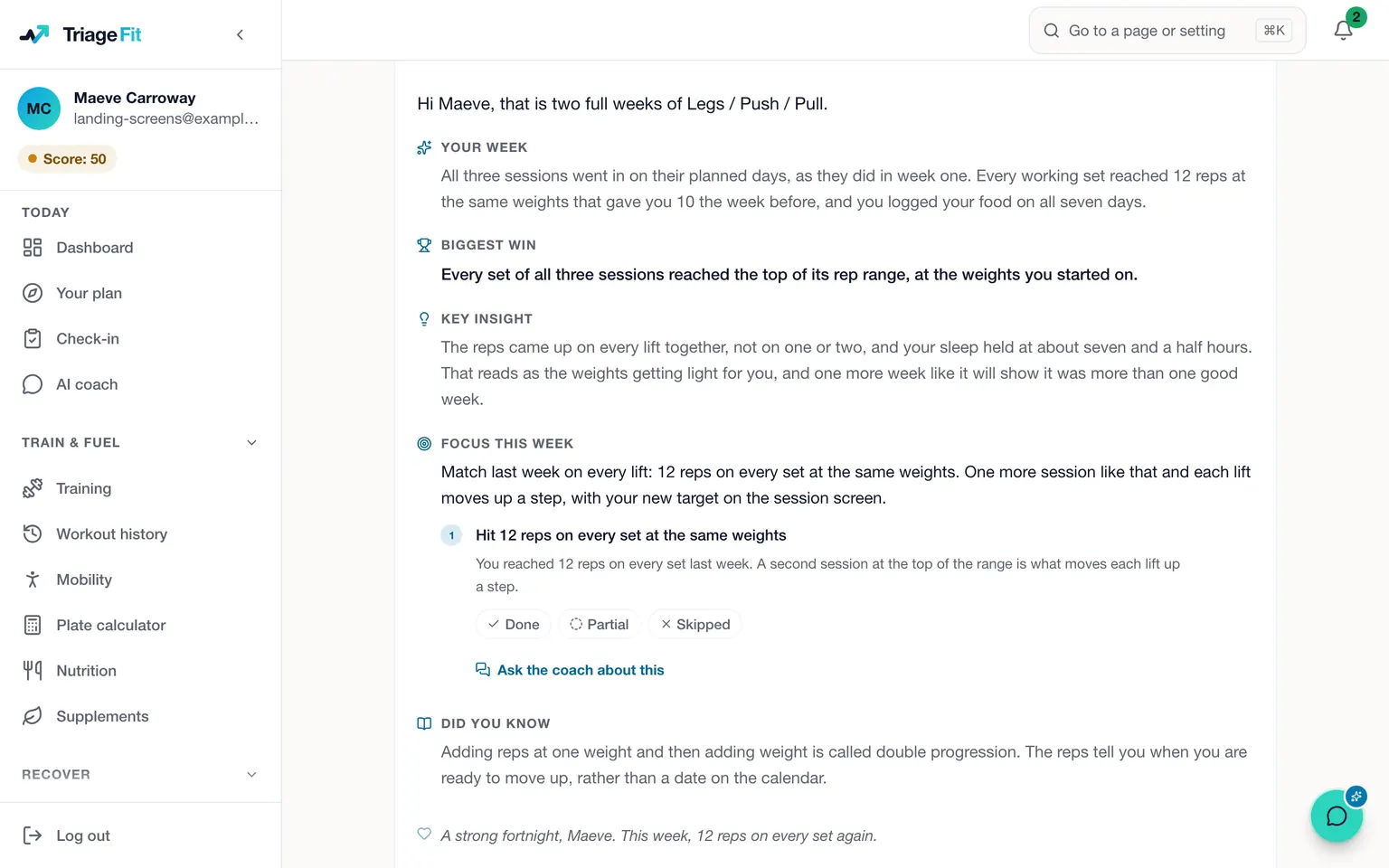
The check-in lands on a day you choose, with your week's food and sessions in it already. You score energy, recovery, sleep, stress and motivation, the AI coach reads it and replies in seconds, and your macros shift to match. Between check-ins the AI coach can shorten a session, swap an exercise or move a session to another day, once you say yes. The group has coaches in it who answer where every member can see. You can upload an export from an Apple Watch, a Garmin, a Whoop, an Oura ring or a Fitbit, and your recovery then sets how hard each session pushes. TriageFit runs in a browser on your phone or computer.
Moving from an app to coaching
Say you are a software tester in Cork who has lifted with an app for a year and would now like coaches to look at your training and food together. You join TriageFit, list the barbell, rack, cables and dumbbells at your gym, mention a left elbow you rate as mild, and pick Monday, Wednesday and Friday evenings.
Your first phase sets a session on each of those evenings with that kit, and the elbow's exercises stay in with a pain-free-range note. Your food target comes from the intake, and after the first check-in your macros move. A late release at work takes Wednesday, so the AI coach offers Thursday and moves it once you agree. You film a set of rows for a coach to review, and your Sunday check-in gets its reply straight away.
What TriageFit costs
In Ireland TriageFit is €50 every 4 weeks with VAT included, or €500 for a year paid up front. In the UK it is £45 every 4 weeks or £450 a year, and in the US $55 or $550. The block plan carries no contract, a pause of one to three months covers an injury or a holiday, and your first payment opens the intake.
Which one suits you
Gravl suits someone who wants an AI plan that sets each session's weights, an Apple Watch app and AI feedback on form from a video. TriageFit suits someone who wants coach-designed phases built around their injuries, kit and diary, their eating coached in the same place and real coaches in their group.
How to start
Choose your plan on the pricing page, set up your account and pay, and the intake opens. What another workout-writing app costs covers a second app that plans your sessions, what a barbell programme app costs covers a fixed programme, and AI against a human coach weighs the two. AI personal training explains how TriageFit's AI coach and its coaches work together.
Questions people ask
- How much does Gravl cost?
- In Ireland, Gravl's App Store listing shows €14.99 a month, €34.99 for three months and yearly memberships at €59.99 and €79.99 (checked 3 November 2026). In the US it shows $14.99 a month, $34.99 for three months and yearly memberships at $59.99, $79.99 and $89.99. TriageFit costs €50 every 4 weeks in Ireland with VAT included.
- Is Gravl free?
- Gravl is free to download, with in-app purchases. Its listing says it is free to start, with full training plans, the Apple Watch app and analytics on Gravl Premium. TriageFit has no free tier, because your first payment opens an intake that a coach-designed programme and coached food are built from.
- Does Gravl check my form?
- Gravl's site lists AI feedback on your form from a video. At TriageFit you film a set and a coach reviews it, and coaches answer questions in the group where every member can read the reply.
- Does TriageFit read my Apple Watch?
- You upload an export of your readings from an Apple Watch, a Garmin, a Whoop, an Oura ring or a Fitbit, and TriageFit uses your recovery to decide how hard each session pushes. Gravl's site lists integrations with Apple Health, Health Connect, Garmin and Strava.
- Can I cancel TriageFit whenever I like?
- Yes. The block plan is billed every 4 weeks and has no contract, so you can stop at the end of any block. If you need a break rather than an ending, you can pause for one to three months and pick up where you left off.
Sources
- Gravl on the App Store (US), checked 3 November 2026
- Gravl on the App Store (Ireland), checked 3 November 2026
- Gravl, home page, checked 3 November 2026
Gravl, Garmin, Whoop and Oura are trademarks of their owners. TriageFit is independent of each of them, and none of them has reviewed or endorsed this page.
Read next
- Is Nike Training Club free, and what do you get without paying?What Nike Training Club gives you at no cost from its own app listings, who its free classes suit, and what TriageFit adds for a fixed price each block.
- What Cronometer Gold costs, and what the free plan already gives youCronometer Gold's monthly and yearly prices from its own pages and App Store listings, what the free Basic plan keeps, and what TriageFit costs.
- What Centr costs, and what its membership includesCentr's one, three and twelve-month prices from its own App Store listings, its trial and renewal terms, what the app gives you, and what TriageFit costs.
- How much does a personal trainer cost, and what does the same money buy?What a personal trainer costs for a session, a package and four weeks in Ireland, the UK and the US, and what the same money buys with TriageFit.